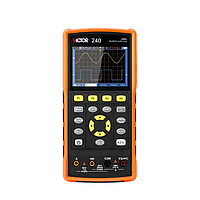
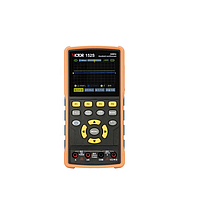
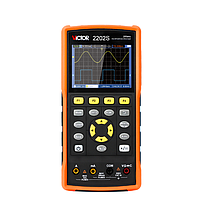
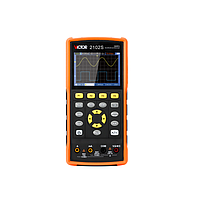
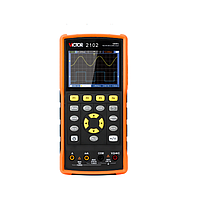
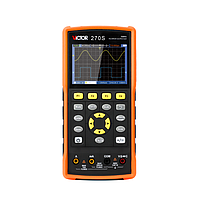
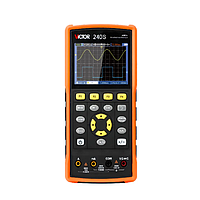
Handheld Oscilloscope
When measurements have to be made on a production line, inside an electrical cabinet, or out in the field, portability matters as much as waveform visibility. A Handheld Oscilloscope is built for that type of work: compact enough to carry, practical for on-site troubleshooting, and capable of capturing real electrical behavior without the setup requirements of a bench instrument.
For maintenance teams, service engineers, and industrial technicians, this category is especially relevant when signals need to be checked directly at the machine. Handheld units are commonly chosen for commissioning, diagnostics, power electronics checks, automotive testing, and quick verification tasks where mobility, battery operation, and rugged handling are more important than a large desktop form factor.

Why handheld models are useful in field measurement
The main advantage of a handheld scope is straightforward: it brings waveform analysis closer to the equipment being tested. Instead of disconnecting components or bringing samples back to a lab bench, technicians can inspect signals at the actual point of failure. This often shortens downtime and helps confirm whether the issue is related to switching behavior, unstable voltage, noise, or intermittent events.
Compared with larger bench units, handheld designs are often easier to use in narrow spaces or during mobile service work. They are also a practical alternative to a digital oscilloscope when the priority is portability rather than a permanent workstation setup.
Typical applications in maintenance, power, and electronics service
Handheld oscilloscopes are widely used where signals must be observed under real operating conditions. Examples include checking sensor outputs, monitoring PWM waveforms, evaluating inverter behavior, tracing control signals, and confirming whether switching circuits are responding correctly during startup or under load.
In industrial maintenance, battery-powered operation can be a major advantage because it reduces cable clutter and makes testing more convenient around panels and rotating equipment. For electronics repair and general troubleshooting, these instruments are also useful for comparing channels, spotting distortion, and identifying timing issues that may not be visible with a standard multimeter alone.
What to look for when selecting a handheld oscilloscope
The right model depends on the type of signals you expect to measure. Bandwidth, channel count, sampling performance, input isolation, battery runtime, and safety category are usually the first factors to review. A technician checking low-frequency control signals may not need the same performance as a user working with faster switching edges or more demanding waveform analysis.
It is also worth considering how the instrument fits into your workflow. Some users prioritize compact 2-channel units for routine maintenance, while others need more advanced decoding, FFT, segmented acquisition, or integrated meter functions. If your application is bench-based but still needs portability through a laptop workflow, a PC oscilloscope may also be worth comparing.
Examples from FLUKE and BKPRECISION
Within this category, FLUKE is commonly associated with field-oriented handheld instruments for industrial diagnostics. Models such as the FLUKE-123B/INT and FLUKE-124B/INT are relevant for routine 2-channel troubleshooting, while the FLUKE-125B/INT adds context for users who also need current clamp-based testing in electrical maintenance work.
For users looking at higher bandwidth portable storage scopes, BKPRECISION offers examples such as the 2511B, 2512B, 2515B, and 2516B. These products illustrate how handheld instruments can extend beyond basic portability and support features such as higher sampling speed, waveform analysis, isolated inputs on selected models, and integrated DMM-style readings for broader troubleshooting tasks.
Understanding performance beyond size
A common misconception is that a smaller instrument automatically delivers lower-quality measurement. In practice, the more important question is whether the oscilloscope matches the signal. If the bandwidth and sample rate are appropriate for the waveform being analyzed, a handheld unit can provide reliable insight for many real-world service applications.
Where larger benchtop instruments still tend to lead is in extended channel density, deeper advanced analysis workflows, and comfort during long lab sessions. But for mobile diagnostics, machine-side testing, and quick fault isolation, the balance of portability and capability makes handheld scopes a strong fit. Users comparing portable formats may also explore a pen-type PC oscilloscope for lightweight measurement tasks.
Features that matter in real troubleshooting
In day-to-day use, the most valuable features are not always the most obvious on a specification sheet. Battery life, readable display quality, clear controls, and safe measurement design often have as much impact as headline bandwidth. A portable scope that can be carried comfortably and used quickly in front of live equipment is usually more productive than a higher-spec device that is inconvenient in the field.
Many buyers also look for functions that reduce the number of tools they need to carry. Examples include built-in meter capability, protocol decoding, FFT, segmented acquisition, and USB connectivity for transferring results. In industrial settings, isolated inputs and the relevant safety category are especially important when measurements are taken around power circuits and control systems.
Choosing the right fit for your environment
If your work mainly involves service calls, machine diagnostics, and mobile inspection, a handheld scope is often the most practical starting point. A 2-channel instrument may be sufficient for many repair and maintenance tasks, while more advanced users may prefer models with higher bandwidth, more channels, or application-specific accessories.
For example, FLUKE ScopeMeter models such as the FLUKE-190-102-III and FLUKE-190-104-III show the direction of more advanced portable analysis, while specialized tools like the FLUKE-MDA-550-III point to motor-drive focused measurement workflows. On the other hand, BKPRECISION handheld digital storage oscilloscopes may suit users who want stronger lab-style waveform performance in a portable package. The best choice depends on signal type, working environment, and how often the instrument will be used away from a bench.
Final considerations
This category is best approached as a solution for portable waveform troubleshooting, not simply as a smaller version of a benchtop scope. The value of a handheld oscilloscope comes from using it where access, mobility, and immediate diagnostics are critical.
By comparing bandwidth, channels, safety rating, battery operation, and workflow features, buyers can narrow the selection to instruments that suit real maintenance and testing conditions. Whether you are checking control circuits, verifying switching signals, or diagnosing equipment on site, handheld oscilloscopes offer a practical way to bring signal analysis directly to the point of work.
Get exclusive volume discounts, bulk pricing updates, and new product alerts delivered directly to your inbox.
By subscribing, you agree to our Terms of Service and Privacy Policy.
Direct access to our certified experts