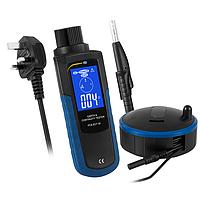
Portable Appliance Testers (PAT tester)
Routine electrical safety checks are a core part of equipment maintenance in workshops, offices, laboratories, healthcare environments, and field service operations. When portable appliances need to be inspected quickly and consistently, Portable Appliance Testers (PAT tester) help technicians verify protective earth continuity, insulation condition, leakage behavior, and related safety parameters without relying on separate instruments for every step.
This category brings together PAT instruments for different testing workflows, from straightforward continuity and earth resistance checks to more advanced appliance safety procedures with load, leakage, polarity, and RCD-related functions. Whether you need a compact tester for essential verification or a higher-capacity platform for structured recordkeeping, the right selection depends on the type of appliance, test volume, and documentation requirements.
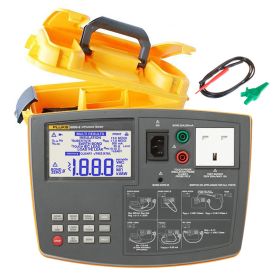
Where PAT testers fit in an electrical safety workflow
A PAT tester is used to assess the electrical safety of portable and movable equipment connected to mains power. In practice, this often includes checking earth continuity, insulation resistance, leakage current, and power connection integrity so that equipment can be evaluated before use, after repair, or during scheduled maintenance.
These instruments are especially useful when a maintenance team needs repeatable test routines across large numbers of appliances. Compared with general-purpose tools such as a multimeter, a PAT tester is designed around appliance safety procedures, making it easier to perform standardized checks with clearer pass/fail logic and more suitable test sequences.
Typical tests performed by portable appliance testers
The exact test set varies by model, but most products in this category focus on the core checks required for portable equipment safety assessment. Common functions include protective conductor or earth bond testing, insulation resistance measurement, leakage or touch current testing, polarity verification for leads, and load-related measurements under mains conditions.
Some units are oriented toward essential continuity and earth resistance work. For example, the PCE ECT 50 and PCE ECT 50-UK are built around continuity and earth resistance measurement, with a measuring range up to 2000 Ω, making them suitable where the priority is a focused and portable test method rather than a broad automated workflow.
More advanced testers expand the scope considerably. Instruments such as the FLUKE 6200-2 UK, FLUKE 6500-2 UK, and KYORITSU 6205 support broader appliance checks that may include insulation, leakage, load current, and in some cases RCD-related procedures, which can be important for service teams dealing with a wider variety of assets.
Choosing the right model for your application
The best choice depends less on brand preference and more on how testing is performed in the field. If your work mainly involves quick verification of continuity and earth resistance, a simpler handheld format may be enough. If you manage large equipment fleets, mixed appliance classes, or regular compliance routines, a more capable tester with structured test programs and memory can improve consistency.
Another important factor is the appliance mix. Class I and Class II equipment may require different test approaches, and extension leads often add polarity and conductor checks to the workflow. Where users also need to investigate grounding quality beyond appliance-level verification, it may be useful to compare PAT testing with dedicated earth resistance and resistivity instruments, which serve a different but related purpose in electrical safety diagnostics.
Examples of PAT testers in this category
Several well-known manufacturers are represented here, including FLUKE, KYORITSU, PCE, and Seaward. Each serves a different use case, from compact field instruments to more comprehensive kits intended for high-throughput inspection and reporting.
The FLUKE 6200-2 UK is a practical option for routine appliance testing where users need established PAT functions in a straightforward platform. For more extensive procedures, the FLUKE 6500-2 UK adds broader test capability suited to users handling more varied equipment and more detailed inspection routines.
KYORITSU 6205 is positioned for portable appliance testing tasks that include Class I, Class II, extension lead, and RCD-related checks. In contrast, Seaward APOLLO 500+ and APOLLO 600+ kits are designed for environments where data storage, repeatable workflows, and accessories such as software, labels, or scanners can be part of the broader asset management process.
When advanced kits make sense
Not every PAT program needs a full kit, but larger organizations often benefit from instruments that support record capacity, software integration, and operator guidance. This is particularly relevant in contractor operations, facility maintenance teams, universities, housing providers, and service companies where many appliances must be tracked over time.
Seaward APOLLO 500+ and APOLLO 600+ variants illustrate this difference well. These kits combine core PAT measurements with larger memory capacity and ecosystem accessories, helping users move from basic testing toward a more organized inspection and documentation workflow. That can reduce manual record handling and support more efficient reporting across multiple sites or departments.
Key considerations before buying
Before selecting a PAT tester, it helps to review a few practical points: the test methods you actually need, the expected number of appliances per day, whether RCD or extension lead testing is part of your routine, and how results must be stored or transferred. Battery-powered portability may matter for field work, while mains-powered operation or rechargeable packs may be preferable in fixed testing stations.
Standards support, operating category, and physical usability also matter in real working conditions. A clear backlit display, accessible test leads, and a sensible instrument size can have a noticeable impact on productivity. For troubleshooting beyond formal PAT procedures, technicians may also use complementary tools such as a ground fault locator when investigating wiring-related issues outside normal appliance checks.
Why this category is relevant for maintenance and compliance teams
PAT testing is not only about passing an inspection routine. It helps maintenance personnel identify damaged cords, poor protective earth paths, insulation deterioration, and leakage-related risks before equipment returns to service. In many workplaces, that makes PAT testers a practical part of preventive maintenance as well as safety management.
This category is therefore useful for buyers who need instruments aligned with real service conditions: compact testers for targeted checks, mid-range models for routine electrical safety work, and advanced PAT kits for larger test volumes with stronger traceability. The available range from FLUKE, KYORITSU, PCE, and Seaward gives buyers flexibility across these different requirements.
Conclusion
Choosing a PAT tester is mainly about matching the instrument to your testing routine, appliance types, and reporting needs. A compact unit may be ideal for essential continuity and earth checks, while a more advanced platform can support wider test coverage and better record management.
If you are comparing options in this category, focus on the functions you need most often, the scale of your inspection work, and whether your process requires simple pass/fail checks or a more complete testing and documentation system. That approach makes it easier to narrow down the right PAT tester for safe, efficient day-to-day use.
Get exclusive volume discounts, bulk pricing updates, and new product alerts delivered directly to your inbox.
By subscribing, you agree to our Terms of Service and Privacy Policy.
Direct access to our certified experts