Motion Controllers
Coordinated axis movement is central to modern automation, especially where positioning accuracy, repeatability, and synchronized machine behavior directly affect throughput. In applications such as packaging, material handling, CNC subassemblies, and automated inspection, Motion Controllers help translate higher-level machine commands into controlled motor movement with the timing and logic needed for stable operation.
On this page, buyers and engineers can explore controller options used to manage servo, stepper, and networked motion systems across different machine architectures. The category includes board-level, PCIe-based, Ethernet-ready, and DIN-rail solutions for designs that range from compact embedded systems to larger industrial platforms.

Where motion controllers fit in an automation system
A motion controller sits between the machine control layer and the motor drive or actuator layer. Its role is not just to start and stop motion, but to manage axis coordination, command execution, signal handling, and communication with the rest of the machine. In practical terms, this is what enables controlled indexing, repeatable positioning, speed profiling, and synchronized movement across one or more axes.
Depending on the architecture, a controller may operate as a dedicated card inside an industrial PC, as a networked EtherCAT master, or as a module integrated into a broader control platform. For many machine builders, motion control is selected alongside programmable controllers so that sequence logic and axis control can be aligned without overcomplicating the system design.
Common controller formats in this category
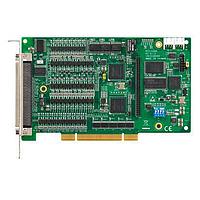
This category includes several hardware styles suited to different integration strategies. PCIe and PCI-based motion cards are often used in industrial computers where deterministic control and direct host integration are important. Examples include the ADLINK Technology PCIe-8338 EtherCAT master motion controller, the Advantech PCIE-1245E-AE, and the Advantech MIC-3245-AE 3U cPCI motion control card.
For modular or distributed systems, Ethernet and EtherCAT-based solutions are also relevant. iBASE Technology offers DIN-rail and Ethernet-oriented options such as the 207-M2A2-GEN and STP-K121A/STP-K121B units, which are useful when motion control needs to be placed closer to the machine section being controlled. In other cases, a module such as the Omron Automation and Safety FQM1-CM002 coordinator module supports motion coordination within a larger automation environment.
Single-axis, multi-axis, and coordinated motion requirements
Axis count is one of the first selection points. Some applications only need a single controlled axis, such as a feeder, actuator, or indexing mechanism. Others require two, four, or more axes moving independently or in coordination. A board such as the Performance Motion Devices PR8358120 is suited to a 1-axis requirement, while products like the Performance Motion Devices PR8358420, ADLINK Technology AMP-304C, and ADLINK Technology EMX-100 address 4-axis motion use cases.
The important consideration is not just the number of axes, but the type of synchronization needed. Machines that run multiple conveyors, pick-and-place stages, or packaging stations may require coordinated multi-axis control so motion events occur at precise intervals. Where motion data must move over an industrial network, EtherCAT- and Motionnet-oriented options can simplify scaling while maintaining timing consistency across the machine.
Communication interfaces and system integration
Interface choice has a direct impact on how easily the controller will fit into the overall system. PCI and PCIe cards are commonly selected for embedded PCs and control cabinets where the host computer is fixed and local. Ethernet-based units are often preferred for distributed installations, while networked motion modules can help reduce wiring complexity in larger machines.
Several products in this category illustrate that range. ADLINK Technology provides options spanning pulse-train control, Motionnet modules, and PCIe EtherCAT master hardware. iBASE Technology focuses on compact Ethernet and DIN-rail motion platforms, while Advantech supports industrial PC motion integration through card-based solutions. When reviewing interfaces, engineers should also check how the motion hardware will exchange status, I/O, and command data with the supervisory controller or HMI.
How to choose the right motion controller
The right selection usually starts with the machine requirement rather than the part number. Key questions include the number of axes, motor type, required network, mounting constraints, and whether the application needs simple point-to-point positioning or more advanced synchronized movement. Environmental conditions matter as well, especially where the controller will be mounted in cabinets or machine frames exposed to elevated temperatures.
It is also useful to look at I/O needs and the desired control architecture. Some products in this category include defined digital input/output capacity, while others act more as dedicated motion modules within a larger control system. If your project combines motion with broader process regulation, related control hardware such as PID Controllers may also be relevant elsewhere in the machine, although their role is different from axis control.
Representative brands and product examples
ADLINK Technology is well represented in this category with options that cover embedded PC motion, EtherCAT master control, Motionnet expansion, and pulse-motion applications. Products such as the PCIe-8338, MNET-4XMO, AMP-304C, and EMX-100 show how one vendor can support different machine-control approaches without forcing a single hardware style.
iBASE Technology contributes compact EtherCAT-oriented hardware including 2-axis controllers and microstep driver/controller combinations. Advantech adds industrial card-based solutions for PC-centric designs, while Performance Motion Devices provides board-level options for 1-axis and 4-axis control. Omron Automation and Safety appears in the category through a coordinator module approach, which can be useful in systems that prioritize broader automation platform integration.
Typical applications for motion control hardware
Motion controllers are commonly used anywhere a machine must position, feed, align, index, or synchronize mechanical movement. Typical examples include packaging machinery, assembly stations, cutting and dispensing systems, inspection platforms, gantry mechanisms, and test equipment. In these environments, the controller helps ensure movement follows the intended path, sequence, and timing expected by the machine process.
They are also relevant in systems where motion control interacts with other industrial control functions. A production line may use axis control for positioning, separate power controller hardware for heater or load regulation, and additional logic control for interlocking and sequencing. Understanding that wider ecosystem makes it easier to select a motion platform that will integrate cleanly into the complete machine.
Final considerations for specification review
Before ordering, it is worth confirming the practical details that affect installation: interface type, supported axis count, available I/O, supply requirements, mounting style, and expected operating temperature range. For compact machine sections, DIN-rail and Ethernet-based products may simplify panel layout. For IPC-based systems, PCIe or PCI motion cards may be a better fit.
Overall, this category is designed for engineers, panel builders, and OEM buyers comparing industrial motion control options across different machine designs. A careful review of architecture, communication method, and axis requirements will usually narrow the shortlist quickly and lead to a more reliable integration path.
Get exclusive volume discounts, bulk pricing updates, and new product alerts delivered directly to your inbox.
By subscribing, you agree to our Terms of Service and Privacy Policy.
Direct access to our certified experts