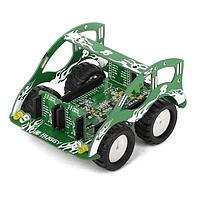
Educational Robotic Kits
Hands-on learning is often the fastest way to understand motion, control, sensing, and system integration. For schools, labs, makerspaces, and technical training environments, Educational Robotic Kits provide a practical starting point for building real skills in electronics, programming, and basic automation without jumping straight into fully customized robotic systems.
These kits are useful in a wide range of settings, from STEM education and prototype development to introductory industrial automation training. Instead of focusing only on theory, they help learners work with physical components, test control logic, connect subsystems, and see how a robot or mechatronic assembly behaves in practice.
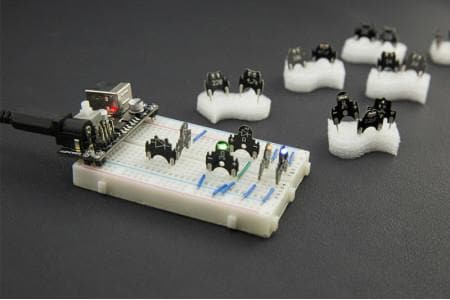
Why educational robotic kits matter in technical learning
Robotics education usually sits at the intersection of mechanics, wiring, embedded control, and software. A well-chosen kit simplifies that complexity into manageable modules, making it easier to teach or learn how sensors, connectors, controllers, and actuators work together inside a functional system.
For B2B buyers, this category can support multiple needs at once: classroom instruction, engineering workshops, maintenance training, proof-of-concept builds, and team onboarding. It is also a natural companion to broader robotics accessories and support hardware when a project grows beyond an entry-level training setup.
What you can expect in this category
Educational robotic kits may include different types of learning-focused components depending on the intended use. Some kits are centered on circuit experimentation and prototyping, while others are better suited to assembly practice, connector preparation, or building supporting subassemblies around a robot or training rig.
In this selection, examples such as the Adafruit 1976, Adafruit 3146, and Adafruit 5069 illustrate the type of hardware often used in electronics-oriented learning environments. Products like KEMET FXS-ENG-KIT-07 and KEMET TXS-ENG-KIT-02 show how kit-based formats can also support component evaluation and structured experimentation, especially when learners need to compare parts or understand behavior across a design workflow.
Typical use cases for educational robotics kits
These kits are commonly used in training programs where the goal is not only to assemble a device, but to understand the process behind system design. Instructors may use them to teach basic circuit construction, cable and connector handling, troubleshooting methods, or the relationship between control inputs and mechanical response.
They can also be valuable in early-stage prototyping. A team evaluating concepts for automation, mobile platforms, or simple robotic functions may use an educational kit to validate ideas before moving to dedicated hardware such as cobot controllers or more specialized integration components. That makes this category relevant not just for education, but also for engineering exploration and internal technical training.
How to choose the right kit
The best choice depends on the learning objective. If the priority is electronics education, a kit built around experimentation, wiring, and modular add-ons may be the most suitable. If the goal is field-style preparation, assembly work, or technician training, products associated with practical tools and connection workflows may be more relevant.
It is also important to consider the learner profile. Entry-level users usually benefit from kits with clear structure and repeatable exercises, while more advanced users may need kits that allow open-ended prototyping or deeper component analysis. For example, options from KEMET can be useful when the teaching focus includes component behavior and evaluation, while products such as Amphenol TK-500EZ or TK-600EZ-75 may fit better in environments where connectivity and installation practice are part of the training process.
Examples of products in this range
This category includes a mix of kits that support different educational and technical contexts. Adafruit 1459, 1976, 3146, and 5069 are relevant examples for hands-on electronics and maker-oriented instruction. KEMET FXS-ENG-KIT-06, FXS-ENG-KIT-07, and TXS-ENG-KIT-02 reflect kit formats that can help users explore parts selection and design concepts in a more structured way.
Other products, such as Klein Tools 5300, Dremel MM389, Amphenol TK-500EZ, Amphenol TK-600EZ-75, and Molex F203W50000, highlight that educational robotics is not limited to boards and code. In many real learning environments, students and technicians also need exposure to assembly tools, interconnect preparation, and practical bench work that supports reliable robot or mechatronic builds.
Educational kits within a broader robotics ecosystem
One reason this category is useful is that it helps bridge the gap between simple STEM activities and real automation thinking. Learners can begin with guided build exercises, then move toward subsystem integration, testing, and application-specific design. That progression is especially valuable for technical schools, industrial trainers, and organizations building internal capability in robotics and controls.
When the training path needs more structured platforms, it can also make sense to review related educational robotics solutions alongside accessories, controllers, and supporting hardware. In practice, many successful programs use kits as the first stage of a larger learning environment that gradually introduces more advanced components and application scenarios.
Key buying considerations for B2B teams
Procurement decisions are usually based on more than just price or availability. Training managers and engineering buyers often look at repeatability, ease of deployment, replacement availability, and suitability for the intended curriculum or workshop format. A kit that works well for a single demonstration may not be the right fit for a classroom, lab bench, or multi-user technical program.
It is also worth thinking about support compatibility with your existing platform. If your organization already works with specific electronics brands, connectors, or prototyping workflows, choosing kits from familiar manufacturers can reduce setup time and improve adoption. Brands featured in this category, including Adafruit, Amphenol, KEMET, Klein Tools, Dremel, and Molex, reflect a mix of educational, component, and practical hardware ecosystems.
Conclusion
Choosing the right educational robotics kit starts with understanding what learners need to do: build, wire, test, compare, prototype, or troubleshoot. The strongest fit usually comes from matching the kit to the teaching method, technical level, and expected workflow rather than simply selecting the most general option.
For organizations building hands-on programs in robotics, electronics, or automation fundamentals, this category offers a useful foundation. Whether the need is introductory STEM instruction, practical lab exercises, or early-stage system development, educational robotics kits can help turn abstract concepts into repeatable, measurable learning outcomes.
Get exclusive volume discounts, bulk pricing updates, and new product alerts delivered directly to your inbox.
By subscribing, you agree to our Terms of Service and Privacy Policy.
Direct access to our certified experts