Press machines
Consistent bonding and stable heat application are critical in garment production, especially when working with interlining, collars, cuffs, waistbands, and other components that depend on clean adhesion. In this area of textile manufacturing, press machines help convert temperature, pressure, and dwell time into repeatable production results, reducing rework and supporting a more controlled finishing process.
Within textile auxiliary equipment, this category focuses on fusing and pressing systems used in apparel workflows that require precision across different fabric types, production volumes, and installation conditions. Whether the priority is a compact setup for smaller lines or a wider straight-line system for continuous operation, selecting the right machine depends on matching process requirements with width, heating performance, pressure range, and available power supply.
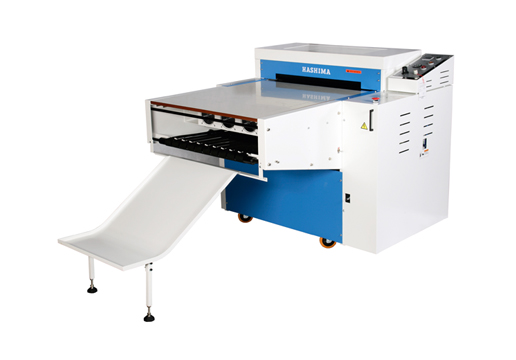
Where press machines fit in garment production
In textile and apparel manufacturing, press machines are commonly used to fuse interlining to fabric layers so the finished part keeps its structure and appearance. A reliable fusing process supports product quality by improving shape retention, surface finish, and consistency from one batch to the next.
These machines are often considered alongside upstream and downstream equipment. For example, material preparation may begin with a fabric cutting machine, while pressing and fusing equipment completes the bonding stage before sewing or final assembly. This makes the press section an important link in the wider production flow rather than an isolated machine choice.
Main machine types in this category
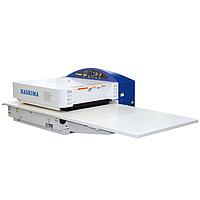
The product range shown here includes both flat type fusing press models and straight linear fusing press systems. Flat type units are often suitable when operators need controlled pressing over defined plate areas, especially for smaller lots, component work, or processes that benefit from direct platen contact.
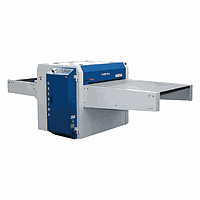
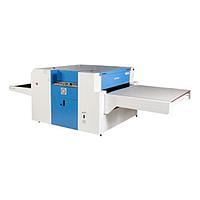
Straight linear machines are designed for more continuous throughput, using a belt-driven path to carry materials through heated zones. This format is typically preferred when production requires stable processing over longer runs, with defined fusing width, line speed, and heating time as key operating parameters.
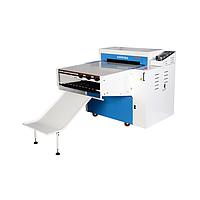
There are also compact fusing press options that can be practical when floor space is limited or when the production layout calls for a smaller machine footprint. These machines can support targeted apparel applications without moving to the larger dimensions of full straight-line systems.
Representative HASHIMA machines in the range
This category prominently features equipment from HASHIMA, a manufacturer widely associated with garment finishing and fusing applications. The listed models cover multiple machine formats, from compact units to larger industrial systems intended for wider processing widths and higher output environments.
Examples of flat type machines include the HASHIMA HP-124N and HP-124NP, both built around a 1,200mm × 400mm plate format, as well as the HP-125FA with a 1,200mm × 500mm plate and 3P380V power. For users needing wider or heavier-duty straight-line processing, models such as the HASHIMA HP-600LF, HP-600LFS, HP-900LF, HP-900LFS, and HP-1200LS illustrate how the range scales by fusing width, heating capacity, and machine size.
Compact models like the HASHIMA HP-450M and HP-450MS are also relevant where a 450mm fusing width and smaller machine body better suit the application. Rather than choosing by model name alone, buyers should compare operating method, required width, power availability, and expected daily throughput.
How to choose the right press machine
A practical selection process usually starts with the material and the product being made. Lightweight fabrics, structured shirting components, jackets, uniforms, and other apparel items may each require different combinations of heat, pressure, and processing time. The machine should be able to support these variables in a controllable way, especially if the factory handles multiple fabric constructions.
Next, consider the production format. A flat press may be more appropriate for batch-based operation or specific garment parts, while a straight linear fusing press can be more efficient for continuous feeding and larger volume runs. Available utilities also matter: the listed machines include both 1P220V and 3P380V configurations, so electrical compatibility should be confirmed early in the evaluation process.
Physical installation should not be overlooked. Machine dimensions, tray arrangement, and total weight affect layout planning, operator access, and movement inside the production area. In larger lines, it may also be helpful to review adjacent equipment categories such as other textile industry auxiliary products when planning a complete workflow.
Important performance factors to compare
When comparing machines in this category, the most useful specifications are the ones that directly affect process stability. These usually include maximum temperature, pressure capability, working width or plate size, heating time, and belt speed where applicable. Together, these values influence how well the machine can handle different interlining and fabric combinations.
For example, straight linear systems in this range vary from 600mm and 900mm widths up to 1200mm, which can significantly affect productivity and the types of garment components processed in one pass. Flat type models differ in plate dimensions and pressure levels, making them more suitable for certain pressing styles than others. Compact machines may offer a balanced option where moderate capacity and smaller space requirements are more important than maximum width.
It is also worth assessing how machine format aligns with process control in actual production. A machine with suitable nominal specifications still needs to match the operator workflow, material handling approach, and expected repeatability in day-to-day use.
Supporting process quality and production consistency
In garment manufacturing, poor fusing results often appear as bubbling, delamination, inconsistent hand feel, or visible variation between batches. While fabric and interlining choice play a major role, the press machine remains one of the core process variables because it determines how heat and pressure are applied over time.
A well-matched machine helps maintain process consistency, especially when production must repeat the same settings across multiple runs. This is one reason many factories evaluate not only machine size and power, but also the practicality of setup, temperature control behavior, and suitability for their target materials.
For companies reviewing broader equipment options, this category can also be considered together with related press machine solutions for different line configurations and production needs. The goal is not simply to add a machine, but to improve bonding reliability within the full apparel workflow.
Typical applications for these machines
Press and fusing machines in this category are commonly used in apparel manufacturing environments where bonded structure is required. Typical applications include shirt components, jacket fronts, plackets, collars, cuffs, waistbands, and other textile parts that need controlled adhesion between shell fabric and interlining.
The right equipment choice depends on whether the application emphasizes narrow component work, medium-scale production flexibility, or larger continuous runs. Flat, compact, and straight linear configurations each serve different operating needs, so the category supports a range of factory setups rather than a single use case.
Choosing with the full production context in mind
The most effective way to select from this range is to start with the actual production requirement: fabric type, interlining behavior, target output, floor space, and power supply. From there, it becomes easier to narrow the choice between compact units, flat presses, and straight linear systems, and then compare suitable models such as the HP-124 series, HP-450 series, HP-600 series, HP-900 series, or HP-1200LS.
For textile manufacturers and garment producers, this category brings together equipment designed for one of the most quality-sensitive steps in apparel assembly. A suitable press machine can help stabilize bonding performance, support smoother workflow integration, and provide a more dependable foundation for finished product quality.
Get exclusive volume discounts, bulk pricing updates, and new product alerts delivered directly to your inbox.
By subscribing, you agree to our Terms of Service and Privacy Policy.
Direct access to our certified experts