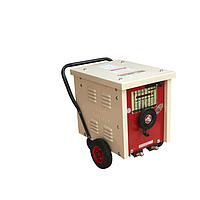
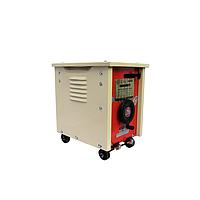
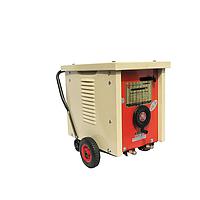
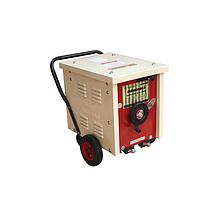
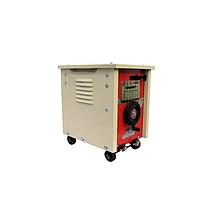
Transformer welding machine
For many fabrication, repair, and maintenance jobs, a durable power source is more important than advanced electronics. That is why transformer welding machine models remain a practical choice in workshops, steel fabrication sites, and general industrial environments where stable arc performance and straightforward operation are valued.
In this category, you can find conventional welding transformers designed for common manual arc welding tasks across different current ranges and input voltage options. The selection is suitable for users who need dependable equipment for routine welding work, especially in applications where rugged construction and easy servicing are key considerations.
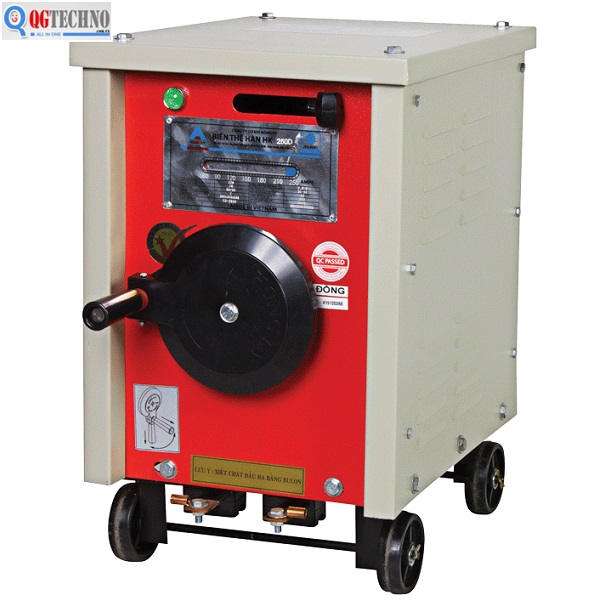
Where transformer welding machines are commonly used
Transformer-based welders are widely used for manual metal arc welding in fabrication shops, construction support work, gate and frame production, equipment repair, and other heavy-duty metal joining tasks. Their operating principle is relatively simple: the machine transforms input power into a lower-voltage, higher-current output suitable for welding electrodes.
This type of machine is often selected when the working environment is demanding and the priority is consistent welding current rather than compact size. For users comparing other cutting and welding processes, a plasma cutter may be relevant for metal cutting, while transformer welders remain focused on arc welding with stick electrodes.
Typical product range in this category
The available range covers both lighter workshop needs and higher-output industrial work. For example, Hồng Ký offers models such as HK H250D, HK-H300D2P380V, HK H350D, and HK H500D, giving buyers options across different output levels and welding rod sizes. These models are suitable for users who need flexibility between smaller fabrication jobs and more demanding structural welding tasks.
There are also TIEN DAT copper welding machine options in multiple current classes, including 200A, 220A, 250A, 300A, 400A, and 500A configurations. This spread helps buyers match machine capacity with expected electrode size, workpiece thickness, and the available power supply at the installation site.
How to choose the right machine
A good starting point is the required output current. Lower-current machines are often sufficient for lighter steel fabrication and maintenance jobs, while higher-current units are better suited to thicker material, longer duty use, and larger electrodes. If your work regularly involves heavier sections or prolonged welding cycles, moving up from a 200A or 250A class machine to a 300A, 400A, or 500A class machine may be more appropriate.
Input power is another key factor. In this category, some models support single-phase 220V, while others are configured for 380V or broader 220V/380V/440V compatibility depending on the product. Checking site power conditions before purchase helps avoid installation issues and ensures the welder can deliver the intended performance under real operating conditions.
Electrode size should also be considered. Several Hồng Ký models indicate compatibility with common welding rod ranges from around 2.6 mm up to 8.0 mm, which gives a useful reference for matching the machine to the work. Buyers who need a broader process range beyond basic stick welding may also want to review a multi-function welding machine category for more flexible workshop setups.
Featured manufacturers in this range
Hồng Ký is represented here with several transformer welding models that span moderate to high output capacities. Products such as the HK H250D, HK H350D, HK H500D, and Hong Ky HK 500N illustrate a range developed for practical welding applications where users may need different current levels, input voltage options, and electrode support depending on job requirements.
TIEN DAT adds another important option set in this category, especially for buyers looking at copper welding machine configurations with multiple current ratings. Their lineup makes it easier to compare compact lower-current units against larger workshop machines without leaving the same category context.
What to look at beyond current rating
Although current output is one of the first specifications buyers check, it should not be the only one. Weight, voltage range, and intended welding rod size all affect real-world usability. A heavier machine may be less convenient to move, but it can still be the right fit for fixed workshop installation where robustness matters more than portability.
It is also useful to think about workflow. If your operation includes multiple welding methods, a dedicated transformer welder can handle standard stick welding while other equipment covers specialized tasks. For example, operations involving stud attachment may need a separate bolt welding machine, while sheet metal joining may call for a spot welding machine.
Who this category is best suited for
This category is a strong fit for industrial buyers, mechanical workshops, maintenance teams, steel structure contractors, and B2B procurement users looking for conventional welding equipment with straightforward operating logic. In many cases, transformer welders are chosen because they are familiar to technicians, suitable for common electrode welding work, and practical for facilities that prioritize durability over compact inverter-style design.
They are also relevant for buyers standardizing equipment across multiple sites. When similar welding tasks are performed in different workshops, selecting from a clear range of 200A to 500A class machines can simplify procurement and operator training.
Find a model that matches your welding workload
The right transformer welding machine depends on the balance between available power supply, required welding current, electrode size, and the type of fabrication work being performed. Within this category, you can compare compact and higher-capacity options from Hồng Ký and TIEN DAT to identify a machine that fits your production or maintenance environment more closely.
If you are selecting equipment for regular industrial use, focus on realistic workload needs rather than choosing only by maximum current. A well-matched machine will be easier to operate, more suitable for your site conditions, and more efficient for day-to-day welding tasks.
Get exclusive volume discounts, bulk pricing updates, and new product alerts delivered directly to your inbox.
By subscribing, you agree to our Terms of Service and Privacy Policy.
Direct access to our certified experts