Air Drill
When drilling needs to stay fast, repeatable, and practical in a workshop or production environment, pneumatic tools remain a reliable choice. Air drills are widely used where compact size, continuous-duty capability, and a simple compressed-air setup make more sense than relying on electric tools alone. On this page, you can explore models suited to general drilling, tight-space work, and lighter assembly or maintenance tasks.
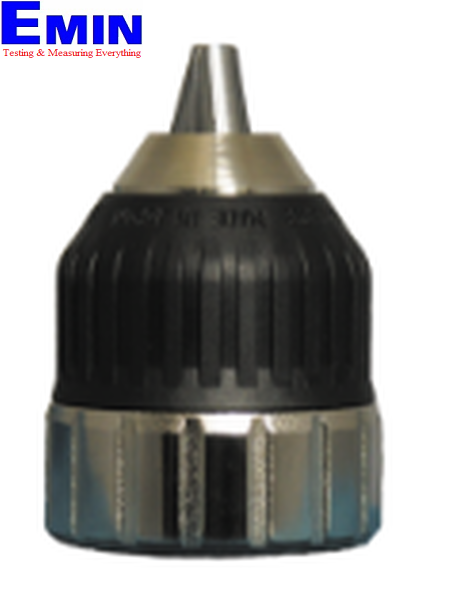
Where air drills fit in industrial and workshop applications
In the broader world of pneumatic tools, a drill powered by compressed air is often selected for repetitive workstations, vehicle service, metal fabrication, and maintenance operations. Compared with other tool types, the main advantage is the combination of straightforward construction and steady performance when a suitable air supply is available.
Air drills are especially useful for drilling sheet metal, preparing holes for fasteners, and handling tasks that benefit from lower tool weight and continuous operation. In many setups, they are used alongside air screwdrivers for fastening work or with an air impact wrench for heavier torque applications.
Common air drill configurations in this category
This category includes several practical formats rather than one single drill style. Straight drills are typically chosen for general-purpose access, while angle drills help operators work in corners, inside housings, or near obstructed surfaces where a standard body shape is difficult to position.
There are also reversible designs, which are useful when drilling workflows are combined with light backing-out or direction changes during maintenance. For tighter and more controlled applications, compact models such as the AIRTEC 375 Mini Air Drill offer a smaller form factor, while larger 13 mm options support broader bit compatibility for general workshop use.
Representative products and what they are suited for
Several models in this range illustrate how air drills can be selected according to access, chuck size, and operating speed. The AIRTEC lineup includes solutions such as the AIRTEC 492/A Drill with 13 mm capacity for conventional drilling tasks, the AIRTEC 383 Reversible Composite Drill for operators who prefer a lighter composite-body option, and the AIRTEC 496 Reversible Angle Drill for work in restricted positions.
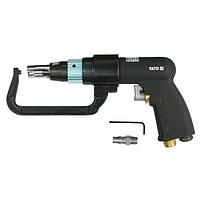
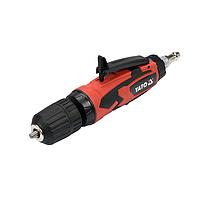
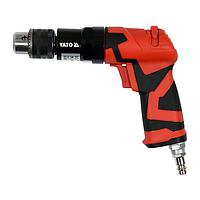
For smaller drilling diameters and compact handling, the AIRTEC 478/A Drill and AIRTEC 495/A Straight Drill are relevant examples. If the requirement is a very small and lightweight body, the AIRTEC 375 Mini Air Drill is a natural fit for more delicate or space-limited work. From other featured brands, the TOPTUL KAQA1650 Reversible Air Drill is a useful reference for 13 mm drilling, while YATO also offers pneumatic drill options such as the YT-09695 for high-speed operation.
How to choose the right air drill
The most practical starting point is the drill bit capacity. In this category, common capacities include 6.3 mm, 10 mm, and 13 mm. Smaller capacities are typically suitable for lighter-duty work and compact access, while 13 mm models are often preferred when the application involves more general workshop drilling with broader bit selection.
The next factor is tool layout. A straight-body drill is usually the default choice for open access, but an angle drill can save time and improve operator ergonomics in confined spaces. Reversible operation may also matter if the tool will be used in maintenance routines or workflows requiring direction changes.
Buyers should also review working air pressure, average air consumption, inlet connection, hose diameter, speed range, and tool weight. These points directly affect compatibility with the existing compressed-air system and day-to-day usability. A drill that matches the plant air setup will generally perform more consistently than one selected only by maximum speed or chuck size.
Performance factors that matter in day-to-day use
For B2B buyers, performance is not only about RPM. A useful comparison should include air consumption, weight, noise level, and vibration. Lower weight can reduce operator fatigue during repetitive tasks, while a reasonable air demand helps prevent pressure drop when several pneumatic tools are used on the same line.
Speed should be matched to the material and drilling process, not treated as an isolated specification. Some models in this category are oriented toward moderate-speed controlled drilling, while others are designed for significantly higher rotational speed. In practice, the best choice depends on hole size, workpiece material, access conditions, and how often the tool will run during a shift.
It is also worth considering the surrounding tool ecosystem. A drilling station may be paired with an air grinder for edge preparation or finishing, especially in metalworking environments where drilling is only one step in the overall process.
Featured brands in the category
This category includes products associated with established pneumatic tool brands such as AIRTEC, TOPTUL, and YATO, while the wider manufacturer portfolio also highlights names like SATA, KAWASAKI, and Vessel. Each brand may appeal to different buying priorities, whether the focus is general workshop use, lightweight handling, or specific tool configurations.
Rather than choosing by brand name alone, it is better to compare the actual drill format, rated capacity, and operating requirements. For example, an angle drill from AIRTEC may be more relevant than a standard-body alternative if the main challenge is restricted access, while a reversible drill from TOPTUL or YATO may be more suitable for mixed maintenance tasks.
Typical applications and related accessories
Air drills are commonly used in machine maintenance, fabrication shops, automotive service, assembly support, and repair work. Typical jobs include drilling metal panels, creating pilot holes, enlarging existing holes, or preparing surfaces for threaded fasteners and mechanical installation.
Some product listings in the wider range may also include accessory-related items, such as adapters or specialized drill-related tools. These components should be viewed as part of the pneumatic tooling workflow, helping support compatibility and task-specific setups rather than replacing the core role of the drill itself.
Choosing with confidence for your compressed-air setup
A suitable air drill should match the job, the operator, and the available air system. Looking at chuck size, body style, reversibility, speed, and air demand together will usually lead to a more practical decision than focusing on only one specification. For workshops that rely on compressed air every day, that balance is what supports stable productivity over time.
Browse this category to compare air drill options for compact work, general drilling, or limited-access applications. If your workflow also includes fastening or material finishing, it can be useful to review related pneumatic tools and build a more complete setup around the way your team actually works.
Get exclusive volume discounts, bulk pricing updates, and new product alerts delivered directly to your inbox.
By subscribing, you agree to our Terms of Service and Privacy Policy.
Direct access to our certified experts