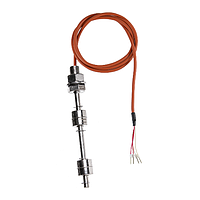
Level gauge
Accurate liquid level verification is essential in wells, boreholes, tanks, and water management systems where operators need dependable readings for inspection, monitoring, and fieldwork. In many applications, the right instrument is not only about measurement range, but also about the measuring principle, portability, readability, and suitability for manual checks or continuous signal output.
Level gauges in this category support practical level measurement tasks across industrial, environmental, and utility settings. The range includes compact manual devices for field sounding, long-reach meters for deep wells, and sensor-based instruments that provide analog output for integration into broader monitoring systems.
Where level gauges are commonly used
Level measurement is a routine requirement in groundwater observation, pumping tests, tank inspection, and general liquid handling. In these environments, operators often need a clear way to confirm actual level conditions, whether for periodic manual readings or for signal-based indication in a control panel.
This makes level gauges relevant for geohydrological work, water quantity research, utility maintenance, and process support. Depending on the task, users may choose a manual tape-and-probe meter for direct field measurement or combine a sensor with a display for fixed-point monitoring. Where broader system integration is needed, a dedicated level transmitter may also be considered alongside gauge-based solutions.
Manual and sensor-based level measurement options
A useful way to compare this category is to separate manual sounding instruments from sensor-driven indicators. Manual water level meters are widely used for direct measurement in boreholes, wells, and tanks, especially when portability and repeatable field readings matter more than continuous automation.
Sensor-based models, by contrast, are better suited where the level value needs to be displayed on a panel or transmitted as a standard current signal. The PCE ULM-10-N24S Level Indicator is a good example of this approach, combining ultrasonic measurement with a display-oriented setup and 4 ... 20 mA output for practical installation in monitoring systems.
Typical products in this category
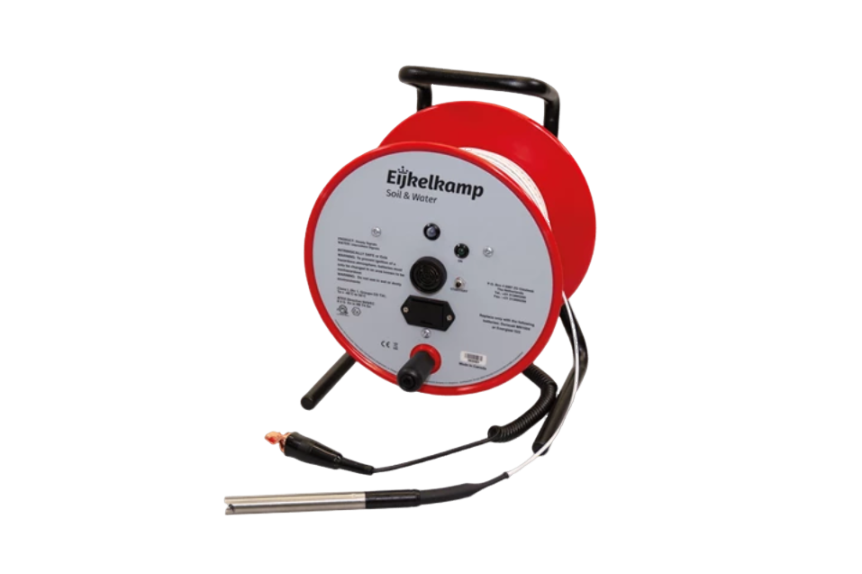
For groundwater and well applications, Eijkelkamp offers several manual water level meters designed for electrically conducting liquids. Examples in this category include the Eijkelkamp 11.03.40 Water level meter pocket size (10 m) for short-range portable work and the Eijkelkamp 11.03.43, 11.03.45, and framed variants extending to 50 m, 100 m, 150 m, 200 m, 300 m, and 500 m for deeper measurement tasks.
For users working with groundwater monitoring wells and field reels, the Solinst 101 Water Level Meter represents another established format for manual measurement across a wide range of tape lengths. In more specialized interface detection work, the Eijkelkamp 11.08.07 Interface meter (30 m) is intended for identifying light and dense non-aqueous phase liquids, making it relevant in environmental investigations where product-water boundaries must be checked.
How to choose the right level gauge
The first selection factor is the measurement task. If the requirement is routine manual checking in wells or boreholes, a conductivity-based water level meter is often the practical choice. If the requirement involves fixed installation, panel display, or analog transmission to another device, an ultrasonic or signal-output level indicator may be more appropriate.
The second factor is depth or measuring range. Shallow applications may only need a compact 10 m or 15 m instrument, while hydrogeological or pumping-test work can require 100 m to 500 m capacity. Beyond range, users should also look at reading resolution, environmental protection, probe construction, and whether the device is intended for occasional inspection or regular field deployment.
It is also important to consider the liquid and site conditions. Conductivity-based devices are suitable for electrically conducting liquids, while ultrasonic instruments depend on installation conditions and a stable measuring path. If the application also requires switching logic or pump protection, a separate level relay may be part of the overall solution.
Key differences in measuring principle
Conductivity measurement is common in manual water level meters used in wells and tanks. A probe detects contact with the liquid, allowing the operator to read depth directly from the tape. This method is straightforward, field-proven, and well suited to periodic checks, long-term observation campaigns, and pumping tests where manual confirmation is required.
Ultrasonic measurement works without direct contact with the liquid and can be advantageous in fixed installations. A model such as the PCE ULM-10-N24S is designed for level indication with display integration and current output, which can simplify connection to local panels or monitoring loops. For broader automation strategies, this category can also complement a level controller when indication and control need to work together.
Benefits for fieldwork and industrial operation
In field environments, level gauges help technicians verify actual conditions quickly without relying only on inferred process data. This is especially useful in groundwater studies, maintenance inspections, and temporary testing where direct measurement remains important. Portable instruments with battery operation, durable probes, and clear tape markings are often preferred for these tasks.
In industrial or building service applications, gauge-type level indication can support local visibility and routine checks, while output-capable instruments help bridge manual observation and system monitoring. The result is better awareness of tank or vessel conditions, improved maintenance planning, and more reliable verification during commissioning or troubleshooting.
Choosing by application instead of by product list
Rather than starting from model numbers alone, it is usually more effective to begin with the installation type and operating objective. For example, a compact meter may be enough for occasional manual sounding in shallow wells, while a framed long-length instrument is more suitable for deep boreholes and repeated site use. An interface meter is the more relevant choice when the real task is layer detection rather than standard water level measurement.
For fixed-position indication in tanks or vessels, output signal requirements, display compatibility, and mounting conditions become more important than reel length. In those cases, browsing the available PCE instrumentation can help narrow down options for panel-based indication and analog integration without overcomplicating the selection process.
Final considerations
This category brings together practical solutions for direct and display-based liquid level measurement across water, environmental, and industrial applications. From compact portable meters to deep-well manual gauges and sensor-based indicators, the most suitable choice depends on depth, measuring principle, installation style, and whether the reading is needed locally, manually, or as part of a larger system.
When comparing options, focus on the actual liquid conditions, required measuring range, and how the result will be used in daily operation. That approach makes it easier to select a level gauge that fits the job without adding unnecessary complexity.
Get exclusive volume discounts, bulk pricing updates, and new product alerts delivered directly to your inbox.
By subscribing, you agree to our Terms of Service and Privacy Policy.
Direct access to our certified experts