Electronically Erasable Programmable Logic Devices
When a design needs fixed digital logic with short development cycles and the flexibility to update logic after manufacturing, Electronically Erasable Programmable Logic Devices remain a practical choice. They sit in an important space between simple glue logic and more complex programmable architectures, helping engineers implement deterministic logic functions, interface conversion, address decoding, and control tasks without redesigning custom hardware.
For embedded and industrial electronics, EEPLDs are often selected because they combine reprogrammability with predictable behavior, compact integration, and support for long-life designs. This category focuses on devices suited to applications where stable logic implementation, manageable I/O counts, and straightforward programmable logic are more important than the overhead of larger programmable platforms.
Where EEPLDs fit in an embedded design
EEPLDs are commonly used to replace multiple standard logic ICs with a single programmable device. In practice, that can simplify PCB layout, reduce component count, and make future logic revisions easier during prototyping or product maintenance. For many control boards, communication interfaces, and legacy-compatible systems, this approach is still highly relevant.
Compared with a central processing unit, an EEPLD handles dedicated hardware logic rather than software-driven processing. It is also closely related to complex programmable logic devices, especially when a project needs more macrocells, more I/O, or broader integration while still preserving deterministic digital control.
Common application areas
These devices are frequently used in systems that require deterministic combinational or sequential logic. Typical roles include state machines, bus interfacing, signal routing, timing-related control functions, chip select generation, and replacement of aging programmable logic in maintenance or retrofit projects. In industrial environments, that makes them useful in control boards, instrumentation electronics, communication gateways, and specialized embedded modules.
They are also relevant when supporting mature platforms that were originally designed around SPLD or CPLD-style architectures. Reprogrammable logic can help extend product lifecycles by making it easier to maintain compatibility with established interfaces while avoiding a complete redesign around a larger processing platform.
Product range in this category
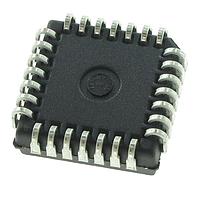
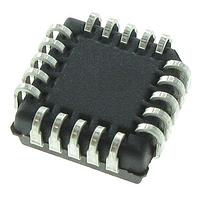
This selection is led by Microchip Technology, with representative devices spanning compact low-I/O logic through higher-density programmable logic. For example, the ATF16V8CZ-15SU and ATF16LV8C-10JU suit smaller logic implementations where a limited number of I/O and macrocells is enough for control or interfacing tasks.
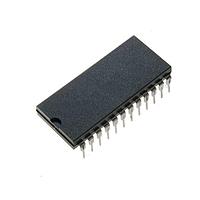
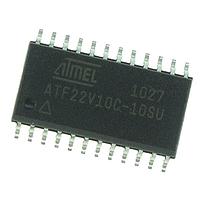
Moving up in capability, parts such as the ATF22V10C-10PU, ATF22V10C-10JU, and ATF22LV10C-10XU provide a larger logic footprint for designs that need around 10 macrocells and fast propagation performance. For applications that require more integration, devices such as the ATF1500AL-20AU, ATF1500AL-20JU, ATF1508ASL-25AU100, ATF1508AS-10QU100, and ATF1508AS-7AX100 extend the available logic and I/O significantly, making them suitable for denser board-level logic consolidation.
How to choose the right device
The best starting point is the logic size your design actually needs. A small replacement for simple gates, decoding, or a compact state machine may only require 8 to 10 macrocells. If the design must absorb several discrete logic functions or manage wider buses, a larger device with 32 or 128 macrocells may be a better fit.
It is also important to review I/O count, package style, and supply voltage. In this category you can find both through-hole and SMD/SMT options, which matters for serviceable legacy boards as well as new compact layouts. Voltage range is equally important in mixed-voltage designs, especially where 3 V to 5.5 V support can simplify interfacing with older and newer logic domains.
Timing should be checked early as well. Propagation delay and maximum operating frequency influence whether the device can meet control-loop timing, interface timing margins, or legacy bus requirements. Environmental range can also be a deciding factor for industrial use, since some products in this range support extended temperature operation suitable for harsher conditions than standard commercial electronics.
EEPLD, CPLD, and related programmable logic options
Although the terms are often discussed together, device class matters. Smaller EEPLDs are useful when the goal is targeted logic replacement with minimal complexity. Larger programmable logic may be preferable when the design needs broader internal resources, more registers, or more I/O expansion. If your project is scaling beyond compact logic implementation, it may be worth reviewing the wider electronically erasable programmable logic devices ecosystem alongside higher-density alternatives.
In some architectures, programmable logic also works alongside processors or dedicated control silicon. For signal-heavy embedded applications, related options such as digital signal processors and controllers may be more suitable for algorithmic processing, while EEPLDs continue to handle hardware-level logic, gating, and deterministic interfacing.
What engineers typically compare on product pages
For practical sourcing and design-in work, engineers usually compare a few core parameters first: macrocell count, number of I/O, operating voltage, package type, propagation delay, and temperature range. Those specifications quickly indicate whether a part is suitable for replacing an existing design or supporting a new board revision.
For example, a device such as the ATF22LV10CQZ-30PU may be considered where lower-power operation and through-hole mounting are both relevant, while ATF1508 family parts are more aligned with higher-density logic integration. The right choice depends less on marketing labels and more on matching the device architecture to actual logic requirements, interface constraints, and lifecycle expectations.
Why this category is still relevant for industrial and long-life designs
Not every embedded system needs a large FPGA or a software-heavy controller. In many industrial products, the requirement is simply to implement dependable logic in a form that can be updated when needed and sourced as a dedicated component. That is where programmable logic with electronic erasability continues to offer value.
For retrofit, repair, and long-service equipment, these devices can help preserve proven hardware behavior while giving designers room to revise logic equations or migrate older implementations. They are especially useful in projects where stable timing, manageable complexity, and practical board-level integration matter more than feature expansion.
Final considerations
Choosing an EEPLD is usually a matter of balancing logic density, timing, voltage compatibility, package format, and environmental needs. A smaller part may be ideal for compact decoding and control, while a larger device can consolidate multiple logic functions into one programmable component.
This category is a useful starting point for engineers building new embedded hardware, maintaining legacy systems, or replacing discrete logic with a more flexible solution. By comparing the available Microchip Technology devices against your required macrocells, I/O, and operating conditions, it becomes much easier to narrow down a part that fits both the design and the long-term support strategy.
Get exclusive volume discounts, bulk pricing updates, and new product alerts delivered directly to your inbox.
By subscribing, you agree to our Terms of Service and Privacy Policy.
Direct access to our certified experts