
Isolator
Protecting sensitive RF and telecom equipment from reflected power is a practical requirement in many signal chains, especially where stability, repeatability, and component life matter. In these applications, an Isolator helps control signal flow in one direction while reducing the impact of reverse energy on the source side.
This category brings together isolator products used in telecommunication and high-frequency systems, from compact RF models for specific frequency bands to insulating components used in related industrial assemblies. For engineers, buyers, and maintenance teams, the main value of an isolator is not only signal protection, but also cleaner system integration and more predictable performance across the full path.
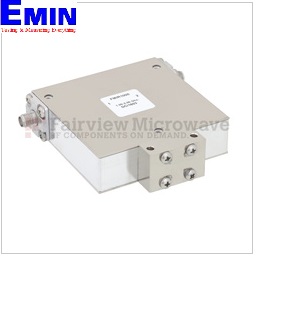
Where isolators fit in telecom and RF systems
In a typical RF chain, reflected power can return from mismatched loads, antennas, or downstream devices and disturb the transmitting or driving stage. A telecommunication isolator is commonly inserted between active and passive sections to limit that reverse effect, helping protect amplifiers, oscillators, and other sensitive components.
This makes isolators relevant in test setups, communication links, microwave assemblies, and specialized signal routing architectures. In broader component selection, they are often considered alongside items such as RF adapters or a power divider, depending on how the signal path is built.
Representative products in this category
The range shown here includes several frequency-specific RF isolators from Fairviewmicrowave, covering bands from VHF through microwave frequencies. Examples include the Fairview SFI1317S for 135-175 MHz applications, the Fairview SFI1724S for 1.7-2.4 GHz, and the Fairview SFI0618S for 6-18 GHz systems where broader high-frequency coverage is required.
These examples illustrate how isolator selection is usually tied to the operating band, connector style, impedance, and the expected forward and reverse power conditions. Instead of treating all isolators as interchangeable, engineers typically match the unit to the exact frequency window and protection requirement of the application.
The category also includes the OMRON F03-14 3P insulating electrode separator, which serves a different but still important isolation role in equipment assemblies. That distinction matters in procurement: some products in this category are RF signal-path isolators, while others are insulating components designed to separate or protect conductive elements within a device structure.
Key parameters to review before choosing an isolator
The first checkpoint is the frequency range. An isolator must be selected for the band where the system actually operates, whether that is 330-403 MHz, 450-520 MHz, 2-4 GHz, 7-12.4 GHz, or higher microwave bands such as 17.3-22 GHz. Choosing outside the intended range can reduce effectiveness and create avoidable loss or mismatch issues.
Next, look at impedance and insertion-related matching behavior, typically expressed with values such as 50 Ohm and VSWR. These parameters affect how well the isolator integrates with the rest of the RF path. In systems where multiple components are combined, it can also be useful to review related devices such as telecommunication switches when signal routing flexibility is part of the design.
Power handling is equally important. Forward power and reverse power capability should align with the real operating conditions, not just nominal values. Isolation performance in dB is another practical specification because it indicates how effectively reverse energy is suppressed. For some applications, 12 dB may be sufficient, while others may need 18 dB, 20 dB, or a different balance between loss, protection, and available space.
How application requirements influence product selection
Low-frequency and VHF/UHF applications often prioritize robust power handling and stable operation in communication infrastructure, radio systems, or field equipment. Products such as the Fairview SFI3340S and SFI4552S fit this style of requirement, where the operating band is tightly defined and reverse isolation must support reliable day-to-day operation.
At higher frequencies, the selection logic usually becomes more sensitive to connector interface, bandwidth, and compact integration. Models such as the Fairview SFI2040, SFI4080A, SFI0712, and SFI1822 show how isolators are tailored for different microwave regions rather than offered as one universal part. This band-specific approach is especially relevant in labs, telecom modules, and OEM assemblies.
For insulating accessories like the OMRON F03-14 3P, the buying criteria are different. Here, physical dimensions, pole configuration, and compatibility with the host assembly become more relevant than RF isolation metrics. If your project mixes signal handling and interface adaptation, products in the Balun category may also be relevant for broader signal-chain design.
Understanding the difference between RF isolators and insulating components
Because the category name is broad, it is useful to separate two common product roles. An RF isolator is a directional component used in coaxial or microwave signal paths to reduce the effect of reflected power. It is evaluated by frequency range, impedance, VSWR, isolation level, and power capability.
An insulating component, by contrast, is typically a mechanical or electrical separator used to isolate conductive parts from each other inside equipment. The OMRON F03-14 3P is a good example of this second group. It is not selected for GHz-band RF behavior, but for its physical insulation function within the broader equipment ecosystem.
This distinction helps prevent selection errors during sourcing. When reviewing products in this category, the intended role in the system should always come first, followed by the technical parameters that matter for that role.
Common purchasing considerations for B2B buyers
For OEMs, panel builders, telecom integrators, and maintenance teams, purchasing decisions are usually driven by fit-for-application rather than by headline specs alone. Buyers often need to confirm the operating band, connector interface, mounting compatibility, and expected stress conditions before standardizing a part number.
Manufacturer preference can also matter when teams want consistency across projects. In this category, OMRON and Fairviewmicrowave represent two different product contexts: industrial insulating parts on one side and RF/microwave isolators on the other. Selecting between them depends less on brand comparison and more on the exact engineering function required.
It is also worth checking whether the isolator will operate in a permanent installation, a test bench, or a service environment. Access constraints, replacement intervals, and system sensitivity can all influence whether a narrower-band or broader-band option makes more sense.
Choose the isolator that matches the actual system role
A good isolator choice starts with a clear understanding of what needs to be isolated: reverse RF energy in a signal path, or physical/electrical separation inside an assembly. Once that role is defined, the remaining selection steps become more straightforward, from frequency range and power handling to dimensions and interface compatibility.
This category is intended to support that process with practical options across different operating bands and use cases. If you are comparing parts for a telecom, RF, or industrial equipment project, focusing on the real application conditions will lead to a more reliable and maintainable selection.
Get exclusive volume discounts, bulk pricing updates, and new product alerts delivered directly to your inbox.
By subscribing, you agree to our Terms of Service and Privacy Policy.
Direct access to our certified experts