
Industrial Temperature Sensors
Accurate temperature feedback is a basic requirement in process control, building systems, machinery protection, and thermal monitoring. When the environment is harsher than a lab or office installation, selecting the right Industrial Temperature Sensors becomes important not only for measurement quality, but also for long-term reliability, maintenance planning, and control stability.
This category is intended for industrial users who need dependable sensing solutions for equipment, ducts, panels, production lines, and high-temperature processes. The range includes contact-based sensing devices for standard monitoring tasks as well as specialized options for demanding applications where response time, mounting style, and operating range all matter.
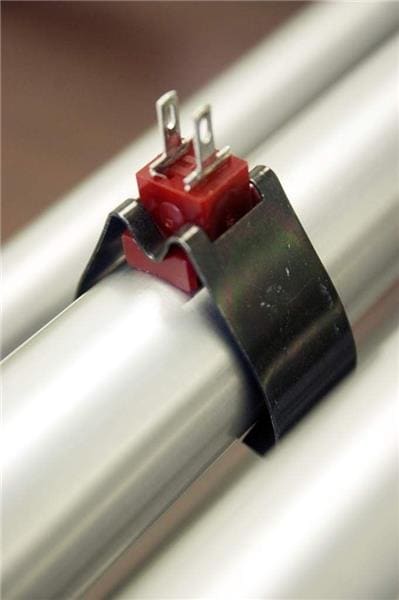
Where industrial temperature sensors are typically used
In industrial and commercial settings, temperature data supports both safety and performance. Sensors are commonly used in HVAC systems, control cabinets, machinery, air handling units, thermal equipment, and process lines where overheating, underheating, or unstable conditions can affect product quality and uptime.
Application needs can vary widely. Some installations need a compact wall-mounted sensor for building monitoring, while others require a rugged device for elevated process temperatures or a sensor that can be integrated directly into controls and instrumentation. For users comparing broader options, related categories such as thermistor-based sensors or K-type temperature sensors may also be relevant depending on the sensing method and temperature range required.
Different sensing approaches for industrial environments
Not every industrial temperature measurement task is solved in the same way. Many applications rely on contact sensors that detect the temperature of air, surfaces, or equipment through direct thermal transfer. These are widely used in building automation, equipment monitoring, and general-purpose industrial control.
Other processes benefit from non-contact temperature measurement, especially when the target is moving, very hot, difficult to access, or unsuitable for direct probe contact. This is where compact pyrometers and optical measurement devices become useful, particularly in metal, glass, heat treatment, and other elevated-temperature operations.
For lower-temperature and control-oriented applications, users may also compare this category with NTC-type temperature sensors or board mount temperature sensors when the installation is embedded at PCB or electronic assembly level rather than in a field environment.
Representative products in this category
A good example of a practical field device is the Dwyer TE-END-B wall mount temperature sensor with a 10 kΩ Type II thermistor. This type of sensor fits well in building and maintenance environments where a clean wall-mounted format and stable ambient temperature monitoring are needed. It reflects a common requirement in industrial facilities: simple installation combined with dependable sensing for HVAC and room-level control.
For high-temperature process monitoring, the Advanced Energy IGA 320 compact digital pyrometer illustrates a very different use case. Its non-contact design is suited to elevated-temperature targets where direct sensor contact is impractical or undesirable. This kind of instrument is especially relevant when users need fast response, fixed optics, and analog signal integration into industrial systems. You can also explore the broader Advanced Energy range for related thermal measurement solutions.
Several listed Honeywell devices represent another common segment within this category: compact temperature sensing components and switch-oriented temperature devices used in control assemblies, equipment protection, and OEM integration. Depending on design intent, these may support analog or digital interfacing, compact packaging, or straightforward mechanical integration.
What to consider when selecting industrial temperature sensors
The first step is defining the actual measurement point and installation condition. Ask whether you are measuring ambient air, a surface, a process target, or an enclosed internal space. Mounting method, thermal contact quality, cable routing, enclosure constraints, and exposure to dust or moisture can all influence sensor suitability.
Next, review the required temperature range, expected accuracy, and signal type. In some systems, a thermistor-based output is appropriate because the controller is designed for a specific resistance curve. In other cases, users may need analog outputs such as 4 to 20 mA for easier transmission into industrial controllers over longer distances.
Environmental durability is equally important. Industrial users often need to consider housing material, ingress protection, vibration, electrical noise, and long-term stability. For process-facing applications, response time and repeatability may matter more than compact size, while for building systems, appearance and mounting orientation can be just as relevant.
Manufacturer options and ecosystem fit
This category includes products from recognized suppliers used across automation, building systems, and industrial measurement. Dwyer is well known in HVAC and environmental monitoring applications, making it a practical choice for wall-mounted and facility-oriented sensing tasks. Honeywell appears frequently in control-oriented temperature sensing, with many devices suited to equipment integration and thermal switching functions.
Advanced Energy brings a different angle to the category through optical and high-temperature measurement technologies. Alongside these brands, the wider manufacturer mix in the catalog helps users compare sensor styles, integration methods, and application focus without being limited to a single product family.
Matching the sensor to the application
For building services and facility monitoring, compact wall-mounted devices are often the most sensible choice because they are easy to install and align well with standard control infrastructure. In these cases, users typically prioritize stable ambient readings, compatibility with existing controllers, and a housing format suitable for occupied or service areas.
For OEM equipment and embedded thermal protection, smaller sensor formats or switching-oriented devices may be more appropriate. These are commonly selected when the design must monitor component temperature, trigger protective action, or fit within a constrained mechanical envelope.
For furnaces, hot materials, or moving targets, a pyrometer-based solution may be the better fit. Here, the priority shifts toward stand-off measurement, optical targeting, speed, and performance at temperatures that exceed the practical range of many standard contact sensors.
Choosing with long-term operation in mind
Industrial temperature sensing should be viewed as part of a larger control and maintenance strategy. A sensor that matches the application well can reduce false alarms, improve energy efficiency, support product consistency, and minimize unplanned downtime caused by poor thermal visibility.
When comparing options in this category, focus on how the sensor will actually be installed and used over time. Measurement method, mounting style, operating environment, and controller compatibility are usually more important than comparing part numbers alone. A well-matched solution makes integration easier and helps deliver more reliable temperature data across the life of the system.
Get exclusive volume discounts, bulk pricing updates, and new product alerts delivered directly to your inbox.
By subscribing, you agree to our Terms of Service and Privacy Policy.
Direct access to our certified experts
