Choosing a hyperspectral camera for plant phenotyping starts with the research question, not with a single specification. Plant growth, morphology, leaf condition, and water-related characteristics can be investigated through spectral image data, but the most useful configuration depends on where, how, and how quickly measurements must be made.
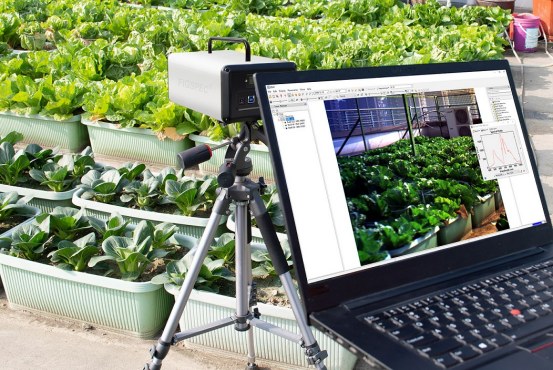
Before comparing products, define the crop or plant material, the traits of interest, the measurement environment, and the expected throughput. A field survey, a greenhouse automation workflow, and close-range leaf analysis may require very different combinations of spectral coverage, image detail, operating speed, and portability.
Match spectral range to the plant traits being studied
Spectral range should be a primary selection criterion. Plant materials show different absorption and reflectance behavior across visible, near-infrared, and short-wave infrared regions. The source information identifies visible light as 400–700 nm, near-infrared coverage as 400–1000 nm, and short-wave infrared coverage as 900–2500 nm.
Visible and near-infrared data can support evaluation of crop growth status because chlorophyll and water in leaves exhibit noticeable spectral behavior in these regions. Short-wave infrared data may be relevant where changes in plant-tissue water content or certain material components are part of the study.
Rather than selecting the widest available range by default, researchers should identify which spectral features their workflow needs to capture. The FS1X line-scan hyperspectral camera series is described as offering multiple spectral-region options, including a 400–1700 nm range. This illustrates why the available range should be reviewed against the intended phenotyping task.
Evaluate both spectral and spatial resolution
Resolution has two distinct dimensions. Spectral resolution affects the ability to separate similar spectral features. It is particularly important when subtle variation in plant spectral characteristics is relevant to the analysis.
Spatial resolution affects image detail. It matters when the project involves morphology, leaf texture, leaf area, or leaf shape, since these measurements depend on a clear representation of plant structures. The source notes that some high-resolution cameras can provide spatial resolution of 1920×1920 or higher.
These requirements should be balanced. A project focused on fine leaf features may place more emphasis on spatial detail, while one seeking to distinguish close spectral responses may prioritize spectral resolution. The right choice is the one that supports the measurements needed without introducing unnecessary data volume or operational complexity.
Consider imaging speed and the scale of monitoring
Imaging speed becomes important when monitoring large fields, many greenhouse plants, or changing plant responses. It can also affect the feasibility of high-throughput phenotyping workflows.
The source states that CHN SPEC hyperspectral cameras can achieve full-band imaging speeds up to 128 Hz, with ROI (Region of Interest) processing reaching up to 3300 Hz. ROI processing may be useful when the study can focus on a defined portion of the image rather than the full scene.
Speed should be assessed in context. Determine whether the workflow requires full-band acquisition, whether selected regions can be used, and whether plant or platform movement affects image capture. A faster setting is valuable only when it aligns with the intended measurement method and preserves the data required for analysis.
Plan for field use, greenhouse work, or laboratory workflows
Portability and ease of operation are especially relevant for mobile studies. Equipment used across multiple sites must be practical to transport and operate, while field teams may benefit from a workflow that reduces setup time.
The FS-IQ portable hyperspectral camera series is described as supporting 1200 spectral channels and 1920×1920 spatial resolution. The source also lists a 5-inch touch screen and up to 300 measurements on a single charge. These characteristics are relevant points to assess when comparing options for mobile plant phenotyping.
For any portable system, confirm that its operating approach fits the actual research environment. Consider the number of plants or plots to be measured, how often the device will move, and who will perform acquisition. A suitable workflow should make repeatable measurement procedures easier to maintain.
Include data processing in the purchasing decision
A hyperspectral camera produces substantial spectral image data. The value of that data depends on the ability to process and interpret it. Review whether the available software supports essential tasks such as correction, denoising, and feature extraction, and whether outputs can be used within the planned analysis workflow.
Some analysis tools may support plant disease and pest identification, nutritional assessment, or yield prediction. These functions should be evaluated according to the available data and validation requirements of the specific research program. They should not replace a clear plan for data collection, model development, and result review.
Use a practical selection checklist
- Define the plant traits and spectral regions required.
- Set minimum needs for spectral and spatial resolution.
- Estimate the imaging speed needed for the target area and throughput.
- Choose a form factor appropriate for field, greenhouse, or fixed-location work.
- Review processing functions for correction, denoising, and feature extraction.
- Consider training, installation, technical support, and long-term maintenance needs.
A well-matched hyperspectral camera for plant phenotyping is one that connects technical capabilities with a realistic research workflow. By evaluating spectral range, resolution, speed, portability, and data handling together, research teams can make a more focused and defensible equipment decision.