The TD2 Geek was created to address that very situation. Instead of listening and then inferring, the device allows you to directly see the sound as it's being emitted, spreading, and focusing on its location right on the screen.
Listen carefully to the sounds instead of guessing.
The TD2 Geek uses a cluster of 64 microphones arranged in an array. Simply put, this device captures sound from multiple directions simultaneously, not relying on a single listening point. Each microphone records a portion of the signal, which the system then synthesizes to determine the source.
The results are displayed as a color map overlaid on the actual image from the camera. Areas with strong sound are more clearly visible, while areas with weak sound fade away. Everything is exactly where the sound is coming from, without any distortion or misinterpretation.
Thanks to this display method, users can tell where the sound is coming from simply by looking at the screen, even if the source is behind a wall, high up, or out of sight.
When the human ear can no longer keep up
The TD2 Geek handles the frequency range from 2kHz to 50kHz. Sounds above 20kHz are inaudible to the human ear but are quite prevalent in electrical equipment, pneumatic systems, and operating components.
High-frequency hissing, small vibrations, or background noise are often difficult to detect by ear. They are vague and indistinct even when standing close. With the TD2 Geek, these sounds appear immediately on a color map, clearly showing their origin.
This approach is particularly useful when inspecting running machinery, where standing close to listen is both difficult and potentially risky.
The application is designed to be as versatile as the user needs.
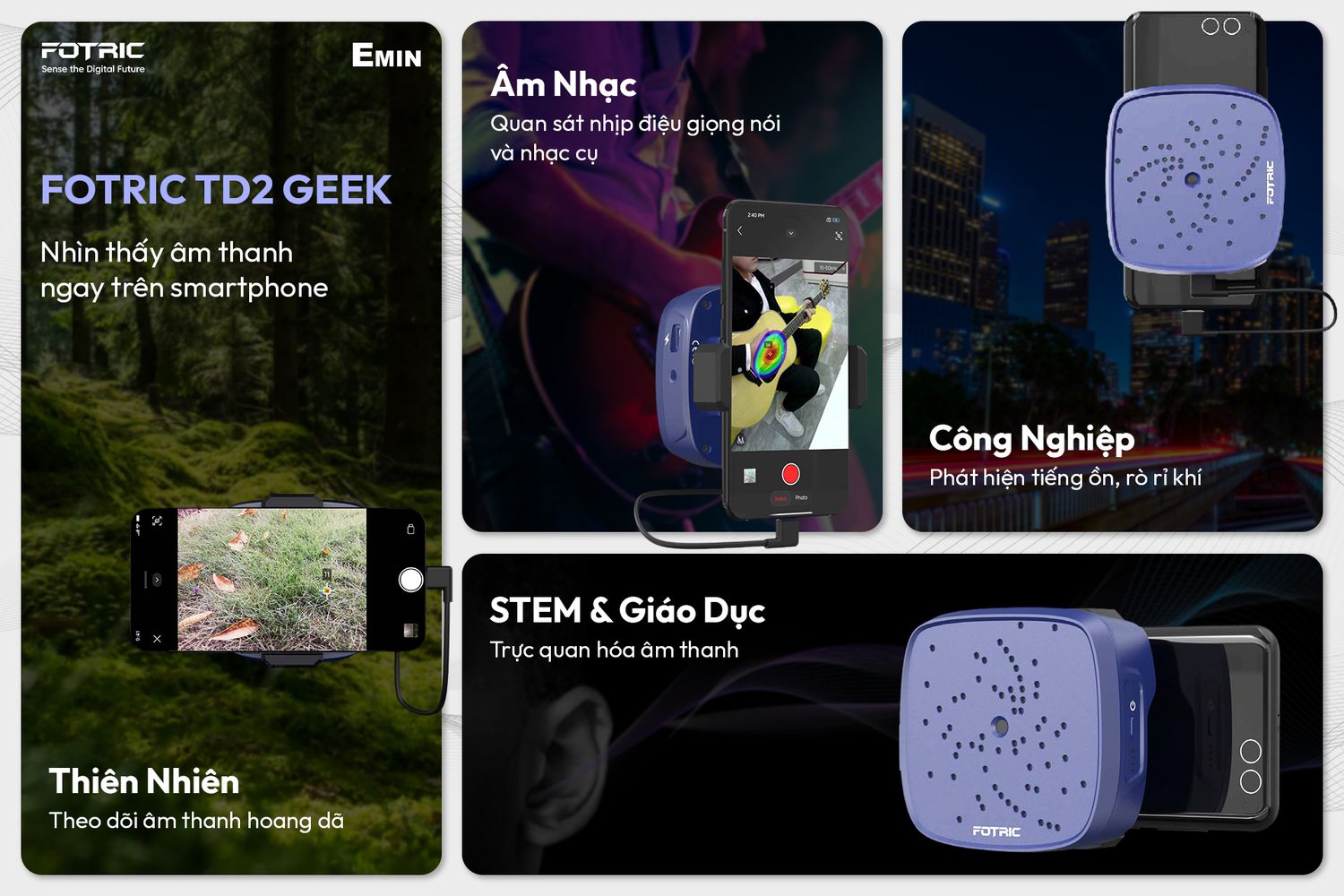
The TD2 Geek is widely used for detecting compressed air leaks, locating electrical noise sources, and identifying unusual noises emanating from within machinery or building structures. Users can stand at a safe distance and still clearly see the source of the sound.
By accurately identifying the location from the outset, inspection time is significantly reduced. There's no need to disassemble many components just to find the source.
Beyond technical applications, the device is also used for very practical purposes. Tracking birds and insects, finding pets, or observing how sound propagates in enclosed spaces. For musicians or room designers, seeing the resonance zone makes adjusting the layout easier than relying solely on hearing.
Use it flexibly with your phone.
The TD2 Geek connects directly to Android phones via an app. The usage is quite straightforward; simply plug in the device and you can observe immediately, without complicated procedures. This is suitable for quick inspections or field work.
The device has its own battery, sufficient for a full work session without affecting the phone's battery. The outer casing offers basic dust and water resistance, making it suitable for construction sites or workshops.
The user experience is geared towards convenience. Carry it around, connect it, observe the process, and then solve the problem it truly fulfills the role of a support tool.