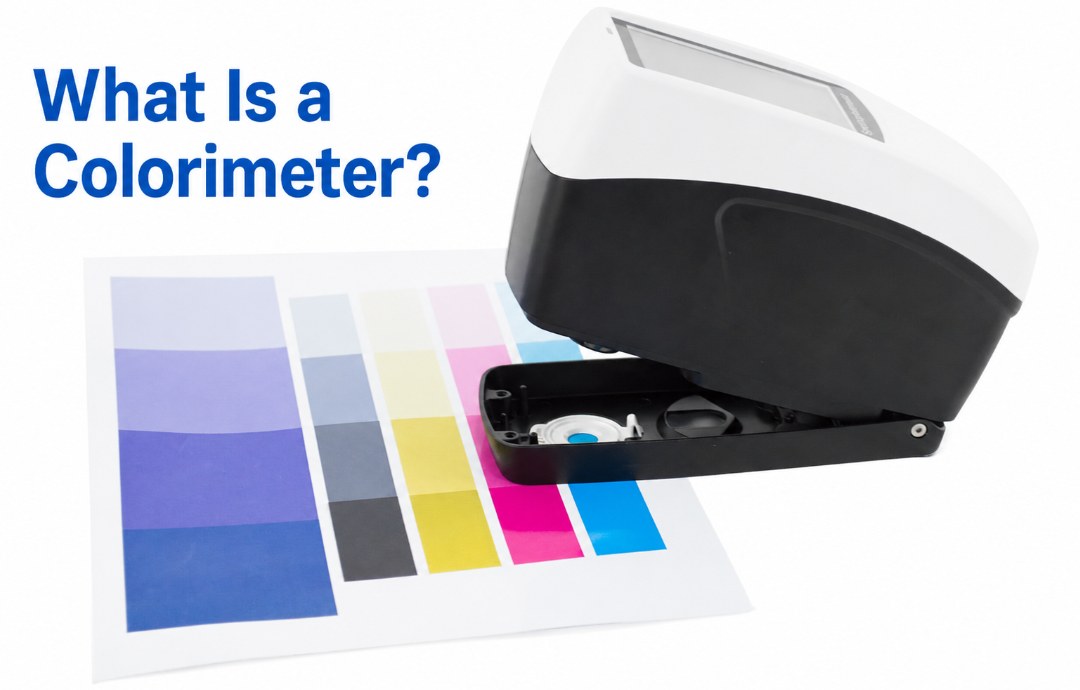
A colorimeter is a color measurement instrument used to turn the visual appearance of a sample into objective numerical data. In manufacturing environments, it supports more consistent color decisions than visual inspection alone, which can be influenced by observer fatigue and surrounding lighting conditions. It is commonly used where a product must match an approved color standard, including plastics, textiles, paints, coatings, automotive components, and packaging.
For electronics manufacturing, consistent color can matter across housings, panels, coatings, labels, and related components. A measured approach helps teams compare incoming materials and finished parts against the same defined target rather than relying solely on individual visual judgments.
What does a colorimeter measure?
A colorimeter quantifies color using standardized values. Common outputs include L*a*b* coordinates, which describe lightness and color position, and color difference data, often expressed as ΔE. These values make it possible to compare a production sample with a reference or master sample.
In practical terms, the result can indicate whether a sample differs from its target in lightness or color direction, such as appearing relatively redder, bluer, darker, or lighter. A business can then apply its own acceptance criteria to decide whether a part or batch meets the required color specification.
How a colorimeter works
A colorimeter generally uses an optical system with a light source, filters, and a photosensitive detector. The instrument illuminates the sample, then evaluates light reflected from or transmitted through it, depending on the measurement application.
- Illumination: A built-in light source directs light to the sample surface.
- Filtering: The measured light passes through tristimulus filters designed to represent aspects of human visual response.
- Detection and calculation: A detector records light intensity, and the instrument processes those signals into tristimulus values such as X, Y, and Z, along with readable color coordinates such as L*a*b*.
This workflow provides a repeatable numerical basis for evaluating color. To obtain useful comparisons, the reference sample, measurement method, and tolerance criteria should be defined consistently within the quality process.
Typical colorimeter applications
Incoming and finished-goods inspection
Colorimeters can support inspections of raw materials and finished products. In plastics, textiles, paint, and coating workflows, a team may compare a sample to an approved master sample before accepting materials or releasing a production batch.
Pass/fail quality checks
When an organization establishes a color-difference tolerance, a colorimeter can assist with pass/fail assessments. The tolerance itself should reflect the product requirement and internal quality standard; it is not a universal value for every material or application.
Supplier and assembly consistency
Where parts are made at different locations, numerical color data can help communicate a common target. This can be valuable when components must visually align after assembly, such as a plastic component and a coated or glass component.
Color-change monitoring
Color measurement can also be used to observe color changes over time. This is relevant when materials are evaluated after exposure to conditions such as UV light, weather, or chemicals.
Colorimeter vs. spectrophotometer
Both colorimeters and spectrophotometers are used for color evaluation, but they serve different levels of analysis. A colorimeter uses tristimulus filtering and is suited to routine color checks where quick color-coordinate and color-difference results are useful.
A spectrophotometer measures spectral reflectance across wavelengths. In addition to color values, it can provide spectral data and reflectance curves. This broader analysis is relevant to research and development, color matching, formulation work, metamerism analysis, and materials that are highly reflective or textured.
| Consideration | Colorimeter | Spectrophotometer |
|---|---|---|
| Measurement approach | Tristimulus filters | Spectral reflectance measurement |
| Typical output | Color coordinates and color difference | Spectral data, curves, and color analysis |
| Typical use | Routine quality control and spot checks | R&D and complex color analysis |
| Instrument role | Fast, practical color evaluation | More comprehensive color characterization |
Choosing the right approach for color control
A colorimeter may be appropriate when the goal is routine comparison to a defined standard and efficient quality checks. A spectrophotometer may be more suitable when a process requires spectral information, advanced color matching, or evaluation of challenging surfaces.
CHN SPEC provides color measurement solutions including portable colorimeters and benchtop spectrophotometers. The appropriate choice depends on the material, surface characteristics, measurement workflow, and level of color analysis required.