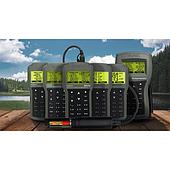
Unlike other desktop spectrum analyzers, this device is smaller in size and certainly many times lighter in weight. It has a built-in battery and the ability to operate independently in the field, making it extremely suitable for engineers who measure, survey or maintain systems.
Anyone who has used desktop or handheld spectrum analyzers is probably familiar with the fact that they can identify, observe, and evaluate the frequency spectrum of a signal, thereby detecting interference, evaluating transmission performance, or checking for electromagnetic compatibility (EMC/EMI) issues.
Despite their compact design, many models now offer performance that is nearly desktop-level thanks to advanced digital signal processing (DSP) technology and real-time spectrum display capabilities. You can check out Rigol's newly launched real-time spectrum line at: Top the most worth buying spectrum analyzer at the end of 2025 - Check out the RSA6000 real-time spectrum analyzer from Rigol

Structure and basic operating principle:
A handheld spectrum analyzer typically consists of the following components:
- Pre-Amplifier: Amplifies weak signals before feeding them into the mixer.
- Mixer: Mixes the input signal with the signal from the local oscillator (LO) to down-convert the frequency to the intermediate frequency (IF) band.
- IF Section: Selects frequencies and removes unwanted signals.
- Analog-to-digital converter (ADC): Converts IF signal into digital form for processing.
- Digital signal processor (DSP): FFT analysis, spectrum display, amplitude, frequency, background noise measurement, etc.
- Display screen: Usually a high-brightness LCD or TFT, spectrum or waterfall display.
- Connection interface: USB, LAN, Wi-Fi or Bluetooth for data transmission, PC connection or software synchronization.
How does it work?
The basic principle of a spectrum analyzer is to separate the frequency components contained in the input signal, and then display the amplitude magnitude along the frequency axis.
The signal is scanned sequentially through the measurement frequency range (e.g. 9 kHz - 3 GHz), and at each frequency, the corresponding amplitude is measured. This process creates a frequency spectrum graph, which helps the user to observe the individual signals in the measurement range.
Some modern machines use FFT and real-time processing (RTSA) techniques to avoid missing short signals, transient noise, or flicker signals that only last a few milliseconds.
Some Practical Applications of Handheld Spectrum Analyzers

RF transmission system testing and maintenance
Transmission systems such as BTS, Wi-Fi, radar, satellites… all need to be checked periodically to ensure stable signals. Handheld spectrum analyzers help:
- Determine the transmission power level.
- Check for cross-channel or out-of-band interference.
- Detect abnormal signals or emission errors.
Electromagnetic interference analysis (EMC/EMI)
In industrial environments, noise signals can affect the operation of electronic equipment.
Handheld spectrum analyzers help engineers detect and identify noise sources on site, for example:
- Noise from motors, inverters, power circuits.
- Radiated noise in factory and laboratory areas.
- Check compliance with EMC standards before sending samples for testing.
Applications in the field of wireless communications
Handheld spectrum analyzers are used to measure channel power, spectrum occupancy, or analyze signal bandwidth of LTE, 5G, Wi-Fi, Bluetooth…
Field engineers can carry them to measure directly at antenna installation points or transmission lines.
Interrupt signal detection and frequency monitoring
Some models support signal hunting, which helps detect abnormal, interrupted or unauthorized signals.
This is especially useful in:
- Military and security frequency monitoring.
- Detecting unlicensed transmitters.
- Monitoring transmission activities in sensitive environments.
Factors to consider when purchasing a handheld spectrum analyzer
-Operating frequency range:
Depending on your needs, you should determine the maximum frequency range to measure.
For example:
3 GHz: suitable for measuring Wi-Fi, Bluetooth, GSM, civil signals.
6 GHz - 13 GHz: for radar, 5G, microwave devices.
Above 26 GHz: for research, in-depth measurement.
- Bandwidth Resolution (RBW/VBW):
The smaller the RBW resolution, the better the ability to separate signals that are close together, but the longer the scan time.
On the contrary, a large RBW allows for fast scanning but is prone to missing small details.
- Dynamic Range and Sensitivity:
A good machine needs high sensitivity (low noise floor) to detect weak signals, and at the same time a large dynamic range to measure strong signals without distortion.
- Extended Features:
Features to consider include:
- Channel Power Measurement (ACP, Channel Power)
- Phase Noise Measurement, Modulation Analysis
- GPS Function, RF Heatmap
- Data Storage and Cloud Synchronization
Conclude:
There are many reputable brands in the field of handheld spectrum analyzers on the market today. Keysight Technologies stands out with its FieldFox series, which is considered a high-end standard, with a frequency range of up to 50 GHz and can also function as a VNA.
Aaronia is attractive with its Spectran V6 series, which provides real-time processing and dynamic spectrum analysis, suitable for those who need to monitor signals instantly in complex environments.
Tektronix offers compact devices with user-friendly interfaces that are easy to operate in the field. Meanwhile, Rohde & Schwarz is highly appreciated for its ability to meet 5G or military applications.
Currently, EMIN Vietnam is an authorized distributor of many major brands such as Keysight, Rigol, Tektronix, Aaronia, Rohde & Schwarz..., providing a variety of handheld spectrum analyzer models to meet all needs from research to field maintenance.