Sieve
Particle size control affects everything from raw material inspection to formulation consistency, which is why the right Sieve is a basic but important tool in many laboratories and industrial workflows. Whether the task involves powder grading, aggregate separation, or routine sample preparation, selecting the correct mesh opening, diameter, and standard helps make screening results easier to compare and repeat.
On this category page, you can explore laboratory sieves used for size classification across a wide range of applications. The available range includes fine micrometer-level options as well as larger openings for coarser materials, making this category relevant for testing, quality control, and general lab handling.

Where laboratory sieves are commonly used
Sieves are widely used when a process depends on particle size distribution. In laboratory environments, they support incoming material checks, batch verification, research work, and preparation steps before further testing. In industrial settings, they are often part of routine quality control for powders, granules, minerals, chemicals, and similar materials.
The main purpose is straightforward: separate material into size fractions using a defined opening. This gives operators a practical way to evaluate whether a sample meets a required range or whether a process is producing material with the expected consistency. For related lab consumables and handling items, users may also browse categories such as sample bags depending on how materials are collected and stored.
Understanding the sieve range in this category
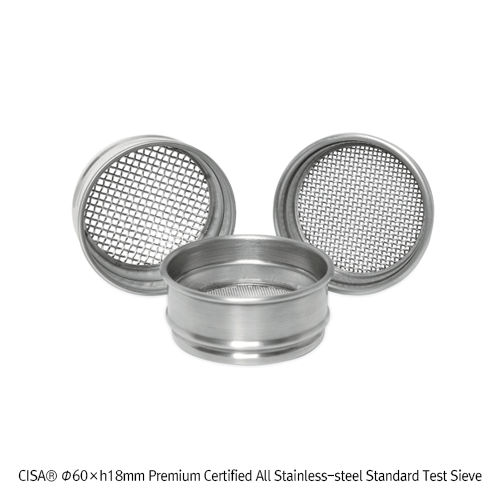
This category includes sieves in different frame sizes and aperture ranges to suit different sample volumes and screening methods. Examples from CISA include compact formats such as the CISA CE.0100801 Sieve, Φ60x18mm, 25㎛, ASTM500 and the CISA CE.0105401 Sieve, Φ60x18mm, 212㎛, ASTM70, which are useful where smaller diameter sieves fit the workflow or available equipment.
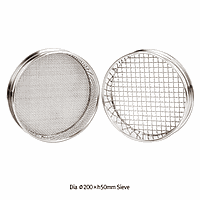
For broader sample handling, the range also includes larger formats such as the CISA CE.0406601 Sieve, Φ100×h40mm, 355 ㎛ and CISA CE.0411001 Sieve, Φ100×h40mm, 2.36 mm. From DaiHan, the selection extends to Φ200x50mm and 203 x h41mm sieve sizes, with openings ranging from fine values such as 100㎛ and 300㎛ to larger sizes such as 8mm, 11.2mm, 13.2mm, and 16mm. This variety is important because a suitable sieve is not defined by mesh opening alone; frame size and stack compatibility also matter in daily use.
How to choose the right sieve for your application
A practical selection process starts with the material being tested. Fine powders may require micrometer-scale openings such as 25㎛, 56㎛, or 100㎛, while coarser particles may be better matched to openings such as 2.36 mm, 8 mm, or 16 mm. The target is to choose a sieve that aligns with the expected particle range and the test method used in your lab or plant.
The second point is sieve diameter and height. Smaller sieves can be useful for limited sample quantities or compact setups, while larger diameters may support higher sample loads or standard sieve stack arrangements. If your work follows ASTM-based procedures, models identified with ASTM references can help maintain consistency across operators and test reports.
It is also worth considering the rest of the sample handling workflow. For example, after screening, some users transfer fractions into lab bowls or other containers for weighing, mixing, or further inspection. Thinking about the full process often leads to a better choice than looking at aperture size alone.
Examples of sieve options in the current range
For very fine separation tasks, models such as the CISA CE.0402401 Sieve, Φ100×h40mm, 56 ㎛ and DaiHan DH.Si8046 Sieve, 203 x h41mm, 100㎛ illustrate the lower end of the range available here. These are relevant when accurate classification of finer particles is part of the method.
For medium and coarse screening, DaiHan DH.Sie7068 Sieve, Φ200x50mm, 300㎛, ASTM No.50 offers a common intermediate opening, while DaiHan DH.Sie7031 Sieve, Φ200x50mm, 8mm, ASTM 0.313, DaiHan DH.Sie7029 Sieve, Φ200x50mm, 11.2mm, ASTM 0.438, and DaiHan DH.Sie7026 Sieve, Φ200x50mm, 16mm, ASTM 0.625 are more suitable where larger particle separation is needed. These examples show that the category is designed to support both fine laboratory analysis and more robust material grading tasks.
Why standards and consistency matter
In sieve analysis, repeatability depends not only on operator technique but also on using the correct test sieve format for the method. Differences in opening size, frame dimensions, and standard designation can affect how results are interpreted, especially when data must be compared between batches, departments, or facilities.
That is why many buyers focus on ASTM-referenced sieves or on maintaining a consistent brand and format across their existing setup. Matching replacement units or expanding a sieve stack with the same dimensional logic can reduce variability in routine testing and simplify procurement over time.
Suitable brands for laboratory and industrial screening
This category features recognized options from CISA and DaiHan, two brands commonly selected for laboratory screening tasks. CISA appears prominently in smaller and mid-size sieve formats with fine to medium openings, while DaiHan provides a wide range of larger diameter sieve options suitable for broader sample handling requirements.
Brand choice often comes down to current equipment compatibility, preferred sieve size format, and the standards used by your team. If you already work within one brand ecosystem, staying consistent can make replacement, stacking, and documentation easier. If you are comparing workflows across different lab tools, adjacent categories such as bottle top solvent pumps may also be relevant in broader laboratory preparation processes.
Choosing with confidence for routine screening work
A good sieve selection supports clearer data, smoother sample handling, and better day-to-day repeatability. Instead of focusing only on a product code, it helps to review the material type, the expected particle range, the required frame size, and any method or standard your process follows.
With options from CISA and DaiHan covering fine micrometer openings through larger millimeter sizes, this category provides a practical starting point for labs and industrial users looking to build, replace, or expand a screening setup. If you already know your target aperture and format, you can narrow down quickly; if not, the range here makes it easier to compare suitable sieve options for your application.
数量割引、まとめ買い価格の更新、新製品情報をメールでお届けします。
登録することで、当社の利用規約およびプライバシーポリシーに同意したものとみなされます。
認定専門家へ直接アクセス