The significance of timing application for ignition devices
Components such as ignition coils, spark plugs, or high-voltage units must operate under large, repeated electrical surges. The voltage hold time is the period during which the Hipot device maintains the test voltage on the sample. A sufficiently long period will help detect potential weaknesses in the insulation.
Tiny imperfections such as small cracks, residual air bubbles, or substandard connections are often difficult to detect with the naked eye. When a high voltage is maintained continuously for several seconds, these weaknesses become more apparent, helping to reduce the risk of discharge or short circuits later on.
In the DC Hipot test, a large capacitive current usually appears in the initial power-on phase. If the measurement is ended too early, the results are easily inaccurate because the capacitive current has not yet stabilized. When the voltage is maintained for a sufficient amount of time, the capacitive current gradually decreases, and the leakage current through the insulation layer accurately reflects the state of the component. This forms the basis for evaluating its long-term voltage withstand capability.
In addition, many international and domestic safety standards clearly specify the voltage maintenance time during hipot testing. This requirement aims to ensure that the product meets safety conditions before being put into practical use.
Typical voltage holding time
The voltage holding time depends on the purpose of the test. For routine testing to detect defects arising from mass production, the common holding time is 1-3 seconds. For design evaluation tests, the time can be extended to 60 seconds to fully observe insulation behavior.
For ignition devices, routine tests with short durations of one to three seconds are commonly used to balance testing speed with basic safety requirements.
Ignition testing equipment that assists in controlling the Hipot timing.
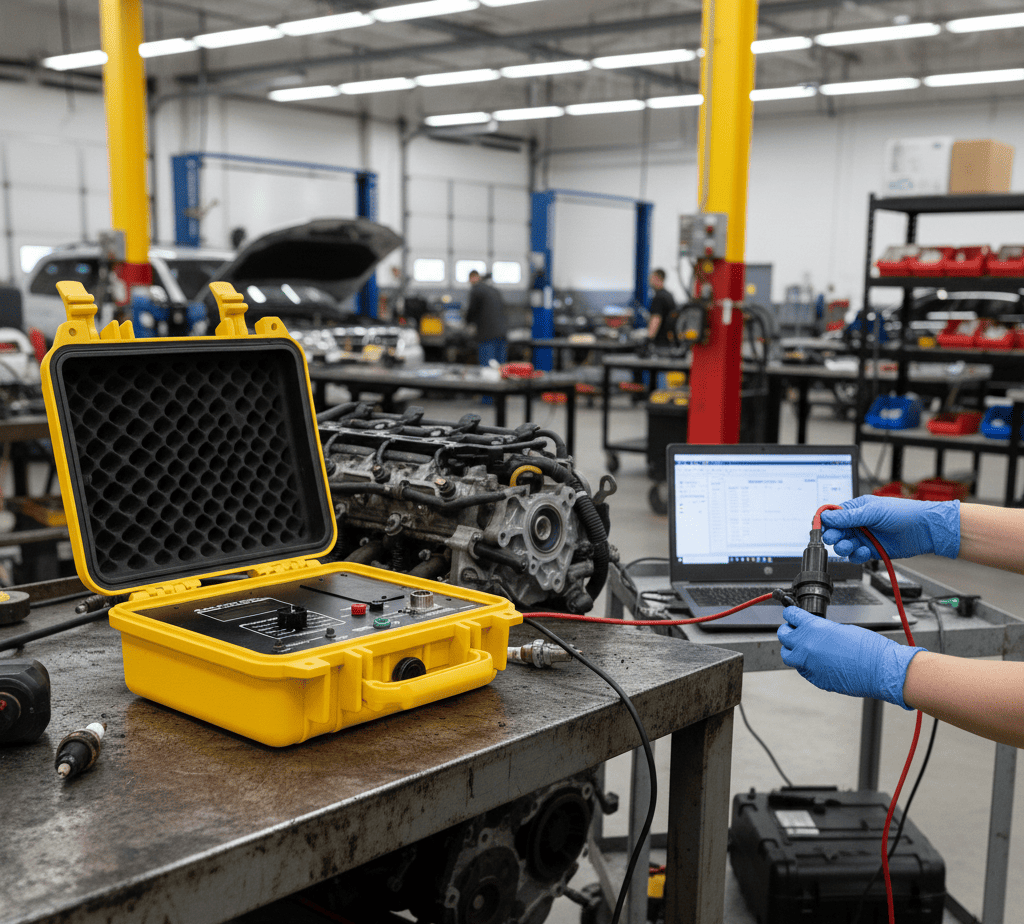
To effectively control voltage hold time, ignition testing equipment from experienced manufacturers helps maintain a stable voltage throughout the test. These devices allow for flexible voltage hold time settings, thereby aiding in the detection of insulation faults that only appear when the voltage is maintained for a sufficiently long period.
Some models, such as the AMPTEC RESEARCH 620MC or Valhalla Scientific 4314 AF, meet this requirement well, allowing for in-depth testing of issues such as material cracking, air bubbles, or insulation degradation. Higher-end models like the AMPTEC RESEARCH 641RS even support full automation of the process, from voltage application and holding to measurement and providing pass/fail results, reducing reliance on manual operation.
Investing in appropriate ignition testing equipment helps control the voltage hold time during hipot testing, thereby enhancing product safety from the research phase to mass production. To learn more about hipot testing solutions and specialized ignition testing equipment, please contact EMIN for a detailed discussion.