It is worth noting that even very small deviations can have major consequences. A 100 MHz source clock that drifts by a few Hz is enough to cause drift, loss of synchronization, or detect data errors. In contrast, accurate frequency measurement is not just an acceptable ancillary measure, but a prerequisite for ensuring the safety of the entire system. And that is why frequency counters were invented.
How is frequency counter measured?
The basic principle sounds simple: the device will count the number of cycles of the signal in a period of time called gate time. The result divided by that time is the frequency. But counting alone is not enough, especially when measuring low signals or requiring very high resolution.
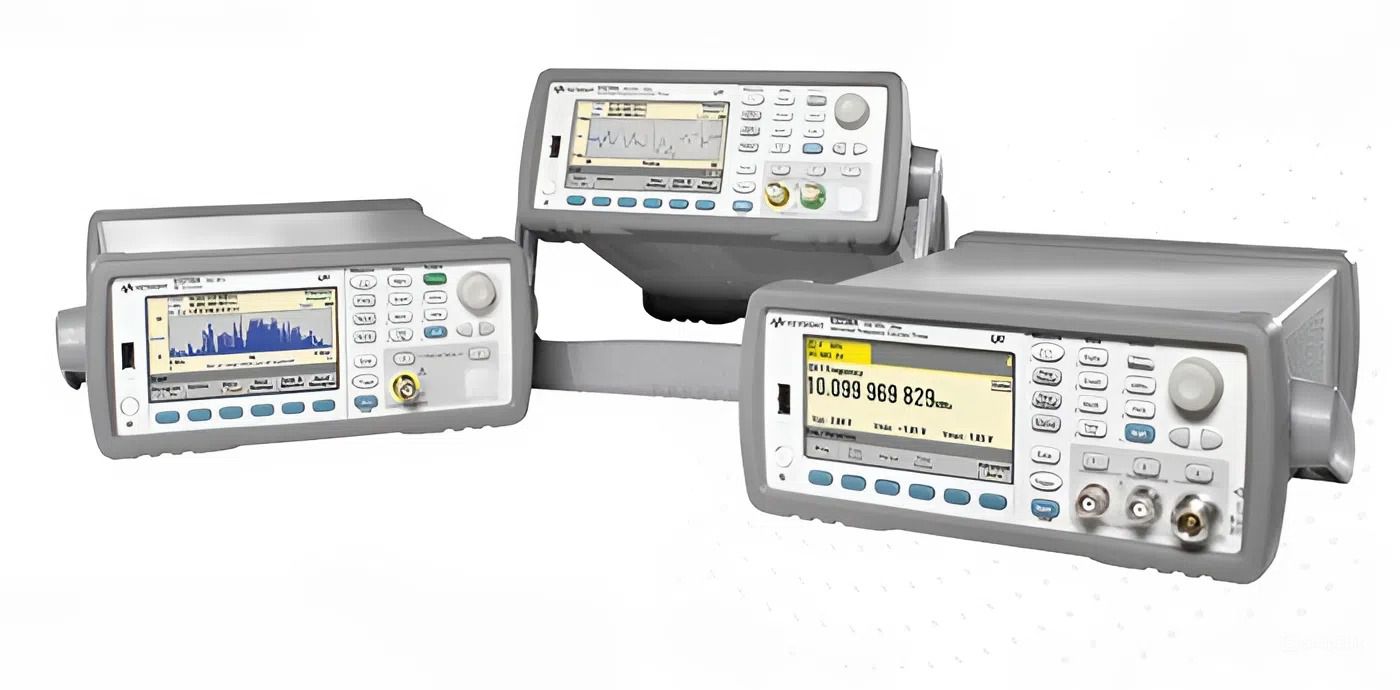
The Keysight 53200 series has overcome the limitation by the reciprocal counting method. Instead of just counting, the device combines the measurement of the time interval between wave edges to increase the accuracy by many levels. Thanks to that, when measuring signals of several Hz or verifying a 10 MHz standard source, the results are still reliable with multi-digit resolution.
When should I use a frequency counter instead of an oscilloscope?
At a simple level, many engineers use an oscilloscope to estimate frequency from a waveform. This is useful when simply observing, but when it comes to proving it with specific data, oscilloscopes quickly show their limitations.
An example is in a network system, where time synchronization requirements are limited to a few parts per billion. It is almost impossible to determine this level of accuracy based on the oscilloscope display. In such cases, a frequency counter such as the Keysight 53220A or 53230A is the tool to use.
The machine's multitasking capabilities
It is worth noting that frequency counters do more than just basic measurements. Models like the Keysight 53220A and 53230A can measure the time interval between two pulses, analyze phase, or count the total number of pulses in a signal sequence.
In radar, engineers use them to accurately determine pulse width and delay. In telecommunications, they help monitor the stability of a reference clock source. In physics research, they also monitor the microscopic oscillations of lasers, where deviations of a few thousandths of a Hertz can change the results of experiments.
Visible differences between Keysight models 53210A, 53220A and 53230A
At the entry level, the Keysight 53210A supports up to 350 MHz, making it suitable for training and general labs. For higher performance, the 53220A offers 12 digits per second resolution and adds precision timing. The 53230A extends the range to 6 GHz with 20 digits per second resolution, enough to handle microwave signals or systems that require near-atomic stability.
An important choice is the OCXO or Rubidium reference standard. OCXO is stable due to crystal temperature control, while Rubidium achieves near-perfect accuracy, making it suitable for large-scale synchronization applications or international standard measurement.
Frequency counters in the measurement device ecosystem
In a professional lab, a frequency counter rarely stands alone. It is often found in conjunction with a 10 MHz reference source, a high-speed oscilloscope, and a spectrum analyzer. Each device has a role: the oscilloscope provides a visual image, the spectrum analyzer provides a picture of the spectrum, and the frequency counter provides an absolute number of frequencies and times.
This complementarity ensures that every measurement is valid. When long-term stability is required, a frequency counter is the choice. When instantaneous waveform checks are needed, an oscilloscope is useful. When full spectrum viewing is required, a spectrum analyzer is indispensable.
Frequently Asked Questions
Can a frequency counter completely replace an oscilloscope?
No. An oscilloscope is used to observe waveforms, while a frequency counter gives absolute data. The two devices complement each other, not replace each other.
Why do many labs choose Keysight over other brands?
The reasons often come from long-term stable accuracy, international standard calibration capabilities, and technical support services.
How do models like 53210A, 53220A and 53230A differ in practice?
The 53210A serves educational or basic needs. The 53220A adds more precise timing measurements. The 53230A has extremely high resolution and a wide measurement range up to GHz, for advanced research or the telecommunications industry.
Do I need to buy additional external reference standards?
For most applications, integrated quartz is sufficient. For long-term measurements or variable environments, an OCXO is a good choice. Rubidium is only needed when near-atomic standards are required.
What applications can the machine be used for outside the lab?
In addition to research, the machine is also used in telecommunications testing, broadcasting station maintenance, radar system monitoring and GPS synchronization.
Does the machine's response time and measurement speed affect the work?
Yes. The Keysight 53200 series measures dozens of measurements per second, with resolutions up to tens of digits, saving time when a lot of statistical data is needed.
What is the durability and maintenance cost?
The device belongs to the high-end group so it has a long life, usually only needs periodic calibration. The biggest cost comes from maintaining the accuracy of the OCXO or Rubidium standard.
Conclude
Frequency counters may not be part of every day measurement, but when the need for absolute accuracy is reached, they become an indispensable tool. The Keysight 53200 series is now the standard, offering both robust frequency measurement and versatile timing and stability analysis.