Precise temperature control in soldering equipment helps reduce waste during soldering by maintaining stable temperatures, preventing overheating, and minimizing the amount of time heat is applied to solder joints. This is particularly important for high-density PCBs, where large copper areas and small components may have significantly different thermal requirements.
When heat is applied appropriately, flux is less likely to burn off prematurely, solder materials can achieve better wetting, and the number of rework operations may be reduced. The benefits extend beyond soldering consumables to include standby power consumption, residue buildup, and the risk of scrapping circuit boards due to thermal defects.
Overview: Stable temperatures help minimize solder joint defects and flux consumption. Fast thermal recovery reduces the time heat must be applied to components. Automatic standby modes can lower power consumption when equipment is not in use. Temperature data helps identify abnormalities in the process.
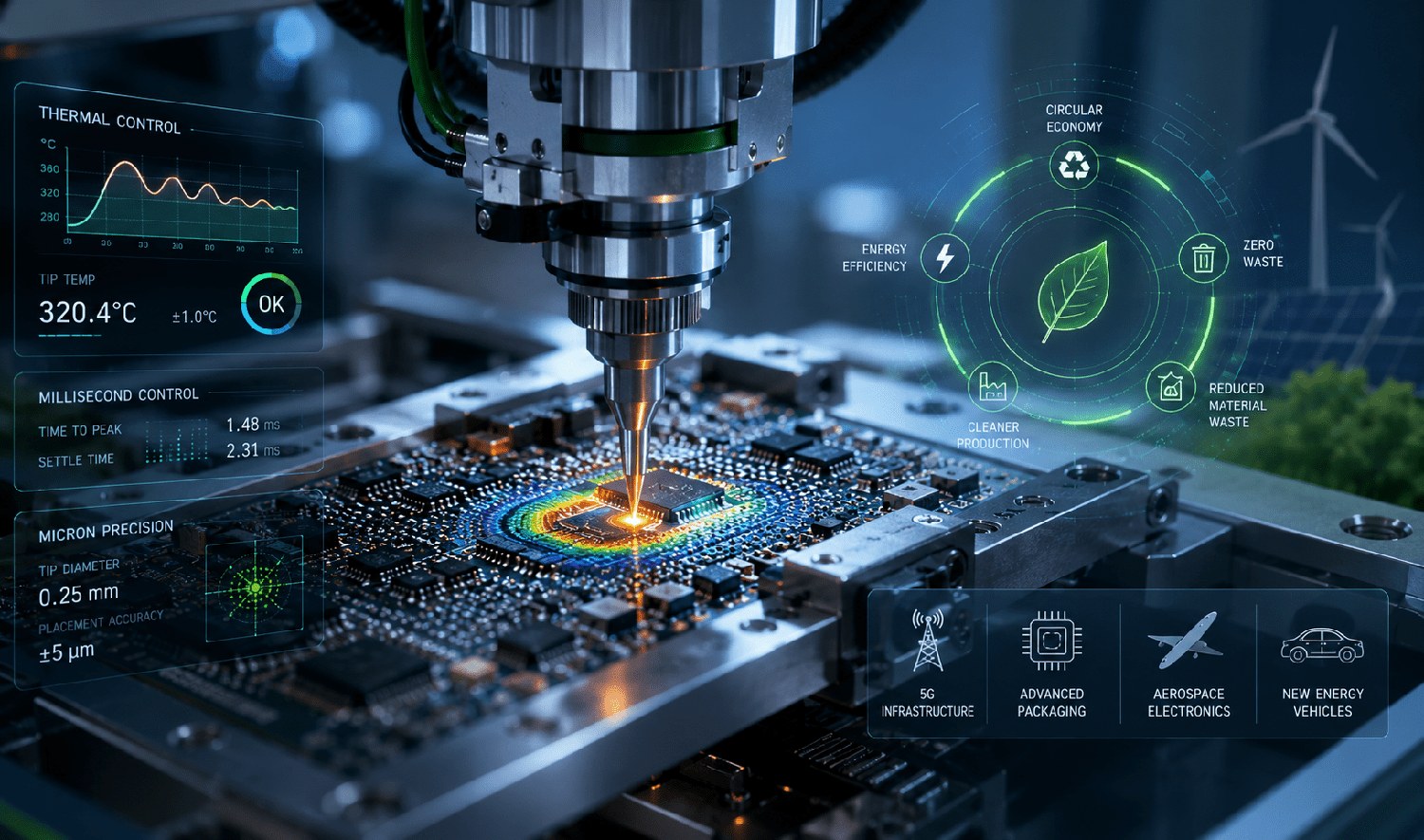
Why Does Precise Temperature Control Reduce Solder and Flux Waste?
Unstable temperatures can cause excessive heat spikes during the initial heating stage, resulting in flux evaporating or burning before it can effectively remove surface oxides. As a result, solder may exhibit poor wetting, leading to defective joints and additional rework.
A stable temperature control system is designed to maintain the soldering tip at an appropriate temperature throughout the operation. By reducing the need for repeated soldering and rework, manufacturers can also minimize solder and flux consumption, as well as the additional time required to correct each defect.
| Condition | Potential Impact | Role of Temperature Control |
|---|---|---|
| Excessive temperature rise | Rapid flux evaporation or burning on the PCB pad | Maintains more stable temperatures during heating |
| Poor solder wetting | May require rework and additional consumables | Helps establish suitable thermal conditions for solder joints |
| Uneven heat transfer | Increased risk of flux residue and solder ball formation on the surface | Reduces unnecessary temperature fluctuations |
How Does Fast Thermal Recovery Help Protect Circuit Boards?
Fast thermal recovery refers to the ability of a soldering system to compensate for heat loss when the tip contacts an area with a high thermal mass, such as a large copper plane. The objective is not to operate at a consistently higher temperature, but to prevent the tip temperature from dropping significantly and forcing the operator to keep it in contact with the solder joint for too long.
Prolonged heat exposure can cause thermal energy to spread to adjacent components. For sensitive devices such as integrated circuits and ceramic capacitors, this increases the risk of thermal shock, component damage, and ultimately, PCB rejection.
Note: In this context, high power refers to the ability to compensate for thermal changes quickly as the load varies. It does not mean arbitrarily setting a higher baseline temperature.
How Do Automatic Standby Modes Reduce Energy Waste in Soldering Equipment?
Standby power consumption refers to the energy used to maintain the soldering tip temperature while the equipment is not actively being used. Traditional soldering equipment may continue drawing power to maintain the set temperature even when the handpiece is placed in its holder.
Automatic standby functions or sensors that detect when the handpiece is placed in its holder can switch the equipment to a low-power state during periods of inactivity. This approach helps control energy consumption during recurring pauses on assembly lines.
Can Temperature Control Reduce Post-Soldering Cleaning Requirements?
To some extent, yes. Applying heat appropriately helps minimize excessive outgassing, overheating-induced oxidation, and solder spatter. When less flux residue and fewer solder balls accumulate on the surface, the cleaning workload after assembly can also be reduced.
Preventing residue formation from the beginning of the process is a different approach from simply removing it after it appears. This can reduce the need for industrial cleaning agents, although the actual reduction depends on the materials and specific process conditions.
Why Do Lead-Free Solder Alloys Require Tighter Temperature Control?
According to the available data, lead-free alloys generally have higher melting temperature requirements and narrower operating windows. Precise temperature control is therefore essential to ensure that the solder reaches the appropriate molten state without causing premature flux degradation or affecting the surrounding PCB substrate.
Temperature settings should take into account the characteristics of the solder alloy, flux, PCB pads, and thermal mass of each soldering location. A single fixed temperature should not be considered suitable for every PCB or component.
How Does Temperature Data Help Optimize Electronics Manufacturing?
Smart management systems can monitor process temperature data in real time. This information enables engineers to identify thermal trends, detect abnormalities before defects spread, and adjust process parameters accordingly.
From an operational perspective, recording this data provides a basis for distinguishing energy used in value-added production activities from unnecessary consumption. This is particularly useful for manufacturers seeking to integrate quality, material efficiency, and energy management objectives into a single production process.
What Factors Should Be Prioritized When Selecting a Temperature Control Solution for Electronic Soldering?
Selection should begin with an assessment of variations in PCB thermal mass and component heat sensitivity, rather than focusing solely on rated power. For areas with large copper planes, fast thermal recovery is important for reducing contact time. For smaller components, temperature stability helps prevent excessive thermal exposure.
Key factors to consider include temperature control performance, power-saving modes during inactivity, process monitoring data, and design features that support repeatable operation. Only by selecting the right combination of electronic soldering equipment, soldering materials, and operator techniques can manufacturers consistently reduce defects and production waste.