A self-reliant AI ecosystem needs to establish a chain of capabilities ranging from data collection and model development to deployment in real-world applications. Within this chain, technologies that may seem outside the AI field, such as measurement and signal testing, also play a role.
AI Self-Reliance Starts with Domestic Data
An AI model can be built from many different data sources, but the ability to develop systems suited to Vietnam depends heavily on the capacity to proactively create and control data.
In industry, data is not limited to text and images. Machines generate data on temperature, pressure, vibration, current, voltage, and electronic signals. These data directly reflect the condition of equipment and production processes.
To use such data for AI, businesses need control over how the data is generated, when it is collected, the measurement conditions, and the reliability of the results. This distinguishes simply using data from having the capability to proactively build data sources for AI applications.
At the national level, establishing high-quality and traceable data sources provides a foundation for developing models suited to specific industries.
Measurement Provides a Basis for Data Verification
A capable AI model still requires infrastructure for training, storage, and deployment. As applications scale up, demand for processors, memory, storage devices, data networks, and power systems also increases.
At the hardware level, developing electronic devices and integrated circuits involves extensive measurement and testing. Electrical characteristics, high-speed signals, noise, temperature, and component stability all need to be evaluated using specialized equipment.
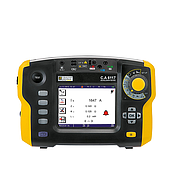
For example, an oscilloscope can capture changes in voltage and current over time. A spectrum analyzer is used to analyze signals in the frequency domain. These tools directly support the development and testing of electronic hardware on which AI systems also depend. A thermal imaging camera can provide data on the thermal distribution of equipment, helping connect sensor data with equipment monitoring and anomaly detection.
=> Contact EMIN for advice on solutions and products suited to your specific application.
AI applications are developing across a wide range of industries
Building AI Self-Reliance Requires Verification Capabilities
Technological self-reliance is not only demonstrated by the ability to create a product but also by the ability to independently test and verify it.
For AI systems, verification can begin with the input data. A sensor with measurement errors, a camera system whose characteristics have changed, or unstable measurement equipment can all alter the data used by a model.
In industrial AI systems, measurement data is also used to determine the actual condition of equipment. Without independent testing methods, it can be difficult to distinguish a model error from an error originating in the sensor, measurement equipment, or data collection process.
Therefore, measurement, testing, and evaluation capabilities need to develop alongside AI capabilities. These technical foundations help verify that the data and system outputs accurately represent the real-world objects or processes being monitored.
From AI to Industry-Specific Technology Capabilities
The goal of building domestic AI capabilities should not stop at developing language models or software tools. Greater value lies in the ability to apply AI to fields where Vietnam has specific needs and development opportunities.
In manufacturing, AI can process data from production lines and equipment to detect abnormalities or support maintenance. In electronics, AI can analyze signals and test data. In the energy sector, data from power systems and measurement equipment can be used for operational monitoring.
In these applications, AI becomes part of a technology chain consisting of hardware – measurement – data – computing – models – applications. Developing capabilities across each link can reduce dependence on any single technology or platform.
Building an Ecosystem Rather Than Just Developing Models
AI self-reliance at the national level needs to be viewed as a technology ecosystem. Algorithm development expertise needs to be supported by data capabilities; computing infrastructure needs to be integrated with hardware; AI models need to be verified and improved using real-world data; and AI applications need to address the practical requirements of individual industries.
As these capabilities develop together, Vietnam can gradually move from simply using existing AI technologies toward participating in the development, control, and mastery of more components across the AI technology chain.
Measurement provides a foundation for data verification. It is one of the technology layers that connects AI with the physical world, particularly in manufacturing, electronics, energy, and automation.
This ecosystem involves multiple participants. Universities and research institutes contribute research into algorithms, models, and new methods. Businesses develop products and platforms and bring AI into real-world operations, while computing infrastructure, data, and hardware technologies provide the foundation for the entire system.
When these components are connected, research results can be translated into products, which in turn generate new data and new problems for further research.