
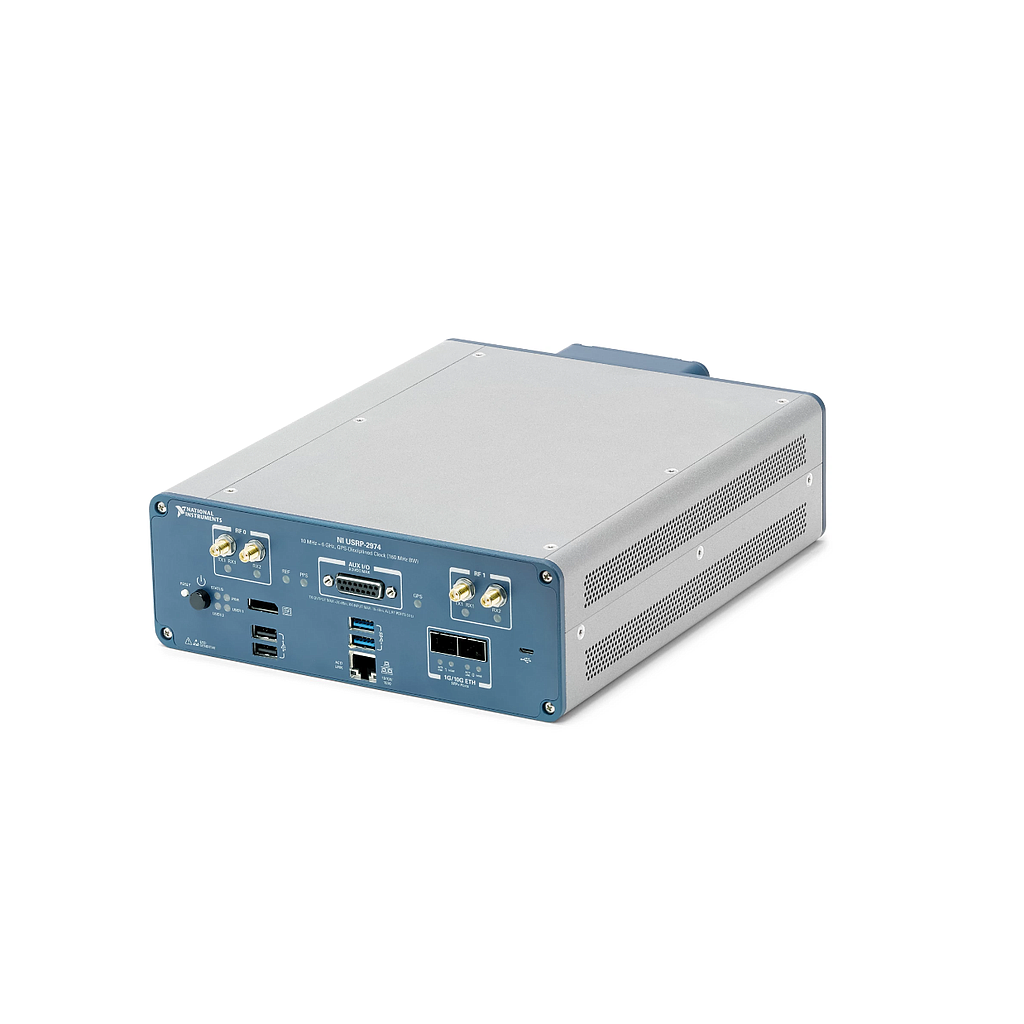
USRP Software Defined Radio Stand-Alone Device NI USRP-2974 (Embedded SDR, 10 MHz-6 GHz, 160 MHz BW)
Conditions
Specifications are valid at 25 °C unless otherwise noted.
Controller
System on module (SoM): Congatec COM Express conga-TS170
CPU: Intel Core i7 6822EQ (2 GHz Quad Core)
Memory: SO-DIMM DDR4 8 GB
SFP+: 10G ETH connection to the SoM
Cabled PCIe: PCIe Gen 2 x4
MicroUSB: USB-to-UART to the SoM
RJ45: 1G ETH host connection
FPGA and Baseband
FPGA: Kintex-7 XC7K410T
DRAM: 1 GB
Baseband analog-to-digital converter (ADC) resolution: 14 bit
Baseband digital-to-analog converter (DAC) resolution: 16 bit
ADC spurious-free dynamic range (sFDR) 88 dB DAC sFDR 80 dB
Maximum I/Q sample rate: 200 MS/s
SFP+: High speed serial link to one of the FPGA GTX transceivers
Transmitter
Number of channels: 2
Frequency range: 10 MHz to 6 GHz
Frequency step: <1 kHz
Maximum output power (P-out): 5 mW to 100 mW (7 dBm to 20 dBm)
Gain range: 0 dB to 31.5 dB
Gain step: 0.5 dB
Maximum instantaneous real-time bandwidth: 160 MHz
Receiver
Number of channels: 2
Frequency range: 10 MHz to 6 GHz
Frequency step: <1 kHz
Gain range: 0 dB to 37.5 dB
Gain step: 0.5 dB
Maximum input power (Pin): +10 dBm
Noise figure: 5 dB to 7 dB
Maximum instantaneous real-time bandwidt: 160 MHz
Provides deterministic control of transceivers using an onboard FPGA and processor for rapidly prototyping high-performance wireless communications systems.
The USRP Software Defined Radio Stand-Alone Device consists of an onboard processor, FPGA, and RF front end. You can program this device using either LabVIEW Communications System Design Suite or an open-source software workflow, depending on the operating system you choose. You can provision the device with NI Linux Real-Time, Linux Fedora, or Linux Ubuntu real-time operating systems. The USRP Software Defined Radio Stand-Alone Device enables you to prototype a range of advanced research applications such as stand-alone LTE or 802.11 device emulation; Medium Access Control (MAC) algorithm development; multiple input, multiple output (MIMO); heterogeneous networks; LTE relaying; RF compressive sampling; spectrum sensing; cognitive radio; beamforming; and direction finding.The registered trademark Linux® is used pursuant to a sublicense from LMI, the exclusive licensee of Linus Torvalds, owner of the mark on a worldwide basis.
Datasheet
Đăng ký nhận chiết khấu độc quyền, cập nhật giá sỉ và tin sản phẩm mới nhất ngay tại hộp thư của bạn.
Bằng cách đăng ký, bạn đồng ý với Điều khoản dịch vụ và Chính sách bảo mật của chúng tôi.
Kết nối trực tiếp với đội ngũ chuyên gia của chúng tôi