
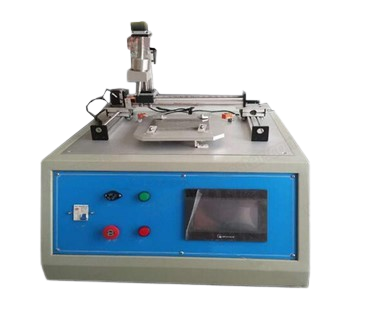
Máy kiểm tra trầy xước PEGO PG-9853 (0~25mm/s)
Tốc độ cào: 0~25mm/giây (có thể điều chỉnh)
Số lần kiểm tra: 0~9999 lần (có thể điều chỉnh)
Khoảng cách cào: 0~50mm (có thể điều chỉnh)
Bàn làm việc: Xoay 900
Lực tác dụng: 10N±0.5N (option: 30N±0.5N với tạ 20N)
Chân cào: Tròn với bán kính 0.25 mm ± 0.02 mm
Công suất làm việc: 220V/50Hz
Hệ thống điều khiển: PLC + màn hình cảm ứng
Chế độ truyền động: Động cơ bước
Scratch Tester also be called as abrasion resistance tester, it is designed according to IEC60950 clause 2.10.8.4 and IEC60335-1 clause 21.2. It is applied to do scratch test for accessible parts of solid insulation of household appliance and printed circuit boards, to ensure the material has sufficient strength to prevent penetration by sharp implements.
The scratch resistance test uses a hardened steel pin for scratching. The end of the steel pin should be tapered with a apex angle of 40°. The tip should be rounded with radius of 0.25 mm ± 0.02 mm.
When performing the scratch test, scratches were performed at a speed of 20 mm/s ± 5 mm/s in a plane perpendicular to the edge of the conductor. The steel pin should be properly loaded so that the hardend steel pin can apply a force of 10N ± 0.5N along its axial direction. The scratch interval should be at least 5mm and at least 5mm away from the edge of the sample.
The scratch tester adopts the control system of PLC and touch screen, with good performance. Rotating the work surface makes it easy to realize the scratch test in both directions.
Đăng ký nhận chiết khấu độc quyền, cập nhật giá sỉ và tin sản phẩm mới nhất ngay tại hộp thư của bạn.
Bằng cách đăng ký, bạn đồng ý với Điều khoản dịch vụ và Chính sách bảo mật của chúng tôi.
Kết nối trực tiếp với đội ngũ chuyên gia của chúng tôi