烧瓶
Reliable vessel selection matters in everyday laboratory work, whether the task is solution preparation, sample mixing, media handling, or controlled heating. The Flask category brings together common laboratory flask formats used in research, quality control, educational labs, and industrial testing environments where stable handling, clear volume reference, and chemical compatibility are essential.
Within this range, users can find glassware suited to both routine and larger-volume workflows. From narrow-neck Erlenmeyer designs for mixing and swirling to flat-bottom options for standing stability, this category supports practical lab operations where vessel geometry directly affects handling, evaporation, transfer, and process consistency.

Common flask types used in laboratory environments
Laboratory flasks are chosen not only by volume, but also by shape and intended use. Erlenmeyer flasks are widely used when samples need to be mixed by swirling with a lower risk of splashing, thanks to their conical body and narrow neck. They are frequently used for reagent preparation, microbiology work, titration support, and general bench procedures.
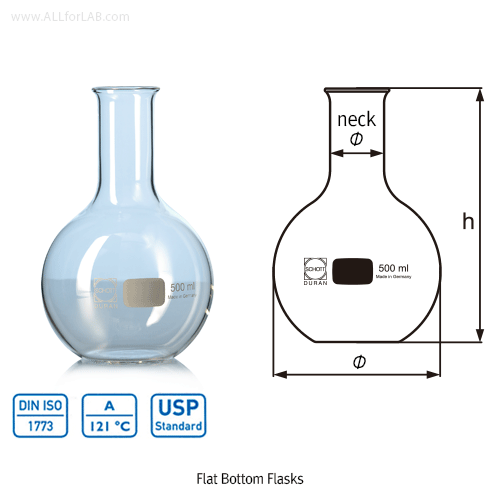
Flat-bottom flasks serve a different purpose. Their stable base can be useful for setups where the vessel must remain upright without additional support, especially during preparation, temporary holding, or gentle heating under suitable conditions. In some workflows, laboratories also pair flasks with related items such as bottle top solvent pumps when controlled liquid dispensing is part of the process.
Typical product examples in this category
This category includes practical examples across a wide capacity range. For routine bench-scale work, products such as the SciLab SL.Fla1052 Eco Erlenmeyer Flask 50/10 mL, SL.Fla1053 100/20 mL, and SL.Fla1055 250/50 mL illustrate compact flask sizes commonly used for sample handling, small-batch solution preparation, or educational demonstrations.
For larger laboratory processes, options such as the SciLab SL.Fla1057 500/100 mL, SL.Fla1058 1,000/200 mL, and higher-capacity versions including 2,000 mL, 3,000 mL, and 5,000 mL support scale-up within the same vessel style. The range also includes larger flat-bottom examples from DURAN, such as 5 L and 10 L flasks, which are relevant when higher working volumes and stable placement are priorities.
How flask geometry affects application
The shape of a flask has a direct influence on laboratory handling. A narrow neck helps reduce splashing and can limit exposure during swirling or temporary containment, while the wider body supports more efficient mixing than a straight-walled vessel of similar volume. This makes conical flasks especially practical for manual agitation and short-term process steps.
Flat-bottom flasks offer a different handling advantage by standing securely on the bench. That can simplify filling, observation, and general workflow organization. Where liquid containment overlaps with storage or transfer needs, users may also review related vessel options such as ampoules for sealed small-volume applications.
Key selection criteria for choosing a flask
Choosing the right flask starts with working volume. A flask should provide enough headspace for safe mixing, thermal expansion, or foam formation where applicable. For example, larger Erlenmeyer vessels are often preferred when shaking or swirling is part of the process, because the conical profile and spare volume improve control during movement.
Neck size is also important. Several SciLab examples in this category show different neck outer diameters depending on vessel capacity, which affects filling, pouring, stopper fit, and accessory compatibility. In addition, users should consider whether graduations are needed for approximate visual reference, or whether a more precise volumetric vessel is required elsewhere in the workflow.
Material and thermal requirements should not be overlooked. Some applications demand a vessel suitable for sterilization or repeated heating cycles, while others focus mainly on chemical resistance and day-to-day handling. If the process involves storage rather than active mixing, a laboratory bottle may be more suitable than a flask for that stage.
Representative brands in the range
This category highlights well-known laboratory glassware manufacturers including SciLab and DURAN, with additional brand context from Pyrex and WITEG. Each brand is commonly associated with laboratory vessel formats used in research, testing, and production support environments.
SciLab appears prominently in the Erlenmeyer segment shown here, covering a broad spread of capacities from 50 mL up to 5,000 mL. DURAN is represented by larger flat-bottom flask options and laboratory bottle formats, giving buyers a useful point of reference when comparing vessel style, intended use, and handling preferences across the wider labware ecosystem.
Where these flasks are commonly used
Laboratory flasks are used across many sectors: chemical labs for solution preparation, food and beverage testing for sample treatment, environmental labs for reagent handling, and pharmaceutical or biotech settings for routine bench procedures. They are also common in universities and training facilities where durable, versatile glassware is needed for repeated use.
In industrial and QC environments, flask choice often depends on whether the task involves mixing, temporary holding, heating, or observation. Some users also combine flask-based workflows with supporting consumables and handling accessories, while separate categories such as laboratory bags may be relevant for sampling, collection, or transport outside the flask itself.
Practical buying considerations for B2B users
For procurement teams, consistency across vessel sizes can simplify daily operations. Standardizing on similar flask shapes, neck dimensions, or manufacturer lines may help with training, storage, cleaning routines, and replacement planning. It can also reduce mismatch issues when accessories or handling practices are shared across multiple lab stations.
It is also useful to review whether the requirement is for approximate graduated handling, larger-volume preparation, or stable bench use. A purchasing decision should reflect the actual process step rather than selecting solely by nominal capacity. In many labs, a combination of small Erlenmeyer flasks and larger specialty vessels provides better coverage than relying on one format alone.
Finding the right flask for your workflow
A well-chosen flask supports safer handling, smoother lab routines, and more appropriate vessel use across preparation, mixing, and temporary containment tasks. This category is structured to help buyers compare common laboratory flask formats by size, shape, and intended application without overcomplicating the selection process.
If you are building or expanding a labware setup, focus on the relationship between vessel geometry, usable volume, and process conditions. That approach makes it easier to choose the right flask range for daily laboratory work, whether the priority is compact bench use, larger batch preparation, or compatibility with broader lab handling practices.
直接联系认证专家