Difference between hot air welder and normal temperature welder
A heat gun can be used for many things such as peeling off labels, drying, shrinking tubes, softening plastic, etc. It creates a strong stream of hot air but is difficult to control completely. A hot air welder is specifically designed for welding, its air flow is more concentrated and even, with enough temperature to melt the material and stick it together. Simply put, a heat gun is for “drying” and a hot air welder is for “welding”. Understanding this difference will help you choose the right tool for your job.
What are some situations where this type of machine is needed?
You will need a hot air welder when you have to weld plastic tarpaulins, reinforce waterproof membranes, repair cracked plastic parts or need to reassemble. In the workshop, it is also used to manufacture plastic parts on demand. For these jobs, if you only use a heat gun, it is almost impossible to make a strong joint.
In the construction of banners and PVC tarpaulins, models such as Danrel DR-V13 or Danrel DR-T300L-1800 are often used because they are optimized for edge joining and long-run welding.
Is the handheld powerful enough, or do I have to buy a big one?
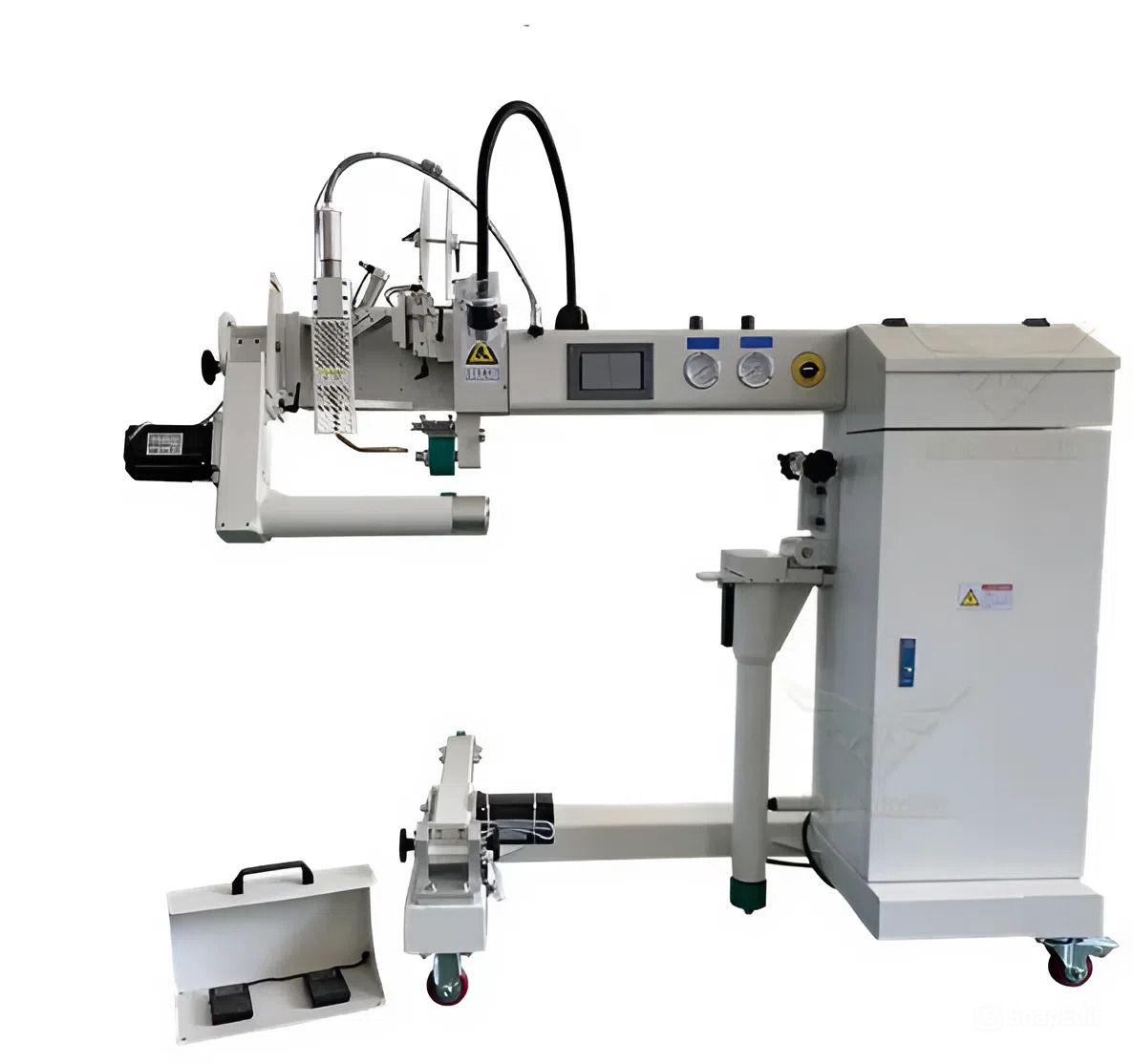
In fact, many handheld hot air welders today are powerful enough to handle common jobs. The compact type is suitable for on-site repairs, easy to move and is also reasonably priced. The large, high-power type is suitable for industrial production, where continuous work is required over a large area. You don't need to buy a large one if your needs are only for repairs or small-scale work. If you need a portable machine for small repairs, EMIN has the CHINA JIT-310 handheld tarpaulin welder; but if you do production or welding over a large area, you should check out the Danrel DR-T300L-1300
Compare old and new methods
In the past, many people often chose to glue or heat plastic with homemade tools such as gas stoves and high-capacity dryers. Although these methods can be used temporarily, they often make the joints less durable, easy to peel off or deform when exposed to high temperatures. In many cases, they have to be redone many times, wasting both time and materials.
Modern hot air welding machines completely overcome these limitations. Thanks to the control of temperature and air flow, the machine creates even, beautiful and much stronger welds than manual methods. In particular, with specialized machines in production, the weld is both fast and stable, helping to save effort and significantly reduce costs compared to the old method.
See more at: EMIN Hot Air Welding Machine Catalog
Tips for preserving your machine so it doesn't break down quickly
Hot air welding machines operate at very high temperatures, so if you are not careful, the machine's lifespan will decrease rapidly. One of the most common mistakes is to turn off the machine immediately after finishing. This habit causes the blower head and heater to be thermally shocked, easily cracked or burned. The correct way is to adjust the air flow to a cool level after welding and let the machine run for another 30-60 seconds. At this time, the air flow will gradually cool the internal components, helping the machine stabilize before stopping.
In addition, the machine's air intake is very easy to collect dust. If left for a long time, dust will block air circulation, causing the internal temperature to increase and cause damage. You just need to pay attention to cleaning it periodically, using a soft brush or compressed air to blow it clean, the machine will run cooler and last much longer.
When storing, avoid placing the machine in a humid environment, because moisture can oxidize electrical components. It is best to keep the machine in a box or sealed cabinet, which is both compact and safe. If you often have to carry it to construction sites, you should use an additional shockproof bag to limit collisions.
A hot air welder is not too difficult to maintain, just a few small habits during use are enough. Do it right from the start, you will find it durable, less prone to damage and ready to serve well whenever needed. It is also the simplest way to save costs in the long run and keep the work running smoothly.