Photovoltaic modules can look intact while internal cell defects remain difficult to see. Micro-cracks, broken grid lines, cold solder joints, and dark areas may not be apparent during a visual check. For incoming quality control, an EL detector for PV module incoming inspection helps teams examine the internal luminescence pattern of an energized module and identify concerns before the material enters production or is accepted for a project.
Choosing equipment for this task should not be based on a single specification alone. The most appropriate EL detector depends on the level of image detail required, the type of incoming materials being inspected, the expected inspection volume, and the way results need to be reviewed and recorded. A structured evaluation helps quality teams balance strict screening requirements with practical daily operation.
Why EL inspection matters for incoming modules
Incoming inspection is an early quality gate for purchased cells, outsourced semi-finished products, and finished photovoltaic modules. Its purpose is to identify pre-existing defects as well as damage that may have occurred during transport. Finding questionable modules at this stage can prevent them from moving further into the production process.
An electroluminescence defect detector captures near-infrared luminescence images from an energized module using a sensitive camera. These images can make internal irregularities visible for assessment. This is particularly relevant when the exterior condition of a module does not reveal its internal cell condition.
Quality teams should define in advance which defect patterns require further review, rejection, return, or another internal disposition. The detector provides inspection evidence, while the final decision should follow the organization’s own documented quality criteria.
Prioritize useful imaging detail
Imaging capability is central to EL-based incoming inspection. Resolution should be considered beyond a headline pixel count. A useful measure is the physical module area represented by each pixel. A smaller represented area can support more detailed observation, provided that the optical system and image quality are also suitable.
Camera sensitivity also matters because EL imaging involves weak optical signals. The source material notes that cooled CCD cameras are commonly used in high-end EL detectors to reduce dark-current noise and support capture of weak signals. This can be relevant where the inspection process needs to assess subtle indications such as micro-cracks, early PID-related effects, or broken grid lines.
When comparing systems, ask for sample images from module types relevant to your operation. Review whether the image makes suspected areas clear enough for consistent operator judgement. Image quality should be evaluated together with illumination conditions, the module format being tested, and the team’s acceptance process.
Match the equipment to the inspection workflow
EL equipment configurations vary by application. Incoming quality control generally differs from in-process production monitoring and final factory inspection. In-process detection may require automated loading and unloading, stable high-speed operation, and the ability to connect with MES systems. Final inspection may also emphasize reporting, traceability, and archiving.
For incoming inspection, a semi-automatic, high-precision arrangement can be a practical option. Manual loading and unloading can help operators handle different incoming batches and module sizes with flexibility. This approach places emphasis on detailed inspection rather than continuous line speed.
Before selecting a system, map the actual workflow: what materials arrive, how often batches are received, which module sizes must be accommodated, and who will review the images. This avoids buying a configuration designed for a different task than the one the incoming inspection team needs to perform.
Balance strict screening with inspection efficiency
Incoming inspection needs clear and consistent judgement, but throughput also affects warehouse turnover and production scheduling. During larger deliveries, slow image capture, manual file handling, or delayed report preparation can create operational bottlenecks.
Assess the complete inspection cycle rather than only the image acquisition step. This includes module setup, capture, image review, any image stitching, exporting results, and report generation. Features that streamline documentation may help teams maintain a repeatable process without weakening the required level of review.
The source material describes portable EL detectors that can inspect a single module in no more than 30 seconds under their stated conditions. Actual productivity will depend on the inspection procedure, staffing, module handling, and the time needed to assess image results. For this reason, it is useful to validate throughput against representative incoming batches rather than relying on an isolated speed figure.
Consider operating conditions and solution scope
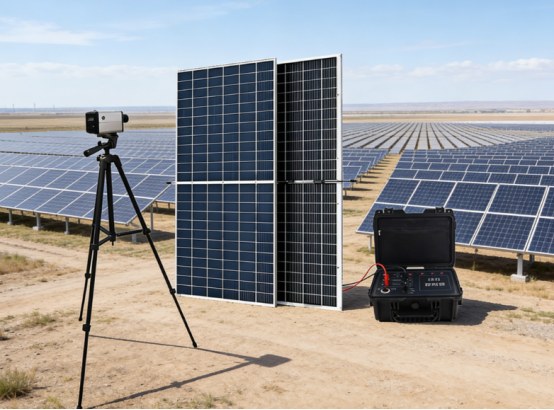
Operating environment can influence the right choice. Some inspection activities take place in laboratories, while others occur at power-station delivery sites or during post-installation acceptance. Equipment intended for these settings may need portability and a workflow that can accommodate field conditions.
The source material describes CHNSpec portable photovoltaic EL/PL testing equipment with nighttime EL, daytime EL, and daytime PL modes. It also states that the equipment is intended to operate in conditions including direct sunlight and rain, and that it supports AI-based defect classification. These capabilities should be assessed against the specific inspection environment and internal validation requirements.
Long-term selection should also consider how images will be stored, reviewed, and used in supplier or internal quality discussions. Reliable operating procedures, trained reviewers, and consistent records are as important as the detector itself.
EL detector selection checklist
- Define the incoming materials and module sizes to be inspected.
- Set internal criteria for defect review and disposition.
- Evaluate image detail using representative samples.
- Choose a workflow suited to sampling inspection rather than assuming one configuration fits every task.
- Review the end-to-end cycle time, including reporting and image management.
- Confirm that the equipment fits the intended laboratory, warehouse, or field environment.
- Plan training and documentation so inspection decisions remain consistent.
Conclusion
Selecting an EL detector for PV module incoming inspection means aligning imaging detail, workflow fit, efficiency, and operating conditions. A high-precision, semi-automatic approach can suit teams that need flexible handling and careful review of incoming modules. By defining inspection criteria and validating performance against real materials and workflows, organizations can build a more dependable first quality gate for photovoltaic modules.