
Grid Simulator
When power conversion equipment, EV components, inverters, or grid-connected devices need to be validated under realistic line conditions, the quality of the source becomes just as important as the device under test. A Grid Simulator helps engineers reproduce controlled AC conditions, apply disturbances, and evaluate how a product behaves under normal operation as well as demanding utility scenarios.
In lab environments, this type of equipment is commonly used for R&D, verification, compliance preparation, and production-level testing. Compared with a standard programmable source, a grid simulator is typically selected when the application requires tighter control of voltage, frequency, phase behavior, regenerative capability, or advanced test functions such as ride-through evaluation and harmonic synthesis.
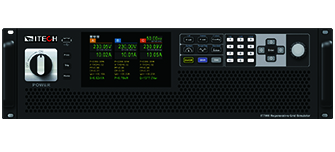
What a grid simulator is used for
A grid simulator is designed to emulate the electrical behavior of a utility grid in a predictable and repeatable way. This allows test teams to supply single-phase or three-phase power to a device under test while adjusting voltage, frequency, phase relationships, and in some cases abnormal conditions that would be difficult or unsafe to reproduce directly from a facility power line.
Typical use cases include testing solar inverters, bidirectional converters, motor drives, battery systems, on-board chargers, industrial power electronics, and products that must interact with changing grid conditions. For users who only need a programmable AC source for general-purpose output, a broader AC power supply range may also be relevant, but grid simulators are better suited when grid emulation and dynamic testing are part of the requirement.
Why regenerative operation matters
Many modern test setups involve equipment that can return energy back to the source, especially when testing bidirectional systems. A key advantage of many systems in this category is regenerative operation, which allows returned power to be fed back to the utility instead of being dissipated as heat. This can improve energy efficiency and reduce the cooling burden in high-power laboratories.
Examples in this category include the NI NHR 9410-12 Regenerative Grid Simulator, the CHROMA 61815 Regenerative Grid Simulator, and multiple high-capacity Preen PAS-F and PFV series models. Depending on the test scope, this can be especially useful for battery-related development, where a test bench may also integrate a high power DC supply alongside the AC grid simulation source.
Key selection criteria for engineers and test labs
Choosing the right platform starts with the electrical profile of the device under test. The first questions are usually output phase configuration, voltage range, current capability, and total power. In this category, available systems span compact bench-oriented or rack-compatible solutions through to large industrial platforms reaching hundreds of kVA and up to 1000kVA in the listed Preen range.
The next consideration is waveform quality and dynamic performance. Engineers often review distortion, regulation, response time, and measurement capability because these factors influence how accurately the source can reproduce real-world conditions. Where the test plan includes utility disturbances, harmonic injection, or phase-specific behavior, features such as independent three-phase adjustment, programmable phase angle, and harmonic synthesis become more important than headline power alone.
Examples across low, medium, and high power applications
For flexible lab testing at lower power, the NI NHR 9410-12 offers a regenerative platform with selectable phase configuration, AC and DC output capability, integrated measurements, waveform capture, and LAN-based control. That makes it relevant for automated test systems where software integration and measurement visibility are important.
The CHROMA 61815 provides a 15kVA regenerative solution with selectable 1-phase or 3-phase operation, programmable frequency, and harmonic synthesis up to higher harmonic orders. This type of configuration is suitable when teams need controlled AC output for inverter, converter, or compliance-oriented pre-test work in a more compact power class.
At the high-power end, Preen offers multiple regenerative models such as the PAS-F-33300, PAS-F-33400, PAS-F-33600, PAS-F-33800, and PAS-F-331000, covering applications from 300kVA to 1000kVA. These systems are aligned with demanding grid-interactive testing where large current, three-phase output, and functions such as LVRT and HVRT may be required.
Important functions beyond basic voltage output
A grid simulator is often selected not just for supplying power, but for how well it supports structured test procedures. In practical terms, users may need to verify response under under-voltage, over-voltage, frequency variation, phase changes, or ride-through events. For that reason, built-in measurement, remote communication, event programming, and waveform handling can significantly reduce external instrumentation requirements.
Some models listed here also support both AC and DC operating modes or include richer measurement and acquisition functions. That can simplify hybrid power test benches, especially where the DUT interacts with both grid-side AC and DC bus conditions. In adjacent setups, engineers may also compare supporting equipment such as a high voltage DC power supply when the application extends into HV battery or DC link simulation.
How to match the simulator to the application
For inverter and converter validation, start by checking whether the DUT requires single-phase or three-phase input, the nominal and maximum line voltage, and the peak current demanded during startup or transient operation. If the product may source power back to the test system, regenerative capability is usually preferable. For utility interaction studies, confirm whether ride-through behavior, phase angle control, and harmonic programming are required by the test standard or internal validation plan.
For automated labs, communication interfaces and software support can be just as important as electrical performance. Systems with Ethernet or common remote-control protocols are easier to integrate into production or validation environments. It is also worth considering whether the source needs built-in measurement, since that can reduce the number of separate power analyzers or acquisition channels required in the rack.
Manufacturer coverage in this category
This category highlights solutions from CHROMA, NI, and Preen, covering a useful spread from compact regenerative platforms to large-format industrial systems. Each brand addresses different testing scales, from engineering workstations and automated validation benches to large energy and power conversion labs.
Rather than focusing only on brand preference, it is usually more effective to compare the available models against the test envelope: power level, output configuration, grid disturbance functions, measurement depth, and integration needs. That approach helps narrow the selection to equipment that supports both current projects and future expansion of the test program.
Conclusion
Grid simulators are a practical choice when a test environment must reproduce controlled, repeatable, and application-specific grid conditions. Whether the requirement is a compact regenerative source for development work or a high-capacity three-phase platform for advanced power conversion testing, the right system depends on the interaction between power level, waveform control, regenerative behavior, and automation needs.
Review the available models in this category with your DUT profile and test objectives in mind. A well-matched simulator can improve test repeatability, reduce wasted energy, and create a more capable validation platform for modern grid-connected products.
Get exclusive volume discounts, bulk pricing updates, and new product alerts delivered directly to your inbox.
By subscribing, you agree to our Terms of Service and Privacy Policy.
Direct access to our certified experts


