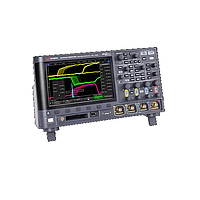
Oscilloscopes
When signal integrity, timing behavior, and waveform shape matter, an oscilloscope becomes one of the most practical instruments on the bench or in the field. From electronics design and maintenance to industrial troubleshooting and power analysis, Oscilloscopes help engineers and technicians see voltage over time and make faster decisions based on real signal behavior rather than assumptions.
This category brings together instruments and related accessories used for waveform observation, circuit debugging, and electrical diagnostics. Whether the application involves embedded electronics, industrial control panels, communication signals, or current measurement, the right oscilloscope setup depends on more than bandwidth alone. Probe selection, channel count, sampling performance, portability, and accessory compatibility all influence measurement quality.
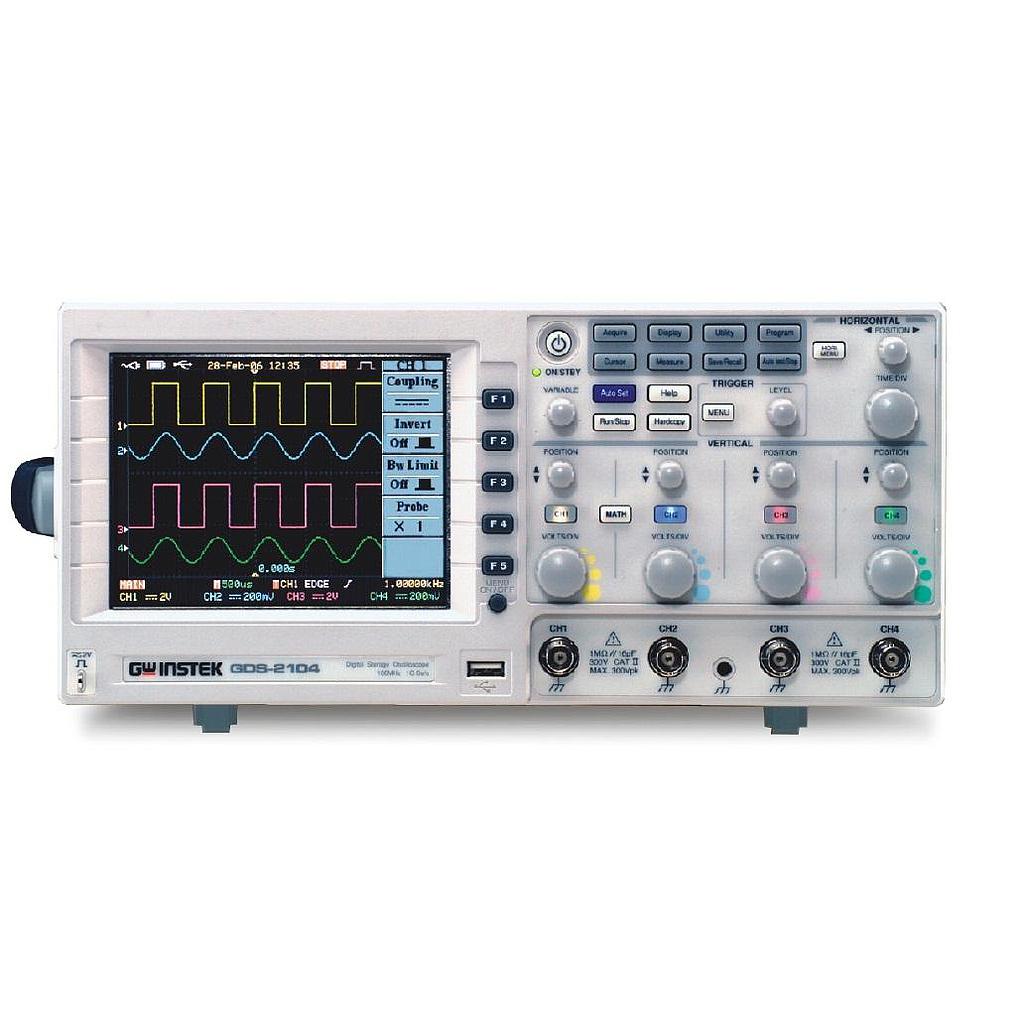
Why oscilloscopes remain essential in electronic measurement
An oscilloscope is used to visualize changing electrical signals, making it easier to identify noise, distortion, overshoot, intermittent faults, switching events, and timing relationships between channels. In practical B2B environments, this matters in R&D labs, production test stations, maintenance workshops, and field service tasks where hidden signal issues may not appear on simpler instruments.
Compared with a multimeter, an oscilloscope adds time-domain visibility. That extra view is critical when checking pulse trains, startup transients, clock lines, PWM outputs, communication buses, or current waveforms. In many workflows, both tools are complementary rather than interchangeable.
Bench, handheld, and application-driven selection logic
Choosing an oscilloscope usually starts with the measurement environment. A bench instrument is often preferred for lab use, validation work, and repeated test procedures, while portable or battery-powered models are useful when measurements must be taken on machinery, power systems, or installed equipment.
A field-oriented example in this category is the FLUKE FLUKE-125B/INT Oscilloscope, a handheld model suited to mobile diagnostics where portability and current measurement support can be useful. For bench analysis, instruments such as the KEYSIGHT DSOX2022A, DSOX2024A, and DSOX2014A illustrate common digital oscilloscope choices across 2-channel and 4-channel configurations, with bandwidth options that fit many general-purpose electronics tasks.
For buyers comparing brands and ecosystems, it can also be helpful to browse manufacturer-specific ranges from KEYSIGHT or TEKTRONIX, especially when accessory compatibility and long-term platform continuity are important.
Core specifications that affect real measurement results
One of the most common selection mistakes is focusing only on headline bandwidth. In practice, bandwidth, sample rate, memory depth, and channel count work together. Bandwidth influences how accurately fast signal edges are displayed. Sample rate affects how much waveform detail is captured. Memory depth becomes important when you need to record longer events without losing resolution, and channel count determines how many signals can be observed simultaneously.
For example, a 2-channel scope may be sufficient for straightforward analog troubleshooting, while a 4-channel model can simplify correlation between control signals, clock references, power rails, and communication lines. Instruments such as the KEYSIGHT DSOX2024A and DSOX2014A are good illustrations of how channel count can shape workflow efficiency, not just technical capability.
In mixed-signal work, digital channels can also be valuable. The TEKTRONIX SUP2-MSO module adds MSO functionality with 16 digital channels, showing how some platforms can expand from analog waveform viewing into mixed-signal debugging for embedded and digital systems.
The importance of probes and accessories
An oscilloscope is only as effective as the signal connection between the test point and the input. Probes and accessories directly influence loading, bandwidth, safety, and measurement confidence. Passive probes are often used for general voltage measurements, while differential probes, current probes, and specialized cables are needed when dealing with higher frequencies, floating measurements, or current analysis.
Several products in this category highlight that broader measurement ecosystem. The KEYSIGHT N2894A Passive Probe and the Rohde & Schwarz RT-ZP03 Passive voltage probe are examples of voltage probing options for routine signal observation. For high-speed work, the KEYSIGHT 1130B InfiniiMax Probe shows how advanced probing supports higher-bandwidth analysis. When current must be observed as a waveform, the KEYSIGHT 1146B Current Probe provides another layer of diagnostic capability.
Accessories that may appear secondary are often critical in real setups. The FLUKE TRM50 50 ohm feed-through terminator helps with proper signal termination, while the FLUKE BP291 battery supports runtime for compatible portable instruments. Even a cable such as the KEYSIGHT 16494A-001 Low Leakage Triaxial Cable can play a specific role in maintaining measurement quality in suitable test configurations.
Typical applications across industry and engineering teams
Oscilloscopes are used in a wide range of technical environments. In electronics development, they help verify clock stability, switching behavior, sensor outputs, and communication timing. In manufacturing and production test, they support pass/fail checks, waveform comparison, and fault isolation. In maintenance and field service, they help diagnose unstable power, intermittent control signals, or unexpected current behavior.
They are also relevant in workflows that extend into semiconductor characterization and more advanced electronic test environments. Teams working on device behavior or precision sourcing may also review related solutions such as SMU semiconductor test equipment when their measurement needs go beyond waveform capture alone.
How to choose the right oscilloscope setup for your task
A practical starting point is to define the signal type and the measurement goal. If the main task is viewing low-to-mid frequency control signals, a general-purpose digital scope may be enough. If the job involves power electronics, mobile service, or industrial troubleshooting, a handheld instrument and the right current or voltage accessories may be more appropriate. If multiple digital and analog lines must be captured together, mixed-signal capability becomes more relevant.
It is also worth thinking in terms of the full measurement chain. Scope, probe, termination, cable, and power accessories should be considered together rather than purchased separately without a test plan. This helps reduce mismatch issues and improves repeatability, especially in shared lab environments or standardized maintenance procedures.
Brand ecosystems and long-term compatibility
Many buyers evaluate oscilloscopes not only by the base instrument, but by the surrounding ecosystem of probes, modules, and support accessories. Well-established manufacturers such as FLUKE, KEYSIGHT, Rohde & Schwarz, and TEKTRONIX are often considered when consistency, accessory availability, and platform familiarity matter across teams.
This becomes especially important in B2B purchasing, where equipment may need to fit into existing benches, training practices, or calibration workflows. A consistent platform can simplify user onboarding, accessory reuse, and future expansion as measurement requirements evolve.
Find an oscilloscope category that fits your measurement workflow
The best choice depends on where the instrument will be used, what signals need to be captured, and which accessories are required to obtain reliable results. In this category, you can explore oscilloscopes for bench and field use as well as key supporting items such as passive probes, current probes, terminators, batteries, and expansion modules.
If your application involves debugging electronic circuits, validating signal quality, or troubleshooting electrical behavior in real time, an appropriate oscilloscope setup can significantly improve visibility and reduce diagnosis time. Reviewing the available instruments together with compatible accessories is often the most efficient way to build a measurement solution that matches your technical and operational needs.
Get exclusive volume discounts, bulk pricing updates, and new product alerts delivered directly to your inbox.
By subscribing, you agree to our Terms of Service and Privacy Policy.
Direct access to our certified experts