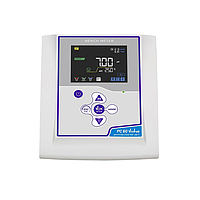
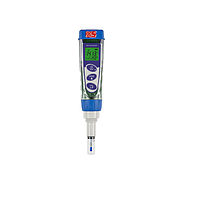
Multi-function environment meter
When water quality decisions depend on more than a single reading, a multi-parameter instrument becomes far more practical than using separate meters for each test. In laboratory work, field sampling, aquaculture, wastewater monitoring, and process control, users often need to check pH, conductivity, salinity, dissolved oxygen, temperature, or related values as part of the same workflow.
Multi-function environment meters are designed for that need. Instead of treating each parameter in isolation, this category brings together benchtop and handheld instruments that support broader liquid analysis, helping teams improve consistency, reduce setup time, and simplify data collection.
Why multi-function meters are widely used in liquid testing
In many water testing environments, measurement tasks are interconnected. A pH result may need temperature compensation, conductivity may be used to estimate TDS or salinity, and dissolved oxygen readings often matter alongside temperature and pressure. Using one platform for several parameters can make routine testing more efficient and reduce the risk of switching between separate instruments.
This is especially useful where operators need traceable, repeatable readings across different sample points. Whether the goal is bench analysis in a lab or spot checks in the field, a multi-parameter water meter supports a more streamlined approach to environmental and liquid testing.
Common measurement functions found in this category
The scope of this category includes instruments built for combinations such as pH/ORP, conductivity/resistivity/TDS/salinity, and dissolved oxygen with temperature. Some models focus on core electrochemical measurements, while others expand into broader water quality monitoring with pressure or ion-related functions depending on the instrument configuration.
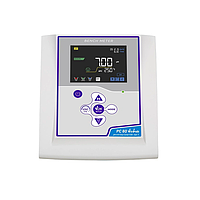
For example, the HORIBA EC2000-S Benchtop Conductivity Meter is suited to conductivity-centered work that also involves resistivity, TDS, salinity, and temperature. The HORIBA PH2000-S Benchtop pH/ORP Meter targets pH and ORP workflows with high resolution and calibration flexibility, while the HORIBA PC2000-S combines pH, ORP, ion, conductivity, resistivity, TDS, salinity, and temperature in one benchtop platform.
For broader field measurement, the HANNA HI98194/10 supports pH, ORP, EC, DO, pressure, and temperature in a waterproof format. This kind of instrument is useful when users need to move between tanks, basins, ponds, or sampling points without carrying multiple devices.
Benchtop and handheld options for different workflows
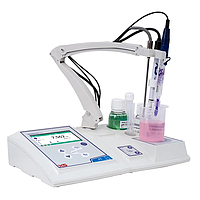
Benchtop meters are typically chosen for controlled indoor testing where stable setup, detailed calibration, and data handling matter most. They are well suited for quality control labs, research spaces, and facilities that perform repeated measurements on incoming water, treated water, or product-related samples. Models such as the HORIBA PH2000-S, HORIBA EC2000-S, and HANNA HI6522-02 fit this type of environment.
Handheld meters are better aligned with mobility, quick checks, and on-site troubleshooting. Examples include the HORIBA DO220-K05 Waterproof DO/Temp Handheld Meter Kit and HORIBA pH210M Handheld pH/ORP Meter. Portable instruments are often preferred for environmental surveys, maintenance rounds, aquaculture, and any application where readings must be taken close to the process rather than bringing samples back to a bench.
There are also application-specific solutions between these two extremes. The HANNA HI981520-02 Continuous pH, Salinity, and Temperature Measuring Device for Water is oriented toward ongoing monitoring, while saltwater-focused models such as the HANNA HI97115C Multi-Parameter Saltwater Meter address testing needs specific to marine and reef environments.
How to choose the right multi-function environment meter
The most practical starting point is the list of parameters you actually need to measure together. If your work mainly revolves around conductivity, salinity, and TDS, a conductivity-focused benchtop meter may be more suitable than a broader instrument with unused functions. If field teams need dissolved oxygen, pH, and EC in one visit, a waterproof portable multiparameter unit is usually the better fit.
It is also important to consider the measurement environment. Lab users may prioritize display size, calibration options, data memory, and communication features. Field users often care more about enclosure protection, battery life, cable length, and ease of handling. For applications that rely on ion-selective measurement, compatible sensors and related accessories can matter just as much as the meter body itself; in those cases, it may also help to review options in ion measurement electrodes.
Another useful checkpoint is maintenance and verification. Some workflows depend on frequent calibration standards, cleaning solutions, or reagent-based checks. If your testing process includes routine verification steps, browsing related consumables such as water testing reagents can help complete the setup.
Representative brands and instrument examples
This category includes recognized names in water analysis and environmental measurement, with strong representation from HORIBA and HANNA. Both brands appear here with instruments covering benchtop analysis, handheld testing, continuous monitoring, and specialized saltwater applications.
On the benchtop side, HORIBA models such as the EC2000-S, PH2000-S, and PC2000-S show the range from dedicated electrochemistry to broader multi-parameter capability. HANNA expands the category with instruments like the HI6522-02 for pH/ORP/ISE and EC/TDS work, and the HI98194/10 for portable multi-parameter water quality measurement.
Specialized products in this category also show that “multi-function” does not always mean the same thing. Some instruments combine several electrochemical parameters in one meter, while others bring together multiple test methods for a defined application, such as the HANNA HI97115C for saltwater analysis or the HI981520-02 for continuous pH, salinity, and temperature monitoring.
Typical applications across industry and environmental monitoring
Multi-function environment meters are relevant anywhere liquid quality must be checked quickly and with enough context to support decisions. Common use cases include wastewater treatment, aquaculture, environmental sampling, laboratory analysis, boiler and cooling water checks, general industrial water management, and marine or saltwater testing.
In practice, the value of these instruments comes from combining readings that influence one another. Conductivity and salinity may help indicate dissolved content, pH and ORP can support chemical treatment evaluation, and dissolved oxygen is often essential when assessing biological conditions or aeration performance. A single instrument that captures these values can improve both troubleshooting speed and reporting consistency.
Data handling, calibration, and long-term usability
Many users selecting from this category are not only comparing measurement ranges, but also looking at how the instrument fits daily operation. Features such as internal memory, automatic logging, time stamps, PC connectivity, and calibration prompts can make a significant difference in regulated or documentation-heavy environments.
Electrode condition, calibration routines, and sensor replacement should also be part of the selection process. A capable meter still depends on suitable probes, standards, and maintenance practices. For quick screening tasks or simple cross-checks in some workflows, supplemental tools like test paper may also be useful, though they serve a different purpose than precision electronic measurement.
Finding the right fit for your testing process
This category is best approached by matching the instrument to the real testing sequence rather than chasing the highest number of functions. A compact handheld meter may be ideal for routine field verification, while a benchtop system with broader calibration and data options may be more appropriate for a lab or quality department.
From conductivity-focused systems to portable water quality platforms and saltwater-specific analyzers, these products support a wide range of liquid testing needs. Reviewing the parameters, operating conditions, and accessory requirements together will usually lead to a more reliable choice than comparing specifications in isolation.
If your application involves regular monitoring of multiple water quality indicators, a well-matched multi-function environment meter can simplify measurement workflows and improve confidence in the results you collect.
Get exclusive volume discounts, bulk pricing updates, and new product alerts delivered directly to your inbox.
By subscribing, you agree to our Terms of Service and Privacy Policy.
Direct access to our certified experts