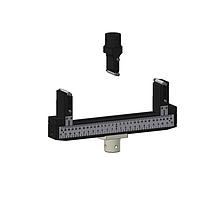
Grip and accessories for Tension Tests
Reliable tensile testing depends on more than the test stand or force gauge alone. The way a sample is held has a direct impact on repeatability, specimen protection, break location, and the overall quality of the result. In many applications, choosing the right grip and accessories for tension tests is what turns a basic setup into a practical testing system for production, laboratory, or incoming inspection work.
This category focuses on gripping solutions used to secure wires, belts, threads, small materials, and other samples during pull, fracture, and tensile testing. Whether the requirement is low-force material handling or higher-load clamping for more demanding tests, the right jaw style, opening width, and load capacity help reduce slippage and improve test consistency.
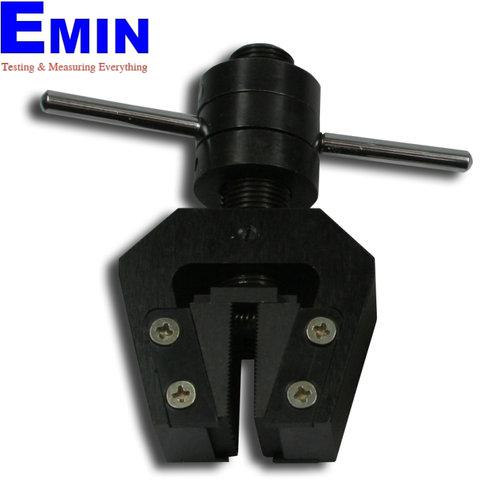
Why grips matter in tensile testing
In a tension test, the gripping point is often the first source of error. If the specimen is clamped too loosely, it may slip before the true tensile load is reached. If it is clamped too aggressively, the sample can be damaged at the jaws, leading to premature failure and misleading results.
That is why specimen handling and grip geometry should match the material being tested. Thin cords, belts, threads, films, and narrow strips all behave differently under load. A suitable accessory helps distribute force more evenly, keeps alignment stable, and supports more repeatable measurement across multiple test cycles.
Common grip types in this category
This category includes several grip styles designed for different specimen shapes and force ranges. Small standard clamps are useful for general-purpose tensile testing on compact samples, while wedge and screw-in designs are better suited where secure retention is critical and movement must be minimized during loading.
Specialized options are also important in real-world testing. Belt clamps are better aligned with flat, flexible materials, while rope and thread grips help hold slender samples without creating unnecessary stress concentration. For fracture or pull testing, long clamps, fine-point versions, or wide quick-release models can make setup faster and more controlled depending on the sample geometry.
Examples of suitable accessories and grip configurations
Several products in this range show how grip selection changes with the specimen type. For small samples and routine work up to 500 N, the KERN AE 01 Standard Small Clamp provides a compact solution with a moderate opening range. Where the application involves belts or similar flat materials, KERN AE 03 and KERN AE 04 belt tension clamps are more appropriate because their clamping style better matches flexible strip-like samples.
For string-like test pieces, the KERN AE 05 rope and thread tension clamp is a more application-specific choice. If a stronger mechanical hold is needed for narrow specimens, KERN AE 02 and KERN AE 06 screw-in tension clamps or the KERN AE 07 wedge tension clamp offer alternative approaches for improved retention in tensile tests up to 500 N.
At higher or different testing requirements, the range also includes models such as the KERN AC 18 2 jaw grip for tension tests up to 5 kN, the KERN AC 16 heavy duty clamp for tension and fracture tests up to 5 kN, and the KERN AC 22 wide clamp with quick-release mechanism for faster specimen handling. These examples illustrate that accessories are not interchangeable by name alone; they should be matched to load range, sample shape, and the type of test being performed.
How to choose the right grip for your application
A practical selection process usually starts with the specimen itself. Consider whether the material is flat, round, soft, brittle, elastic, braided, or threaded. Then review the expected test force, the required jaw opening, and the mounting interface. In the products listed here, some low-force grip options use M6 threading, which is an important mechanical compatibility point when integrating with a test fixture.
It is also useful to think about failure mode. If the goal is to measure tensile strength, the sample should ideally fail in the gauge section rather than at the grip. For quality control environments, quick specimen exchange may matter just as much as holding force. In those cases, wider or quick-release clamp styles can help improve throughput without ignoring test stability.
When the complete force measurement chain is being built, the grip should be considered together with the sensor and display path. Depending on the setup, related devices such as load cell transmitters or weighing indicators may also be part of the system architecture.
Manufacturers commonly used for tensile test setups
This category is closely associated with brands active in force measurement and materials testing. KERN is especially visible in the current product selection, with multiple clamp and grip options covering small tensile tests, fracture testing, and higher-capacity gripping tasks. The available models show a broad approach, from application-specific jaws to more general-purpose accessories.
Other relevant manufacturers in the wider ecosystem include IMADA, Cometech, KMT, and SAUTER. Brand choice is often influenced by fixture compatibility, preferred test method, and the existing test bench or gauge already in use. In B2B purchasing, this matters because accessory standardization can simplify maintenance, operator training, and replacement planning over time.
Typical use cases in industry and laboratory work
Grips for tension tests are used across many routine and development tasks. Typical examples include checking the pull strength of cords, testing the retention of bonded or fastened components, evaluating thin belts and flexible strips, and performing fracture or break tests on small parts and materials. In these cases, the fixture is not just a holder; it directly affects how force is introduced into the sample.
Laboratories may prioritize repeatability and controlled failure behavior, while production environments often focus on speed and operator convenience. A long clamp or fine-point clamp may suit a delicate sample that needs precise contact, whereas a heavy-duty jaw grip is more suitable where higher force and robust handling are expected. The best choice depends on the actual test objective rather than on force capacity alone.
Building a more complete force measurement setup
Grip accessories are one part of a broader testing workflow. Depending on the application, users may also work with force gauges, test stands, indicators, and signal conditioning equipment. For projects that involve material deformation analysis or structural evaluation, related categories such as strain gauges can provide additional context for measurement and validation work.
Looking at the full setup helps avoid compatibility issues later. Mounting thread, allowable load, specimen size, and the expected test method should all be reviewed together. This approach supports more stable testing, better data quality, and a more efficient procurement process for technical buyers.
Final considerations
The right gripping accessory helps transform a tensile test from a simple pull action into a controlled and repeatable measurement process. By selecting jaw style, opening range, and load capacity according to the specimen and test objective, users can reduce slippage, limit sample damage, and improve confidence in the results.
For buyers comparing options in this category, it makes sense to start with the sample type, required force range, and fixture compatibility, then narrow the choice to the grip design that best supports the application. That selection logic is often more important than choosing by model name alone, especially in technical B2B environments where consistency and usability both matter.
Get exclusive volume discounts, bulk pricing updates, and new product alerts delivered directly to your inbox.
By subscribing, you agree to our Terms of Service and Privacy Policy.
Direct access to our certified experts