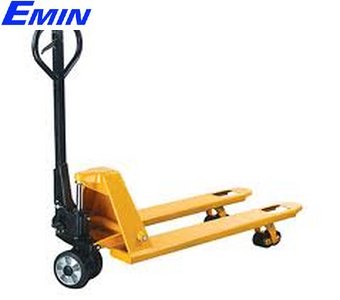
Hand pallet truck
Moving palletized goods safely across warehouses, workshops, and shipping areas often depends on one simple piece of equipment: the hand pallet truck. For many B2B operations, it remains a practical choice for short-distance material handling where reliability, maneuverability, and low maintenance matter more than complex powered systems.
On this page, buyers can explore hand pallet truck solutions within a broader lifting and transport equipment range. This category is relevant for logistics teams, factories, retail backrooms, and maintenance departments that need efficient pallet movement without investing in larger powered vehicles.
Where hand pallet trucks fit in daily material handling
A hand pallet truck is typically used to lift a pallet slightly off the floor and move it over smooth surfaces. In practice, it is one of the most common tools for loading areas, production lines, storage zones, and order preparation spaces where standard pallets need to be repositioned quickly and safely.
This category also makes sense for businesses comparing manual transport options with adjacent equipment. For example, when goods are not stored on pallets or need to be moved as loose boxes, carts, or parts trays, a hand pallet truck may be complemented by platform-style handling tools rather than replaced entirely.
Typical applications across industrial and commercial environments
In warehouses, hand pallet trucks help transfer incoming pallets from unloading points to staging areas. In manufacturing, they are commonly used to bring raw materials closer to assembly stations or to move finished goods to packing and dispatch zones. Retail and wholesale facilities also use them to handle palletized stock in backroom operations.
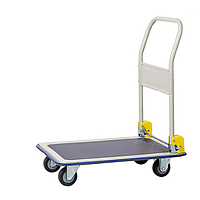
For lighter, non-palletized loads, some users may also consider transport carts from brands such as SUMO or compact manual platforms from Fujihome. Examples in the broader handling ecosystem include the Fujihome SH150 Trolley for compact, foldable transport tasks and multi-tier models such as the SUMO HB-220S or HB-230S for organized movement of tools, components, or cartons.
What to consider when choosing a hand pallet truck
The right model depends on the pallet type, load weight, aisle width, and floor condition in your facility. Buyers usually begin with load capacity, but this should be evaluated together with fork dimensions, turning radius, wheel material, and the frequency of daily use. A truck that is suitable for occasional stock movement may not be ideal for continuous warehouse circulation.
Floor quality is another important factor. Smooth indoor concrete allows easier rolling and lower operator effort, while uneven surfaces increase resistance and affect maneuverability. If your operation includes mixed transport tasks, it can be helpful to review nearby categories such as hydraulic pumps or hydraulic cylinders when planning a broader lifting and maintenance setup.
Understanding the wider manual transport equipment ecosystem
Although this category centers on hand pallet trucks, many businesses evaluate them alongside platform trolleys and warehouse carts because the handling method depends on the load format. Pallet trucks are suited to palletized goods, while flatbed or shelf trolleys are often used for bins, cartons, spare parts, maintenance tools, and mixed cargo.
The product examples available in the current range illustrate this distinction clearly. The Fujihome SH150 Trolley is designed for light-duty transport with a foldable form factor and 100 kg load capacity, making it useful where storage space is limited. In contrast, SUMO trolley lines cover heavier manual transport needs, from the HL-113 range for lighter warehouse duties up to models such as the HG-512 and HG-513 that support substantially higher loads on larger wheel sizes.
Examples of transport configurations seen in this category context
Different trolley structures help show how manual handling equipment is selected by task. Two-tier units such as the SUMO HB-220S and HB-220D are suitable when operators need quick access to items on two levels, while three-tier versions like the HB-230S and HB-230D are more appropriate when vertical organization is more important than open loading space.
There are also models with protective side or back structures, such as the SUMO HB-220M, HB-213, HG-313, and HG-513, which can help retain goods during movement. For larger platform loads, the SUMO HG-312 and HG-512 represent higher-capacity options with broader deck dimensions and larger wheels, supporting transport of bulkier items in industrial environments.
Key buying priorities for B2B users
For procurement teams and technical buyers, the most useful evaluation criteria usually include durability, ease of maneuvering, service simplicity, and compatibility with existing workflows. In facilities that run multiple shifts, wheel design and frame strength directly influence long-term operating cost because they affect user effort, wear, and downtime.
It is also worth considering whether your team needs a dedicated pallet solution or a mix of handling tools. A hand pallet truck works best when pallets are standardized and travel paths are predictable. If the workflow includes lifting, pushing, staging, and maintenance tasks across several stations, combining pallet trucks with other manual transport equipment can improve efficiency without adding unnecessary complexity.
How to evaluate category options more effectively
Instead of choosing only by headline capacity, it is better to match equipment to the real movement pattern inside your site. Consider how often goods are moved, the average trip distance, whether operators work in narrow aisles, and whether loads are palletized, boxed, or irregular. This approach helps prevent under-specifying or over-specifying the equipment.
Brand preference may also play a role for businesses standardizing procurement across sites. In this broader category landscape, manufacturers such as STANLEY, DANDY, STAXX, ADVINDEQ, Fujihome, KOCU, NIKI, and SUMO can be relevant depending on handling style, operating environment, and the type of goods being transported.
Choosing the right solution for your operation
A well-matched hand pallet truck supports safer pallet handling, smoother internal logistics, and better use of labor in daily operations. The right choice depends less on a single specification and more on how the equipment fits your pallet type, load profile, floor conditions, and workflow intensity.
If your business handles both palletized and non-palletized goods, reviewing this category together with related manual transport equipment can make the selection process more practical. That way, you can build a handling setup that supports real operational needs rather than buying around a specification alone.
Get exclusive volume discounts, bulk pricing updates, and new product alerts delivered directly to your inbox.
By subscribing, you agree to our Terms of Service and Privacy Policy.
Direct access to our certified experts