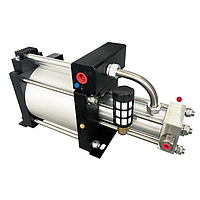
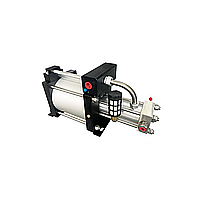
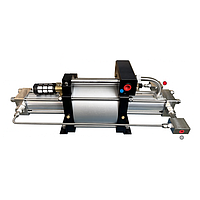
Gas booster pump
Where standard line pressure is not enough, a gas intensifier becomes a practical part of the system rather than an optional accessory. In test benches, gas charging stations, leak testing setups, and other high-pressure processes, the right gas booster pump helps raise inlet gas pressure to the required level in a controlled way while fitting into a broader pneumatic and fluid handling environment.
This category brings together air-driven gas booster pumps designed for applications that need higher outlet pressure from an available gas source. The range shown here includes compact and high-pressure models from Senwell, covering different boost ratios, inlet conditions, and output pressure requirements for industrial use.
How gas booster pumps fit into industrial systems
A gas booster pump is typically used when the available gas supply pressure is lower than the target process pressure. Instead of replacing the entire supply infrastructure, the booster raises pressure at the point of use, which can simplify system design for testing, charging, calibration, or pressure simulation tasks.
These pumps are commonly air-driven, using compressed air as the driving force to intensify the gas side. That makes them useful in facilities where pneumatic power is already available and where electric drive solutions may not be the preferred approach. In broader installations, they are often considered alongside related equipment such as pump control panels for system integration and operational control.
Pressure range and example models in this category
The product selection in this category covers a wide working range, from moderate high-pressure duties up to very demanding applications. At the lower end, models such as the Senwell GBT7/15 Gas Booster Pump and Senwell GBX7/15 Gas Booster Pump support outlet pressures up to 120 Barg, which can suit general-purpose pressure boosting where flow demand is still important.
For mid-range requirements, examples like the Senwell GBT7/25 and GBX7/25 reach 200 Barg, while the Senwell GBT15/40, GBX15/40, GBT15/60, and GBX15/60 extend performance to 320 Barg and 480 Barg. For higher-pressure work, the Senwell GBT15/100 and GBX15/100 reach 800 Barg, the Senwell GBT15/120 reaches 960 Barg, and the Senwell GBH200 goes up to 1600 Barg. This spread makes it easier to match a pump to the actual duty point instead of oversizing from the start.
Key selection factors before choosing a model
The first point to confirm is the required outlet pressure. A higher boost ratio supports higher pressure multiplication, but the final choice should also consider the available inlet gas pressure and the compressed air supply. In this category, example air supply requirements are within the 2 to 8 Bar range, while gas inlet conditions vary depending on the model family.
The second factor is flow at pressure. In practice, pressure capability alone does not define suitability. Some applications need a fast fill cycle, while others prioritize reaching a very high pressure with lower flow. The listed models illustrate this trade-off clearly: certain lower-pressure variants provide higher outlet flow, while ultra-high-pressure versions typically deliver lower flow as pressure increases.
Connection size and interface compatibility also matter. The available models include gas inlet and outlet ports in PT/NPT 1/4 and PT/NPT 3/8 formats, with air inlet configurations such as G1/2. Matching these details to existing piping and instrumentation helps reduce adaptation work during installation.
Understanding model differences in practical terms
Even within one manufacturer, model families can serve different operating priorities. For example, the GBX and GBT series shown in this category offer overlapping pressure classes, but their performance examples indicate different outlet flow characteristics at comparable pressure levels. That can be relevant when deciding between faster charging and more compact high-pressure duty.
The Senwell GBX15/40 Gas Booster Pump, for instance, is listed with a maximum outlet pressure of 320 Barg and a higher example outlet flow than the Senwell GBT15/40 at similar pressure class. Likewise, the GBX15/100 and GBT15/100 both reach 800 Barg, but their example flow values differ. Reviewing these distinctions can help engineers and buyers choose a model that aligns better with cycle time, pressure ramp, and source gas conditions.
Typical application scenarios
Gas booster pumps are often used in systems that need localized pressure increase without redesigning the whole gas supply network. Typical scenarios include pressure testing, gas cylinder charging support, component leak testing, valve and fitting verification, and other industrial processes where stable high pressure is required for a specific stage of work.
They can also be part of a larger pumping and process infrastructure. In some facilities, buyers compare these solutions with adjacent categories such as chemical process pumps when mapping the full process line, although the handling principles and media are different. For safety-critical water-based systems, teams may also browse fire pump solutions separately, depending on the plant scope.
Why boost ratio and inlet conditions matter
Boost ratio is one of the most important parameters because it indicates how inlet driving energy is translated into gas pressure intensification. However, it should not be viewed in isolation. Actual performance depends on the combination of boost ratio, gas inlet pressure, air supply pressure, and the flow demand at the target outlet pressure.
For example, the models in this category include ratios such as 40:1, 60:1, 100:1, 120:1, and 200:1. A 200:1 model like the Senwell GBH200 is aimed at very high outlet pressure, but it also requires suitable inlet conditions to operate effectively. By comparison, 25:1 or 40:1 models may be more appropriate where the target pressure is lower and stronger flow performance is needed.
Choosing within the Senwell range
For buyers standardizing on Senwell, this category offers a useful spread from 120 Barg to 1600 Barg. Smaller-duty selections such as GBT7/15 or GBX7/15 may suit lower pressure boosting tasks, while the 15-series models address higher pressure classes with different flow profiles. At the top end, the GBH200 is more relevant for specialized high-pressure applications where standard booster ranges may not be enough.
If you are comparing options across the wider gas booster pump range, it is usually best to shortlist by four criteria first: target outlet pressure, available inlet gas pressure, compressed air supply, and expected fill or test cycle time. That approach narrows the choice faster than comparing model names alone.
Final considerations for specification and procurement
When selecting a gas booster pump for B2B use, a good specification process starts with the real operating window rather than the maximum rating on paper. Pressure target, inlet conditions, connection compatibility, and required flow under working load should all be checked together. This helps avoid undersized equipment on one side or unnecessary overcapacity on the other.
The models listed in this category provide a practical starting point for applications ranging from moderate pressure boosting to ultra-high-pressure gas handling. If your project involves testing, charging, or controlled pressure build-up, reviewing the available Senwell options by pressure class and flow behavior will make the shortlist more accurate and easier to implement.
Get exclusive volume discounts, bulk pricing updates, and new product alerts delivered directly to your inbox.
By subscribing, you agree to our Terms of Service and Privacy Policy.
Direct access to our certified experts