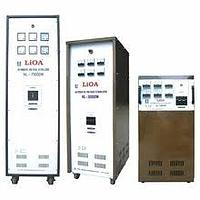
3-phase voltage stabilization
In industrial power systems, unstable mains voltage can lead to nuisance shutdowns, overheating, inaccurate machine operation, and reduced service life for connected equipment. For facilities using three-phase loads, selecting the right 3-phase voltage stabilization solution helps maintain a more consistent supply for production lines, motor-driven systems, HVAC equipment, test benches, and other critical installations.
This category focuses on three-phase voltage stabilizers from LiOA, covering a wide capacity range from compact dry-type units for smaller loads up to high-capacity systems for demanding industrial applications. The product mix is suited to buyers who need practical options for voltage correction where incoming power fluctuates beyond the tolerance of connected equipment.
Where 3-phase voltage stabilizers are commonly used
Three-phase stabilizers are typically installed in environments where the incoming supply varies over time but the load requires a relatively stable output. This is common in factories, workshops, commercial buildings, pumping stations, and technical rooms with mixed inductive and electronic loads. A stable three-phase output helps improve the operating condition of motors, control cabinets, compressors, and process equipment.
They are also relevant in sites where voltage dips occur during peak demand or where long cable runs cause line variation. In these cases, a stabilizer can help reduce the operational risk associated with under-voltage or over-voltage conditions, especially when the downstream equipment is expected to run continuously or within a narrow performance window.
Typical product range in this category
The range shown here includes both lower-capacity and heavy-duty models, which makes the category suitable for different project scales. Examples at the smaller end include the Lioa DR3-3K 3 PHASE DRY Voltage (3KVA), Lioa DR3-6K 3 phase dry Voltage, and LIOA DR3-10K 3 Phase Dry Voltage. These are generally relevant where the load is modest and installation space is more limited.
For medium-demand systems, options such as Lioa DR3-15K 3 phase dry Voltage, Lioa 3 DR3 - 20K 3 PHASE DRY Voltage, Lioa DR3-30k 3 phase dry Voltage, and Lioa DR3-45K II Voltage (45KVA-wide strips) provide a broader selection for workshop equipment, distribution branches, or grouped machine loads. Higher-capacity applications may look toward models such as Lioa DR3-60K Voltage, Lioa DR3-75K Voltage, and Lioa DR3-100K Voltage (100KVA-wide strips).
For very large installations, the category also includes high-capacity solutions like 3 Phase Voltage Lioa SH3-1000K / 3 (1000 KVA) and Lioa SH3-1200K /3 3 Phase Voltage (1200 KVA). These are more aligned with major industrial infrastructure, centralized supply points, or projects where a significant three-phase load must be stabilized at the source.
How these systems work in practical terms
A three-phase voltage stabilizer continuously monitors the incoming voltage and adjusts the output to keep it within a defined range. In the listed LiOA models, the specifications indicate a servo motor control principle, a common approach in electromechanical stabilizers. This method is widely used for correcting input variation while maintaining a regulated output for downstream equipment.
In practical use, the key value is not only the nominal capacity in kVA, but also the ability of the stabilizer to respond to changes in the input supply. Across the products in this category, the output is described around standard three-phase 380V with controlled tolerance, while accepted input ranges vary by model. This gives buyers flexibility when matching the stabilizer to local grid conditions rather than selecting only by headline capacity.
Key points to consider before selecting a model
The first step is to define the real load profile. Total kVA demand matters, but so does the nature of the load: motor starting behavior, cyclic operation, phase balance, and whether the load is continuous or intermittent. A small workshop with mixed equipment may be suited to a dry-type unit such as the DR3 series, while a plant-level installation may require a much higher-capacity SH3 model.
You should also review the expected input voltage range at site. The products listed here show different acceptable input ranges, which is important where utility power is unstable. If the site regularly experiences deeper voltage drops, selecting a model with an appropriate operating window is just as important as choosing the right kVA rating.
Other practical criteria include ambient temperature, installation footprint, and service accessibility. Since these units may be installed in electrical rooms or production areas, physical size and ventilation conditions should be checked early in the project. If your application includes mixed single-phase and three-phase loads, it may also be useful to compare with 1-phase voltage stabilization solutions for branch circuits or separate load groups.
Dry-type models and high-capacity systems
The DR3 models in this category represent a practical choice for many standard industrial and commercial applications. They cover a broad range, from 3 kVA up to 100 kVA in the listed examples, and are suitable for installations where a compact or mid-size stabilizer is needed. Models such as DR3-30K, DR3-45K II, and DR3-75K sit in the middle of the range and are often the kinds of capacities considered for local distribution panels, machinery clusters, or workshop expansion projects.
The SH3 series addresses a different scale of requirement. Products such as the SH3-1000K / 3 and SH3-1200K /3 are intended for much larger loads and centralized power stabilization. In these applications, the stabilizer becomes part of a broader power-conditioning strategy that may also involve distribution design and transformer selection. For projects of that type, it can be useful to review related power transformer options as part of the overall electrical architecture.
LiOA within the broader equipment landscape
This category is centered on LiOA, which is the main manufacturer represented in the current product selection. The range is broad enough to cover both small and very large three-phase stabilization requirements, which is helpful for contractors, maintenance teams, panel builders, and procurement departments looking to standardize sourcing within one brand family.
Depending on the project, buyers may also compare stabilization and power-conditioning equipment from other manufacturers such as MOTWANE, Preen, STANDA, or Fushin. However, the models highlighted on this page are specifically the LiOA options available in the current catalog, so the most useful comparison here is usually between capacity tiers, installation style, and acceptable input conditions rather than brand-to-brand claims.
Related categories for power distribution planning
Three-phase stabilization is often only one part of a wider power setup. In many facilities, buyers also need transformers for voltage adaptation or dedicated devices for smaller single-phase branches. If your project includes both plant-level and localized loads, you may want to explore 1-phase transformer LiOA products alongside the stabilizers shown here.
For users comparing solutions within the same equipment family, the broader 3-phase voltage stabilization range can be reviewed by capacity, installation constraints, and expected line conditions. This makes it easier to shortlist a model that fits both electrical performance and deployment requirements.
Choosing with confidence
A suitable three-phase stabilizer should match the actual site voltage behavior, the true load demand, and the operating environment. Looking only at nominal capacity is rarely enough; the more reliable approach is to consider input range, output tolerance, response behavior, and the role of the stabilizer in the full power system.
Within this category, LiOA offers options from compact DR3 dry-type units through to high-capacity SH3 systems, giving buyers a practical path for both small installations and large industrial projects. If you are selecting for a new installation or replacing an existing unit, use the category as a starting point to compare the available capacity levels and choose a model aligned with your application rather than relying on a one-size-fits-all approach.
Get exclusive volume discounts, bulk pricing updates, and new product alerts delivered directly to your inbox.
By subscribing, you agree to our Terms of Service and Privacy Policy.
Direct access to our certified experts