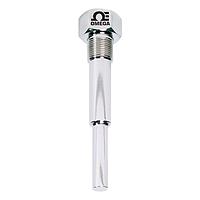
Thermowells
When temperature sensors are installed directly into a process line, they are often exposed to pressure, flow, corrosion, vibration, and mechanical stress. A thermowell helps solve that problem by creating a protective barrier between the process media and the sensing element, allowing thermometers, RTDs, or thermocouples to be installed, removed, or replaced without opening the system.
For industrial temperature measurement, choosing the right well is not only about fit. Material, insertion length, connection style, and process conditions all influence reliability, response, and service life. This category brings together thermowells suited to a range of general-purpose and more demanding installations.
Why thermowells matter in temperature measurement
In many systems, the sensor itself is not designed to face direct process exposure over long periods. Thermowells are used to protect the sensing probe from aggressive media, elevated pressure, flow-induced wear, and accidental damage during operation or maintenance. They also simplify servicing, since the sensor can typically be removed while the well remains installed in the process connection.
This makes thermowells especially useful in process piping, tanks, utility lines, HVAC, OEM equipment, and industrial heating or cooling systems. In applications where the sensor assembly also includes mounting accessories, readers may also compare related components such as protection tubes or connection hardware depending on the installation method.
Common selection factors for thermowells
The most practical way to select a thermowell is to start with the process and the sensor together. Key points usually include material compatibility, process connection type, insertion length, bore size, and the mechanical load created by pressure and fluid velocity. A mismatch in any of these areas can reduce measurement stability or shorten service life.
Material is one of the first decisions. In this category, examples include brass, 304 stainless steel, and 316 stainless steel. Brass may be suitable for general-duty environments, while stainless steel is commonly chosen where better corrosion resistance or broader industrial compatibility is needed. Connection details such as threaded NPT or NEF interfaces also matter, because the well must match both the process port and the sensor assembly.
Threaded thermowells for general industrial use
Many installations use threaded thermowells because they are straightforward to mount and widely compatible with field instrumentation. The listed Dwyer models illustrate this well for compact industrial setups, with options such as the Dwyer IT-W01 and Dwyer IT-W04 in brass, as well as the Dwyer IT-W11, IT-W14, IT-W17, IT-W21, and IT-W24 in stainless steel variants.
These examples show how users often choose between shorter and longer insertion lengths depending on pipe size, immersion target, and the sensor position required for stable readings. For buyers already standardizing around a supplier, the Dwyer product range can be a helpful reference when comparing material and construction options across similar installation styles.
Heavy-duty and lagging thermowells for more demanding conditions
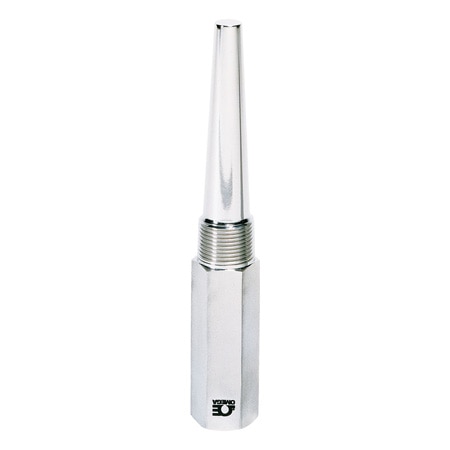
Where process conditions are more severe, heavier construction may be preferred. The OMEGA models in this category, including 3/4-260HL-U101/2-316SS, 3/4-260HL-U131/2-304SS, 3/4-260HL-U131/2-316SS, 3/4-260HL-U191/2-304SS, and 3/4-260HL-U191/2-316SS, represent heavy-duty lagging thermowells designed around threaded installation and tapered shank geometry.
From a selection standpoint, these examples are useful because they highlight how bore diameter, stem length, insertion length, and sheath material work together. In general, longer wells and higher process loads require more attention to mechanical suitability. If your assembly also needs an enclosure for terminal connections, related accessories such as protection heads may be relevant in complete sensor builds.
How material and length affect performance
A thermowell is not just a mounting accessory; it directly affects how the temperature sensing point interacts with the process. Insertion length influences whether the sensor tip reaches a representative part of the flow or vessel, while the well material affects corrosion resistance, durability, and long-term maintenance expectations.
For example, the product selection in this category includes shorter 2.5 in insertion designs and longer 5 in versions in the Dwyer series, alongside much longer heavy-duty OMEGA options. Stainless steel versions, especially 316 stainless steel, are commonly considered where chemical exposure or washdown conditions are more demanding. The right balance depends on the media, the mounting location, and the required durability rather than on one universal configuration.
Matching the thermowell to the sensor and process connection
Good results depend on compatibility between the well, the sensor, and the installation point. Buyers should verify the internal thread or bore arrangement for the sensing element, the external process thread, and the immersion depth needed for accurate measurement. Threaded styles such as 3/4 in NPT process connections and 1/4 in process connection sizes shown in this category are typical examples of why interface details should be checked carefully before ordering.
It is also important to consider whether the application involves insulation or lagging. Some OMEGA thermowells listed here are specifically described as lagging extension types, which can be helpful where the sensor head or connection needs to stand proud of insulated pipework. For teams reviewing broader sourcing options by supplier, the OMEGA lineup offers additional context for heavy-duty temperature measurement hardware.
Typical applications for thermowells
Thermowells are widely used across process industries, machinery, utilities, food and beverage support systems, water treatment, chemical service, and general industrial plant monitoring. They are especially valuable where shutdowns are costly or where sensors may need periodic replacement, calibration, or inspection without disturbing the process boundary.
They are also common in OEM skids and packaged equipment, where a durable and standardized sensor interface helps simplify maintenance. Whether the requirement is a compact brass well for a lighter-duty installation or a stainless heavy-duty design for more demanding service, the right choice depends on the actual operating conditions and the measurement assembly as a whole.
Choosing with confidence
This Thermowells category is intended for buyers who need a practical way to compare protective temperature sensor fittings by material, connection style, and construction level. The available range includes accessible industrial options from Dwyer and heavier-duty threaded lagging thermowells from OMEGA, making it easier to narrow down products that align with your process environment and mounting requirements.
Before selecting, it is worth confirming process media compatibility, thread standards, insertion depth, and any insulation or maintenance constraints. A well-matched thermowell can improve sensor protection, simplify service, and support more dependable temperature measurement over time.
Get exclusive volume discounts, bulk pricing updates, and new product alerts delivered directly to your inbox.
By subscribing, you agree to our Terms of Service and Privacy Policy.
Direct access to our certified experts