Paddlewheel Flow Meters
When liquid flow needs to be monitored continuously without moving to a more complex metering technology, Paddlewheel Flow Meters are often a practical choice. They are widely used in water-based processes, utility lines, treatment systems, and general industrial applications where users need a dependable flow signal for indication, totalizing, or control integration.
On this page, you can explore paddlewheel models suited for inline and insertion installation, including options with analog 4-20 mA output, pulse output, and remote digital transmitter configurations. The category is especially relevant for engineers and maintenance teams looking for compact flow measurement devices that balance installation flexibility, repeatability, and straightforward electrical interfacing.
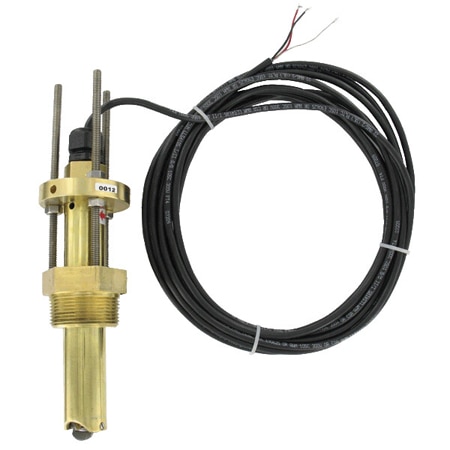
Where paddlewheel technology fits in flow measurement
A paddlewheel meter measures flow by detecting the rotation of an impeller placed in the moving liquid stream. As flow velocity increases, the wheel spins faster, and the sensor converts that movement into a pulse or analog signal that can be sent to a controller, display, or monitoring system. This makes the technology well suited to applications that need a clean electrical output rather than only a local indication.
Compared with some other flow technologies, paddlewheel designs are often selected for water-based fluids, moderate pressure service, and installations where low maintenance and compact form factor matter. If the application involves conductive liquids and users want a different measurement principle, electromagnetic flow meters may also be worth reviewing.
Typical configurations available in this category
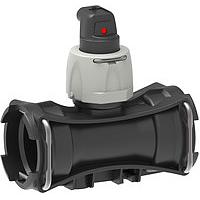
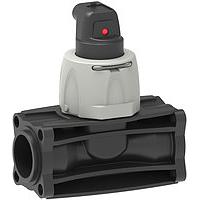
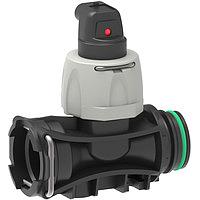
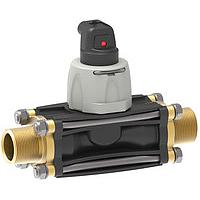
This category includes several common configuration styles. Standard insertion versions are designed for direct installation into the pipe system, while hot-tap insertion models allow installation or service access with a valve arrangement, which can be useful when shutting down the line is difficult. The available examples also show both NPT and BSPT connection variants, helping match site piping standards more closely.
Signal options are another important distinction. Some models provide a 4-20 mA output for straightforward connection to PLCs, SCADA systems, and process instrumentation, while others provide pulse output for flow counting, batching, or totalizing functions. Remote digital transmitter styles with LCD display and combined analog plus pulse output can be useful when local visibility and output flexibility are both needed.
Representative products from Dwyer
Many of the featured products in this category come from Dwyer, including insertion and hot-tap paddlewheel flowmeters for liquid monitoring. Examples such as the PFT-IAN-S111-S and PFT-IAN-B111-S illustrate analog 4-20 mA transmitter versions in stainless steel or brass body configurations, while models like the PFT-IDN-S111-S and PFT-IDN-B111-S highlight pulse-output options for users who prefer frequency-based flow monitoring.
For installations that require service-friendly access, hot-tap models such as the PFT-HAN-S611-S, PFT-HAN-B611-S, and PFT-HDN-S611-S show how this technology can be adapted for pressurized piping systems. The category also includes remote digital transmitters such as the DFMT2-25A, DFMT2-40A, and DFMT2-50A, which combine paddlewheel sensing with a display and output functions suitable for monitoring and control tasks.
What to consider when selecting a paddlewheel flow meter
The first selection factor is the liquid itself. In the products shown here, media compatibility is centered on water-based fluids, and in some remote digital transmitter models also includes water, oils, alcohols, and other compatible liquids. Material choice matters as well, with brass, 316 stainless steel, ABS, and PVDF-related wetted construction appearing across the featured models. Matching the meter materials to the process fluid and operating environment helps support long-term stability.
Next, look at the installation details: pipe size, connection type, and whether the application is better served by insertion or hot-tap insertion. Electrical requirements also deserve attention, including supply voltage, output type, and enclosure rating. Several listed models support DC supply in the 10 to 35 Vdc or 12 to 24 Vdc range, and enclosure ratings such as IP65 or IP67 can be important when the meter is exposed to washdown, dust, or outdoor conditions.
Finally, review the measurement range and expected accuracy in the context of the process. The highlighted models show repeatability figures around ±0.5% and linearity or accuracy values that are suitable for many industrial monitoring duties. For applications where users primarily need visual readout instead of transmitter output, it may also be helpful to compare with indicating flow meters.
Advantages of insertion and hot-tap designs
Insertion flow meters are often chosen when pipe size, installation access, and cost efficiency are key considerations. Because the sensor extends into the flow stream rather than requiring a full-bore meter body, this style can be attractive for larger lines or retrofit projects. It can also simplify replacement compared with some inline flow technologies.
Hot-tap versions add another layer of flexibility. In systems where downtime is costly or operational continuity is critical, the ability to work with a valve-assisted installation point can reduce maintenance disruption. This is especially relevant in industrial water loops, utility services, and process lines that must remain available as much as possible.
Outputs, integration, and system compatibility
From an automation perspective, output type strongly influences how the meter fits into the rest of the system. Pulse output is commonly used where the control system counts events to calculate flow or total volume, while analog output provides a continuous signal that is easy to scale in controllers and monitoring platforms. Some remote digital models in this category combine both approaches, making them more adaptable to mixed monitoring requirements.
Users planning a complete flow control or monitoring setup may also need related hardware such as mounting items, fittings, or replacement parts over time. In those cases, browsing flow measurement accessories can help round out the installation. If the process also requires mechanical regulation in addition to measurement, flow valves may be relevant as part of the broader system.
Common applications for paddlewheel meters
Paddlewheel meters are commonly used in water treatment skids, cooling water circuits, chemical dosing support systems, equipment wash lines, and general liquid utility monitoring. Their compact sensing principle and standard industrial outputs make them suitable for OEM equipment as well as plant retrofit work. They are especially useful when engineers need repeatable flow feedback without moving to a more specialized or higher-cost metering solution.
They can also be a strong fit for B2B environments where maintenance teams value simple wiring, practical installation options, and easy integration into existing controls. Whether the requirement is basic flow trending, alarm generation, or totalizing support, this category offers configurations aligned with those common industrial needs.
Choosing the right model for your process
The best choice depends on how the meter will be installed, what signal the control system expects, and how demanding the process conditions are. A standard insertion model may be appropriate for straightforward liquid monitoring, while a hot-tap version may better suit live systems where shutdown is undesirable. Material selection between brass and 316 stainless steel can also influence suitability based on corrosion considerations and site standards.
If local readout is useful, a remote digital transmitter such as the DFMT2 series may be the better fit. If the priority is simple integration into an analog loop or pulse-counting input, one of the PFT series variants may be more appropriate. Reviewing connection type, flow range, enclosure, and output style together will usually narrow the options quickly.
This category brings together paddlewheel solutions for liquid flow monitoring across a range of installation and signal requirements. By comparing sensor style, construction material, output format, and process connection details, buyers can identify a model that fits both the piping layout and the control strategy with fewer compromises.
Get exclusive volume discounts, bulk pricing updates, and new product alerts delivered directly to your inbox.
By subscribing, you agree to our Terms of Service and Privacy Policy.
Direct access to our certified experts