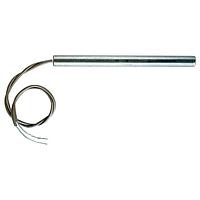
Cartridge Heaters
When heat needs to be delivered directly inside a metal block, platen, die, or mold, compact tubular heating elements are often the most practical solution. Cartridge heaters are widely used in industrial equipment because they concentrate heat in a small footprint, respond quickly, and fit neatly into drilled holes for controlled process heating.
On this page, you can explore cartridge heater options for production lines, packaging systems, molding equipment, hot runner assemblies, food processing machines, and other thermal applications where reliable internal heating matters. The range shown here includes different diameters, lengths, wattages, sheath materials, and power densities to help match the heater to the mechanical design and thermal load of the application.
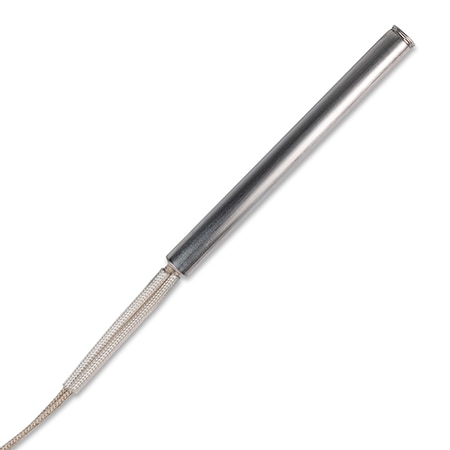
Where cartridge heaters are typically used
These heaters are common anywhere a machine requires localized, inserted heat rather than surface heating. Typical use cases include dies, molds, heat sealing equipment, glue guns, labeling machines, laminating equipment, packaging systems, platens, plastic processing equipment, and selected food processing or scientific setups.
Because the heating element is installed directly into a drilled bore, heat transfer can be efficient when the fit is correct. This makes cartridge heaters a practical choice for equipment builders and maintenance teams looking for a compact heating method for metal tooling, process blocks, and temperature-sensitive production assemblies.
Key selection points for cartridge heaters
The right heater is not chosen by wattage alone. Buyers usually need to consider diameter and insertion length, supply voltage, allowable power density, maximum operating temperature, lead configuration, and sheath material. Fit inside the bore is especially important, since poor contact can reduce heat transfer and shorten service life.
Power density should be matched to the application rather than pushed as high as possible. Higher watt density can support faster heat-up, but it also places more thermal stress on the heater and on the surrounding process. For many machinery designs, the best result comes from balancing ramp-up speed, operating temperature, thermal mass, and duty cycle.
Material, temperature, and operating environment
The product examples in this category include 304 stainless steel and 321 stainless steel sheath constructions. In practice, sheath material selection is tied to operating temperature, process environment, and the nature of the equipment being heated. Applications involving molds, packaging tools, heating gases, or heating liquids may each place different demands on the heater assembly.
Some models in this range are designed for operating temperatures up to 650 °C, while others reach up to 760 °C. That difference can matter in high-temperature process heating, hot runner molds, hot stamping, plastic processing, and other demanding installations. Along with temperature capability, buyers should also review voltage, resistance tolerance, and installation fit before final selection.
Representative OMEGA cartridge heater options
This category includes products from OMEGA, with configurations suited to both moderate and more demanding thermal loads. For example, the OMEGA LDC series includes compact 304 stainless steel models such as the LDC00403, LDC00405, LDC00407, and LDC00409, covering shorter body lengths and different watt densities for machinery where space is limited.
For longer or higher-output applications, examples such as LDC00414 and LDC00419 offer 1000 W configurations in different lengths and voltages, while the HDC series extends into heavier-duty ranges. Models including HDC01011, HDC01013, HDC01021, HDC01025, and HDC01027 illustrate how cartridge heaters can be specified for longer insertion lengths, higher wattages, and elevated operating temperatures in industrial process equipment.
Choosing between standard process heating needs
For molds, dies, and general machinery heating, the first question is usually how much heat must be transferred into the target mass and how evenly that heat must be maintained. A shorter heater with moderate watt density may be suitable for compact tooling blocks, while longer heaters are often selected where heat needs to be distributed across a greater insertion depth.
Voltage also affects selection. In this range, both 120 Vac and 240 Vac options are available, which helps align replacement heaters with installed machine power. If you are replacing an existing unit, it is good practice to verify diameter, heated length, total length, wattage, voltage, and sheath material against the current heater and the bore design before ordering.
How cartridge heaters fit into a broader heating system
Cartridge heaters are only one part of an industrial thermal setup. Some machines use inserted heaters for tooling blocks while relying on other heater types for cabinet climate control, liquid heating, or external surface heating. If your application requires warming a tank or process fluid directly, immersion heaters may be more appropriate.
Likewise, for heat applied across flat surfaces or machine panels, users often compare cartridge heaters with strip heaters. In air-handling cabinets or electrical enclosures, duct and enclosure heaters may be a better fit. Understanding the heating method at the system level helps avoid overengineering one component to solve a problem that belongs elsewhere in the design.
Installation and replacement considerations
A cartridge heater performs best when the bore is properly machined and the heater is installed with suitable thermal contact. Clearance that is too loose can lead to hot spots and inefficient transfer, while excessive mechanical stress during installation can damage the unit. Maintenance teams should also pay attention to lead routing, temperature exposure around exit points, and access for future replacement.
For replacement work, matching the original mechanical and electrical characteristics is often more important than simply finding a heater with similar overall power. In many plants, uptime depends on selecting a heater that fits the application correctly the first time, especially in packaging, molding, laminating, and other continuous-duty equipment.
Find cartridge heaters matched to your process
Whether you are specifying heaters for new equipment or sourcing replacement parts for installed machinery, this category is built to support practical selection by size, voltage, wattage, and operating range. The available models are suitable for many common industrial heating tasks where compact internal heat delivery is required.
Browse the listed products to compare build options and application fit, and use the product details to narrow down the heater that aligns with your process temperature, bore dimensions, and electrical requirements. A well-matched cartridge heater can improve thermal consistency, reduce replacement issues, and support more stable machine performance over time.
Get exclusive volume discounts, bulk pricing updates, and new product alerts delivered directly to your inbox.
By subscribing, you agree to our Terms of Service and Privacy Policy.
Direct access to our certified experts