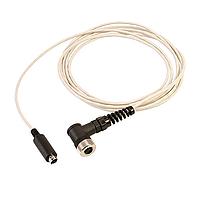
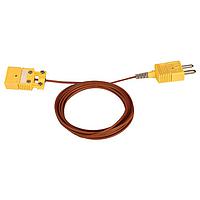
Cables and Patch Cords
Reliable signal transmission is a basic requirement in temperature measurement systems, especially when sensors must be connected across panels, test benches, process equipment, or laboratory setups. In these situations, Cables and Patch Cords help extend sensor connections while preserving wiring consistency, connector compatibility, and installation flexibility for RTD and thermistor applications.
Within temperature wire and cable systems, this category is useful for engineers, integrators, and maintenance teams looking for practical connection solutions rather than raw bulk wire. Pre-terminated assemblies can simplify installation, reduce wiring errors, and make it easier to adapt between miniature and standard connector formats in real operating environments.
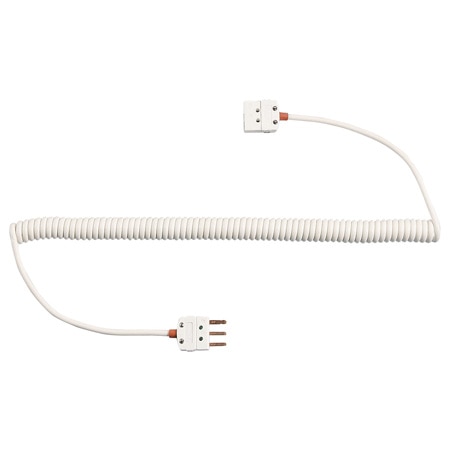
Where cables and patch cords fit in temperature measurement
Temperature sensors are often installed away from indicators, controllers, data acquisition devices, or test instruments. A suitable patch cord or extension cable provides the physical link between the sensing point and the receiving equipment, helping maintain an organized and serviceable measurement chain.
This is particularly relevant when working with RTD or thermistor circuits that require stable conductor paths and correct connector matching. In many systems, the cable assembly is not just an accessory; it is part of the overall measurement architecture that affects installation speed, maintenance convenience, and long-term reliability.
Common configurations available in this category
The products shown in this category highlight a range of pre-configured assemblies from OMEGA, including options with miniature male to miniature female connectors, standard male to standard female connectors, and mixed connector formats for adapting between connection styles. This makes the category relevant for both new installations and retrofit work where connector formats may already be fixed by existing instruments.
Examples include assemblies such as OMEGA TECU10-SMP-U-M-SMP-U-F for compact miniature connections, OMEGA TECU10-OST-U-M-OST-U-F for standard connector layouts, and OMEGA TECU25-MTP-U-M-OTP-U-F when transitioning between miniature and standard 3-prong interfaces. Rather than listing every variant, the broader takeaway is that connector style, cable length, and mating format are key selection points.
Key factors when selecting a patch cord or extension cable
The first point to check is connector compatibility. A cable may need to join like-for-like connections, such as standard male to standard female, or bridge different formats used by sensors and instruments. Choosing the correct termination style can avoid unnecessary adapters and reduce the chance of connection mistakes during maintenance.
The second factor is cable construction. In the featured products, stranded conductors support flexibility during routing, while PFA insulation is suited to demanding environments where temperature resistance and durable insulation matter. Cable length also matters in practice, with shorter options such as 3 ft useful for bench setups and longer 10 ft or 25 ft assemblies better suited to equipment spacing or panel-to-field runs.
Why insulation and conductor design matter
In temperature measurement, the cable must do more than simply carry a signal. It also needs to withstand the installation environment, including heat exposure, movement during setup, and repeated handling around test equipment. The use of PFA insulation in the listed assemblies supports applications where robust thermal and chemical performance is an important consideration.
The featured products also use 26 AWG stranded conductors and 3-conductor construction for RTD or thermistor use. From a system perspective, this combination supports flexibility and practical installation while aligning with the needs of low-level temperature sensing circuits. When cable handling, bend radius, and repeated connection cycles are part of the job, these design details become more relevant than they may first appear.
Typical use cases for RTD and thermistor patch cords
These cable assemblies are commonly used in laboratories, thermal test rigs, machine builds, pilot plants, and industrial panels where sensors need to be connected cleanly and repeatedly. Pre-terminated patch cords can be especially useful when equipment is frequently reconfigured or when technicians need quick, repeatable sensor hookups without field termination work.
They are also useful in troubleshooting and replacement scenarios. If a sensor path is already standardized around miniature or standard thermocouple-style connectors for RTD or thermistor circuits, replacing only the cable assembly can be faster and less disruptive than rebuilding the full wiring path. For broader temperature wiring options, users may also review related wire protection and sleeve solutions where added cable management or insulation support is needed.
Examples of products in this range
Several representative products illustrate the scope of the category. OMEGA TECU03-OTP-U-M-OTP-U-F is a shorter 3 ft option for compact setups, while OMEGA TECU25-OST-U-M-OST-U-F provides a longer 25 ft standard connector solution. For miniature connector systems, OMEGA TECU25-SMP-U-M-SMP-U-F is a practical example of a longer extension assembly designed around miniature male and female terminations.
There are also crossover variants such as OMEGA TECU10-MTP-U-M-OTP-U-F and OMEGA TECU10-MTP-U-F-MTP-U-F, showing how this category can support more specific connector-matching requirements. If your project needs a wider view of sensor interconnect options beyond pre-terminated assemblies, the main temperature cables and patch cords range can help narrow choices by connection style and application.
How to choose the right option for your setup
A practical selection process starts with three questions: what sensor type is being connected, what connector format already exists on each end, and how much cable length is actually required in the installation. From there, it becomes easier to narrow the options between miniature and standard terminations, same-end versus mixed-end connectors, and short versus long cable assemblies.
It is also worth considering service conditions such as routing space, operator handling, and ambient temperature exposure. In many cases, a well-matched pre-terminated patch cord improves installation efficiency and reduces downtime during replacement or expansion. For users comparing related interconnect products, exploring similar cable assemblies alongside protective components can provide a more complete view of the wiring system.
Final thoughts
Choosing the right cable assembly is a small decision that can have a noticeable impact on temperature measurement reliability, serviceability, and setup time. This category brings together practical RTD and thermistor patch cord options with common connector styles, multiple lengths, and insulation choices suited to technical environments.
Whether the goal is extending a sensor connection, standardizing field replacements, or simplifying bench and panel wiring, selecting the right temperature cable assembly starts with connector fit, cable construction, and application conditions. A clear understanding of those basics will make it much easier to identify the most appropriate solution for your measurement system.
Get exclusive volume discounts, bulk pricing updates, and new product alerts delivered directly to your inbox.
By subscribing, you agree to our Terms of Service and Privacy Policy.
Direct access to our certified experts