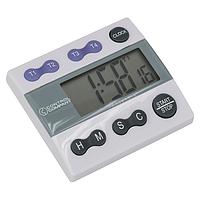
Timers
Precise timing is a basic requirement in many control panels, production lines, and machine sequences. Whether the task is delaying startup, managing a switching interval, or coordinating events between devices, timers help create predictable behavior without adding unnecessary complexity to the control system.
Within industrial control and monitoring applications, this category covers timer relays and time switches used to introduce controlled delays, repeatable switching actions, and simple logic in electrical systems. These devices are commonly selected for panel building, equipment automation, and general-purpose control where stable time-based operation matters.
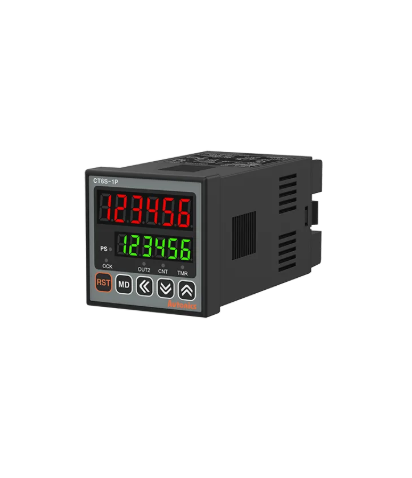
Where timers are used in industrial systems
Time-based control appears in many practical scenarios: delayed motor start, fan overrun, lighting control, alarm sequencing, conveyor staging, and interlocking between control steps. In these cases, a timer acts as a simple but effective device for introducing a defined interval between an input condition and an output action.
They are often used alongside controllers, relays, and sensing devices to support machine logic at the panel level. In some applications, a timer relay is enough on its own; in others, it becomes part of a broader control architecture with indicators, switching devices, and process monitoring equipment.
Common timer types and operating logic
Industrial timer products can be applied in several familiar ways, depending on how the sequence should behave. Typical use cases include on-delay timing, off-delay timing, interval timing, and repeated switching for cyclical operations. The right choice depends on what should happen when power is applied, removed, or when a trigger input changes state.
For example, an on-delay timer is useful when an output should activate only after a preset waiting period. A time switch may be better suited for scheduled or interval-based control, while more compact timer relays are often selected for straightforward panel functions where installation space and wiring simplicity are important.
Representative timer products in this category
This range includes well-known industrial timer models from manufacturers such as OMRON, PANASONIC, and Moeller. Examples visible in this category include the OMRON H3DK-HCS AC100-120, OMRON H3Y-2 DC48 3H, OMRON H3DE-H series, and Moeller ETR4-69-A or ETR4-11-A timer/time switch models.
There are also PANASONIC S1DX series options such as S1DX-A4C10M-AC120V, S1DX-A4C10S-AC120V, S1DX-A4C30S-AC24V, and S1DX-A2C5S-DC110V. These examples show the variety available in operating voltage and contact arrangement, which are two of the first details engineers typically review when matching a timer to an existing circuit.
How to choose the right timer relay
A practical selection process starts with the control objective. First, identify the required timing function: do you need a delayed start, a delayed release, a fixed pulse, or a repeating cycle? Then confirm the electrical conditions, including supply voltage, output contact format, and how the timer will interface with the rest of the panel.
It is also important to check installation constraints such as available mounting space, wiring access, and maintenance preferences. Models in this category include versions for different voltages such as 24VAC, 48V, 100 to 120VAC, and 110V, along with contact arrangements including 2 Form C, 4 Form C, and SPDT-style output formats depending on the model. For broader panel design, it can also be helpful to review related control and monitoring accessories that support integration and installation.
Integration with monitoring and control equipment
Timers are rarely isolated components in real applications. They commonly work with pushbuttons, contactors, relays, level devices, temperature control loops, or machine interlocks to create a dependable sequence. In many panels, timing functions complement feedback devices and display equipment that help operators verify system status.
When a process also requires local readout or signal visibility, related categories such as meters and indicators can provide additional context for a more complete control solution. For applications with more advanced loop management, timer relays may also sit alongside process-oriented devices without replacing the need for dedicated control hardware.
Why timer relays remain relevant in modern automation
Even in systems that use PLCs or smart controllers, standalone timers continue to offer value. They provide a straightforward way to implement a single timing task without consuming controller resources, and they can simplify troubleshooting because the timing function is visible at the device level.
This makes them useful in retrofit projects, compact equipment, auxiliary control circuits, and maintenance replacements where a dedicated timing element is more practical than rewriting a larger program. For many machine builders and panel integrators, timer relays remain a reliable choice for focused, repeatable time-based control.
Finding a suitable timer for your application
This category is designed for buyers who need dependable industrial timing components for control and monitoring systems. If you are comparing models, start with the operating voltage, contact configuration, and timing behavior required by your circuit, then narrow the selection by panel layout and application type.
With products from recognized industrial brands and a mix of timer relays and time switch options, the Timers category supports both replacement needs and new control panel builds. A clear understanding of the required sequence is usually the fastest way to identify the right device and avoid overspecifying the solution.
Get exclusive volume discounts, bulk pricing updates, and new product alerts delivered directly to your inbox.
By subscribing, you agree to our Terms of Service and Privacy Policy.
Direct access to our certified experts