What is a vector network?
A vector network is a geometric data structure used in computer graphics to represent images as mathematical objects instead of pixels. Unlike bitmaps, which store images as a matrix of pixels, vector networks describe images using elements such as lines, Bézier curves, polygons, and circles, along with attributes such as color, line thickness, and transparency.
Outstanding advantages of vector networks
The main advantage of vector networks is the ability to scale up or down without losing visual quality, thanks to the mathematical nature of the data. This makes vectors especially suitable for logo design, technical drawings, UI/UX interfaces, and applications that require high resolution on multiple screen sizes. Popular vector image formats include SVG, EPS, vector PDF, and AI.
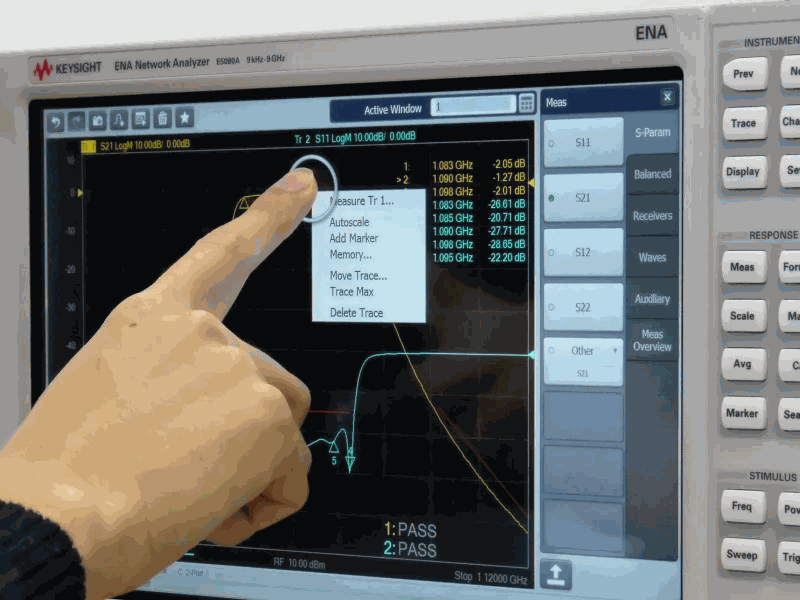
Vector Network Analyzer (VNA) is a specialized device for testing, diagnosing and maintaining systems using microwave signals, especially popular in the fields of television, mobile telecommunications, military networks and professional broadcasting systems.
In the context that almost all users today use mobile devices connected to 3G, 4G, 5G, WiFi or LAN networks, it is necessary to use a network analyzer to monitor performance, coverage and handle problems with interference or signal loss. Modern VNA lines such as Anritsu MS2028C or Copper Mountain Planar 304/1 currently distributed by EMIN, are popular choices for engineers in measuring S‑parameters (S11, S21, S12, S22) and evaluating signal reflections at frequencies from a few kHz to tens of GHz.
Vector network analyzers have been around for over 60 years, with leading measurement companies such as HP (predecessor of Keysight Technologies) and Rohde & Schwarz introducing the first devices for the RF field. To this day, VNAs such as the Keysight E5080B or R&S ZNB Series are still considered the gold standard in the high-speed signal testing industry.
Functions of vector network analyzer (VNA)
The function of a vector network analyzer (VNA) focuses on two core parameters: the amplitude and phase of the transmitted signal. While amplitude measurements can be easily performed with conventional instruments such as spectrum analyzers or oscilloscopes, phase measurements require a high level of accuracy and consistency – something that only a VNA can provide.

Thanks to the ability to collect synchronous amplitude and phase data, models such as the Anritsu MS46524B or Keysight PNA-L Series allow for accurate response graph display, performing inverse Fourier transforms to evaluate signals in the time domain, a necessary feature in testing cables, circuit boards, filters and antennas. At the same time, the vector calibration function also allows users to subtract system errors, ensuring absolute accuracy when measuring.
Related articles:
Why is VNA calibration necessary?
How does a Vector Network Analyzer work?
Types of network analyzers
Currently, the RF/microwave measurement market uses three groups of network analyzers, which differ in measurement range and level of signal processing:
Scalar Network Analyzer (SNA)
As the simplest measuring device, the SNA only measures the amplitude of the transmitted or reflected signal. Without the ability to measure phase, the scalar network analyzer only provides information about gain and loss. Because it does not meet modern measurement requirements, this type of analyzer has almost stopped being produced by major manufacturers.
Vector Network Analyzer (VNA)
Vector Network Analyzer (VNA): This is a device that can simultaneously measure both amplitude and phase, thereby determining impedance, reflection, attenuation and S-matrix parameters. Typical models such as Keysight E5080B, Copper Mountain Planar 304/1 or Rohde & Schwarz ZNB Series are all available on EMIN, covering a wide frequency range from MHz to over 20GHz, suitable for both labs and production lines.
Time Domain Reflectometer (TDR)
Some modern VNAs incorporate a time-domain measurement mode – especially useful in analyzing line discontinuities, locating faults, or testing the differential impedance of high-speed cables.