What Is a Dual Power Supply?
It may sound unfamiliar at first, but in reality, a dual power supply is something quite common in many everyday electronic applications. Unlike conventional DC power supplies that provide only a single positive and negative terminal with respect to ground, a dual power supply delivers two equal but opposite voltage levels, such as ±12V or ±15V. This balanced voltage is essential for many circuits that require symmetrical signal processing, particularly in precision measurement or amplification circuits.
Applications of Dual Power Supplies
It’s no coincidence that electronic engineers often prioritize the use of dual power supplies in systems requiring high accuracy. In audio amplifier circuits, a dual power supply enables signal amplification in both the positive and negative directions, resulting in clear and detailed sound output without distortion or clipping. Circuits that use operational amplifiers (Op-Amps)—a staple in control and sensing applications—also heavily depend on the stability of a dual power source. In fact, in measurement devices, the absence of a dual power supply could cause AC signals to become phase-shifted, leading to significant measurement errors. Clearly, a proper power source doesn’t just keep the circuit running—it determines the overall output quality of the entire system.
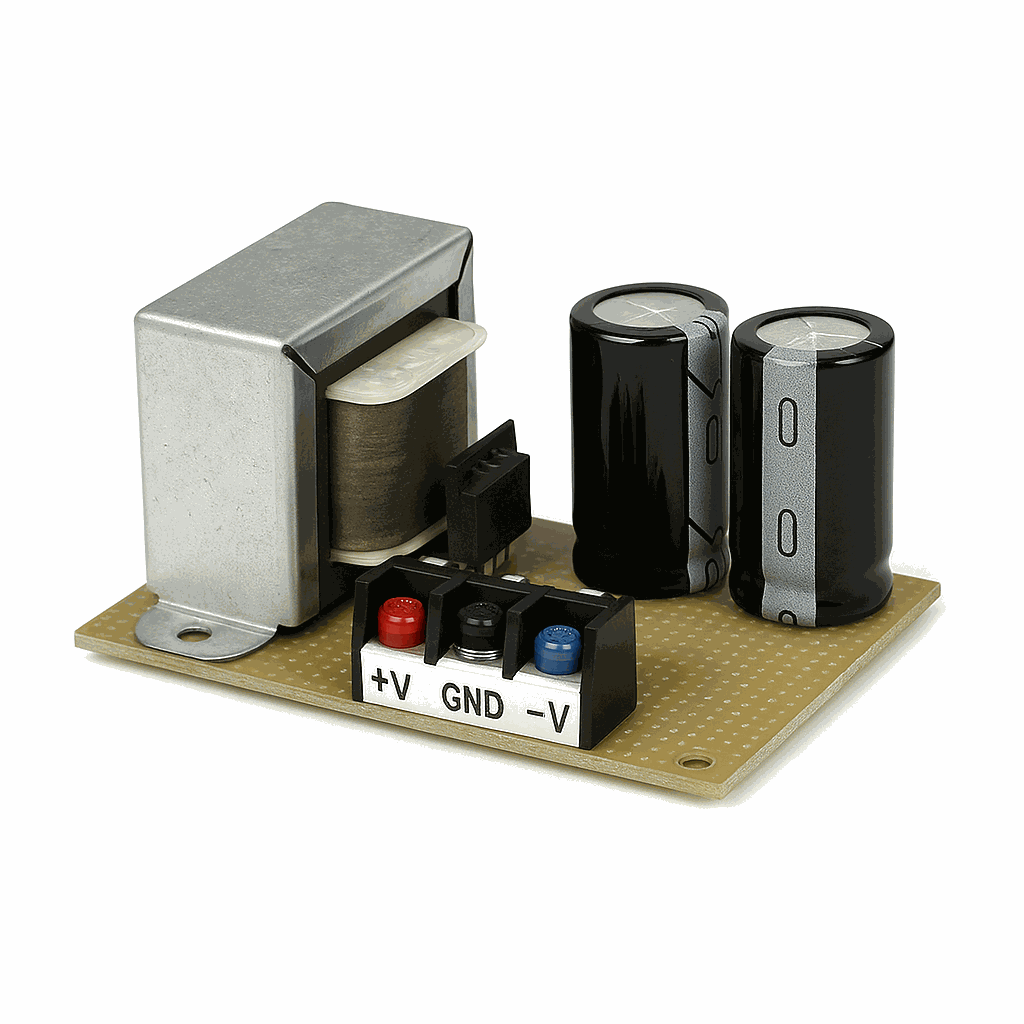
Perhaps the most intuitive way to grasp the concept of a dual power supply is through a simple experiment using an oscilloscope and a couple of batteries. When you connect two batteries in series and designate the midpoint as ground, the two remaining terminals will serve as the positive and negative outputs of a dual power supply. You can clearly observe this by switching the ground reference on the oscilloscope—your signal will flip accordingly. This demonstrates that the concepts of positive and negative are relative, and that a dual power supply is simply a balanced voltage split equally around the ground. It’s a straightforward but highly practical way to understand how dual power supplies are created and used in real-life applications.
So How Is a Dual Power Supply Created?
When it comes to creating a dual power supply, you’ll definitely need a more stable solution than stringing together a few batteries—that method is suitable only for small-scale experiments, not for real-world circuits that require long-term stability and precision.
To achieve this, a transformer with a specially designed secondary winding is often used. This typically includes two coils with the same number of turns, wound together with a shared center tap. This center tap becomes the ground reference. The two outer terminals are then connected to a diode bridge to rectify the AC into DC, thus creating two equal and opposite voltages to form the dual supply.
Adding two electrolytic capacitors after the diode bridge not only filters out noise but also completes the power circuit with symmetrical output. Each capacitor handles one half of the voltage: one stores the positive charge, while the other holds the negative charge. The junction between the two capacitors is connected to the center tap of the transformer, which serves as the ground.
The final result is a clear and stable ±V output, sufficient to power signal-processing circuits like audio amplifiers, precision measurement systems, or sensors that rely on AC signals. This is a common power supply structure because it’s easy to build, easy to understand, and performs reliably in practical applications.
Imagine you have a transformer with two AC outputs. You connect these to the AC terminals of a diode bridge. One DC output from the bridge is connected to the positive terminal of the first capacitor, and the other DC output to the negative terminal of the second capacitor. The remaining terminals of the two capacitors are connected together to form the ground—this is the midpoint between the two symmetrical voltages. With just a few simple steps, you’ve created a ±V power source capable of powering circuits that require dual polarity voltage.
Conclusion
What we’ve shared above are foundational—but extremely important—concepts about dual power supplies, which are often overlooked when we focus too much on other technical details. Understanding how they work and how to create them will help you avoid many unnecessary mistakes during circuit design and operation.