Concrete drills are suitable for making precise holes in surfaces, while concrete chisels are ideal for quick demolition of hard concrete blocks. Understanding this difference will help you choose the right device. The article below will compare the performance of these two types of machines.
What are the differences between concrete drills and concrete chisels?
Both types of machines belong to the group of professional handheld devices, designed to work effectively on hard material surfaces. With relatively large size, strong capacity, and high impact force, they meet the strict requirements in construction.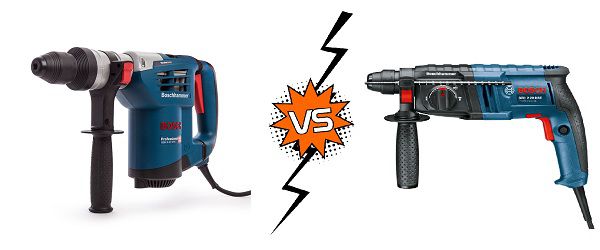
The operating principle of both is based on the piston force inside the machine, creating continuous impacts, helping to enhance outstanding working ability. This has created a valuable common ground, helping both concrete drills and concrete chisels become the top choices for heavy jobs.
What is the difference between a concrete drill and a concrete chisel?
The biggest difference between these two types of machines lies in the operating principle of the drill and chisel
Concrete drilling machine
The concrete drill operates with two modes: normal drilling and hammer drilling, allowing users to adjust the drill bit to rotate clockwise or vice versa. However, some models, such as the Bosch GBH 2-18 RE, do not support reversing.
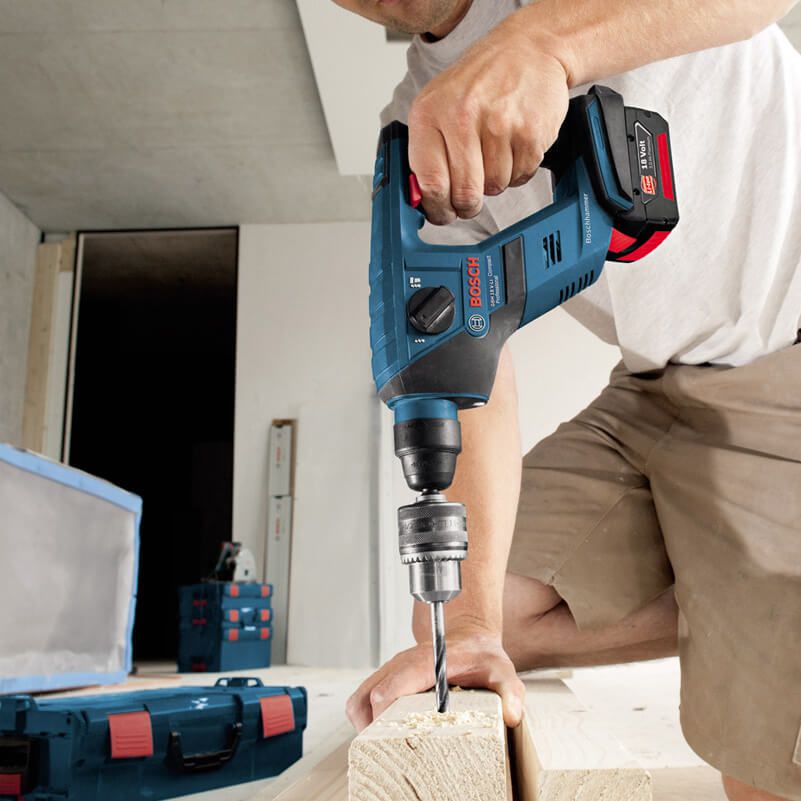
This type of machine often uses SDS or SDS Plus clamping heads, suitable for specialized drill bits. In particular, the machine does not have a screw driving function and focuses on the ability to drill with large diameters, commonly from 18mm to 28mm. The impact force of the machine is usually less than 3J, suitable for jobs that require more precision than demolition.
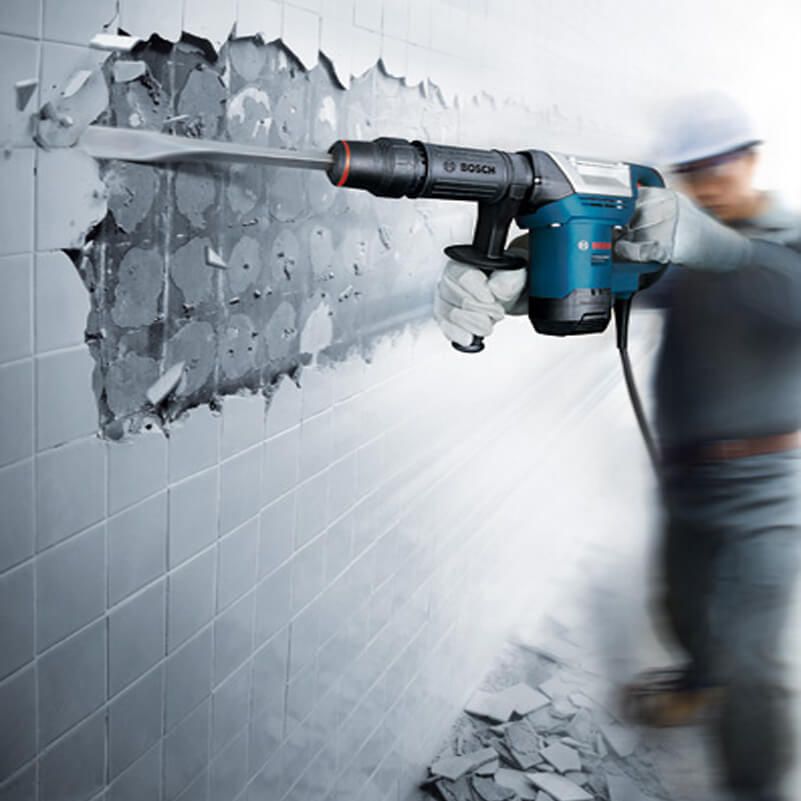
Concrete chisels are often equipped with modern anti-vibration systems, providing maximum comfort and safety for users when working continuously. Brands such as Bosch and Makita provide many lines of handheld chisels, suitable for construction projects or mechanical workshops. However, to achieve high efficiency, chisels only work well with specialized chisels, usually with a diameter of 35mm or more.
Depending on the job requirements, you can choose a small chisel with a capacity of less than 1,000W to break walls or light concrete. For large projects with thick and hard concrete, machines with a capacity of over 1,000W will be the ideal solution, ensuring performance and durability during construction.
How to choose between a concrete chisel and a concrete drill?
Both concrete chisels and concrete drills are indispensable equipment in construction projects, with the ability to flexibly handle thin or thick concrete layers. However, each type of machine is suitable for its own purposes.
The concrete chisel is suitable for demolition work, especially suitable for professional workers. With strong impact force and high speed, the machine can penetrate hard brick or concrete walls quickly, without much dependence on human labor.
In contrast, concrete drills are designed for precise drilling on concrete and stone surfaces. Based on the principle of pressure from an internal piston, this device creates a percussive force similar to a hammer hitting a nail, helping to drill holes effectively and easily.
Although both handle concrete well, the chisel is more adept at breaking through thanks to its specialized chisel bit, while the hammer drill is strong at making holes in the surface.