CRYSOUND Releases Firmware V0.0.41 for CRY8024 and CRY8025: Improved SPL Calculation and Gas Leak Estimation
What’s New in Firmware V0.0.41 for CRY8024 and CRY8025?
CRYSOUND has released Firmware V0.0.41 for two pocket acoustic imaging camera models, CRY8024 and CRY8025, from the SonoCam Pocket series. This update focuses on two key areas: optimizing Sound Pressure Level (SPL) calculation across both models and refining the gas leak flow rate estimation algorithm on the CRY8025.
These changes directly impact how inspection results are analyzed. Specifically, the SPL calculation improvement aims for greater measurement consistency, while the refined leak estimation algorithm enhances the quantitative capabilities of the CRY8025.
Both updates also highlight the distinct application focus between the CRY8024 and the CRY8025 Pro version—particularly when enterprises need to convert leak detection findings into actionable data for energy loss assessments.
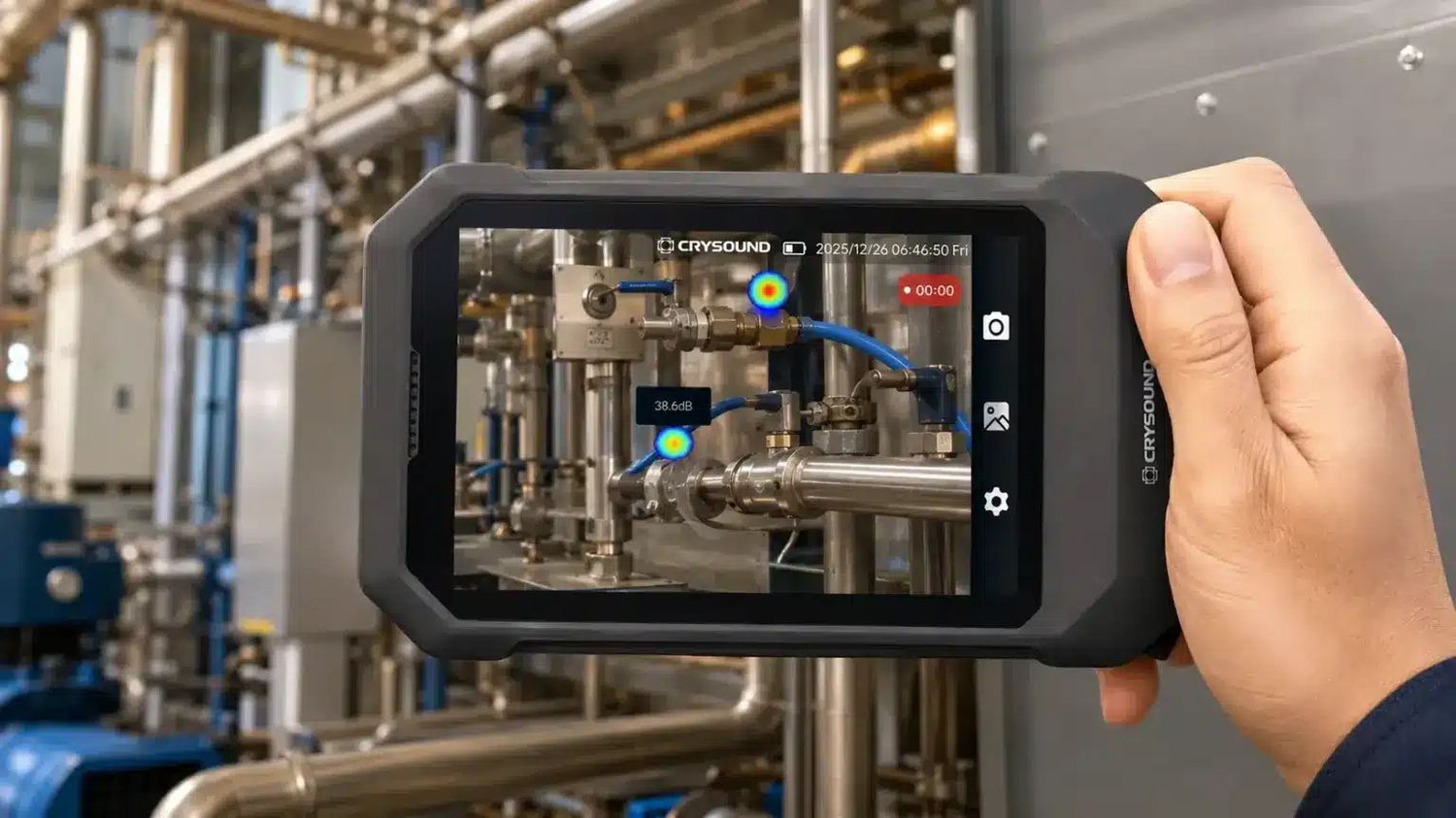
Schematic illustrating ultrasonic wave capture via the 64-MEMS microphone array, Sound Pressure Level (SPL) heatmap overlay on the 5 MP optical image, and quantitative leak rate calculation on the CRY8025 Pro.
Two Key Refinements in Firmware V0.0.41
SPL (Sound Pressure Level) measures acoustic intensity at a given point. In an acoustic imaging camera, this parameter governs how sound sources are processed and rendered on the acoustic heatmap.
With Firmware V0.0.41, CRYSOUND has optimized the SPL calculation algorithm across both the CRY8024 and CRY8025. This refinement improves measurement consistency, making it easier to observe and evaluate acoustic sources.
For routine preventive inspections, consistent readings are critical when technicians need to compare data across multiple inspection cycles or monitor the same asset location over time during maintenance.
Unlike the CRY8024, which focuses on acoustic source detection and localization, the CRY8025 Pro adds the ability to estimate gas leak flow rates and convert them into projected financial losses.
In Firmware V0.0.41, CRYSOUND further refined this leak flow estimation algorithm. This update applies exclusively to the CRY8025 and is not included on the CRY8024.
Quantification provides technicians with an objective basis for prioritizing repairs. Rather than merely logging leak locations, users can reference estimated gas loss volume and annual cost to schedule maintenance effectively.
Note: Displayed figures are estimates. Results depend on system parameters configured on the device and should not be treated as fixed loss rates across all operating conditions.
Gas Leak Quantification Example Using CRY8025
In the update release documentation, CRYSOUND demonstrates a leak inspection case on an industrial compressed air pipeline using the CRY8025. The device screen displays the following results:
These figures represent an illustrative case published by CRYSOUND rather than a standard benchmark for every leak point. Actual costs depend on operating conditions, line pressure, gas properties, and the electricity tariff entered during calculation.
The core value of this capability lies in adding quantitative metrics to maintenance workflows. With estimated flow rates and financial loss data on hand, enterprises gain clear criteria to compare leak severities and prioritize corrective actions.
How Does CRY8025 Detect and Estimate Gas Leaks?
The CRY8025 SonoCam Pocket Pro uses a 64-channel digital MEMS microphone array to capture ultrasonic signals. The unit processes these signals and overlays a color-coded acoustic map onto live imagery from an autofocus 5 MP optical camera.
This visual overlay allows technicians to pinpoint sound sources directly on real-world equipment rather than relying solely on audio cues. Gas leak inspections with the CRY8025 follow a straightforward four-step workflow:
Select leak detection mode on the touchscreen and enter relevant parameters such as gas type, pipeline pressure, and electricity cost. These inputs serve as the baseline for flow rate and financial loss calculations.
Pan the camera across pipelines, valves, fittings, and joints. The acoustic heatmap updates in real time over the optical feed. The CRY8025 supports automatic frequency band selection as well as manual tuning to filter out background noise.
Once a suspected leak is located, capture photos or record video to document its condition. In quantification mode, the camera displays estimated leak flow rate and projected annual loss cost based on configured parameters.
Inspection data can be transferred via Wi-Fi to a mobile device using the Acoustic Link app or exported to PC software for data aggregation, reporting, and ongoing maintenance tracking.
Industrial Applications of CRY8024 and CRY8025 Acoustic Cameras
Beyond compressed air leak detection, CRYSOUND acoustic imaging cameras support a wide range of industrial inspection tasks:
Actual detection performance depends on acoustic source characteristics, inspection distance, ambient environment, and device configuration.
CRY8024 vs. CRY8025 Comparison: Which Model Should You Choose?
Both the CRY8024 and CRY8025 belong to the SonoCam Pocket series, leveraging acoustic imaging to detect and localize sound sources. Key differences lie in leak quantification, PC data analysis, and core operating ranges.