ESD-safe torque tools are used in electronics assembly to help reduce the risk that static charge from a production tool reaches sensitive components. This matters because electrostatic discharge can cause immediate damage or latent defects that emerge after production.
Effective ESD control extends beyond wrist straps and conductive mats. Tools used for fastening, including electric screwdrivers and nut drivers, need an uninterrupted grounding path and suitable conductive or dissipative materials.
Summary: ESD can damage sensitive electronics at voltages below human perception. Grounded production tools help address tool-borne static charge. Mountz ESD FG and FGA torque screwdrivers cover 3 ozf.in to 125 lbf.in (2.1 cN.m to 14.1 N.m). Preset and adjustable versions suit different adjustment needs.
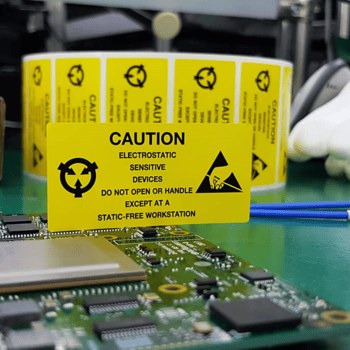
What is electrostatic discharge, and why does it matter in electronics assembly?
Electrostatic discharge, or ESD, is the transfer of an electrostatic charge between objects. A charge can develop when different materials contact and then separate, a process called triboelectric charging.
Electronic devices can be vulnerable to this discharge even when the voltage is not noticeable to people. In semiconductor devices, the reported consequences include gate-oxide damage, junction failure, immediate failure, and latent defects.
Why should production torque tools be part of an ESD-control approach?
Production tools can hold static charges, so human-focused measures alone do not address every potential source of ESD exposure. Electric screwdrivers and nut drivers used in assembly are specifically identified as tools that may generate static charge.
A properly grounded tool is intended to provide a continuous ground path from the tool tip to the power source. Conductive materials support that uninterrupted path and help limit the chance of static charge affecting a sensitive component during fastening.
What features distinguish ESD-safe torque screwdrivers?
ESD-safe torque screwdrivers combine ESD-control properties with controlled torque application. The Mountz ESD FG and FGA drivers use impact-resistant, dissipative materials and are described as having surface resistance from 105 to 108 Ohms.
These drivers also incorporate anti-static properties intended to reduce static-electricity generation and particle attraction. Dynamic, wear-resistant internal seals are included to help prevent grease leakage and contamination from entering sensitive areas or components.
| Feature | Stated purpose or characteristic |
|---|---|
| Conductive or dissipative construction | Supports a grounding path and helps control static charge. |
| Surface resistance | 105 to 108 Ohms for the ESD FG and FGA drivers. |
| Internal seals | Help limit grease leakage and contamination. |
| Light-grey powder coat | Low-outgassing finish designed to tolerate frequent wiping and resist corrosion. |
When should a preset FG driver or adjustable FGA driver be selected?
Choose a preset FG tool when a fixed torque setting and controlled access to adjustment are needed. FG Preset tools have tamper-proof internal adjustments intended to maintain the selected torque setting for repeated fastening.
Choose an FGA Adjustable tool when easy torque adjustment is important, such as research or maintenance work. FGA Adjustable tools include a digital dial for adjustment.
| Tool type | Adjustment approach | Stated application fit |
|---|---|---|
| FG Preset | Tamper-proof internal adjustment | Repeated fastening where maintaining a selected torque is important |
| FGA Adjustable | Digital dial | Research and maintenance requiring easier tool adjustment |
What torque range is available for Mountz ESD FG and FGA screwdrivers?
The stated torque range for ESD versions of the FG preset and FGA adjustable cam-over torque screwdrivers is 3 ozf.in to 125 lbf.in, or 2.1 cN.m to 14.1 N.m. The appropriate setting should match the fastening requirement of the assembly.
The source identifies semiconductor, aerospace, and electronics manufacturing as environments where protecting electronic components is particularly important. It also states that ESD-safe power tools are available with conductive materials and defined ground paths.
Which Mountz ESD torque screwdriver models have the stated 20,000-cycle calibration life?
The source states that Mountz ESD FGA models, along with FG-8i, FG-20i, FG40i, and FG125i, have a stated calibration life of 20,000 cycles. It characterizes this as four times the referenced ISO standard.
Note: Torque range, adjustment method, grounding practice, and ESD-control requirements should be matched to the specific assembly process and component sensitivity.