In the operation of solar farms and commercial rooftop solar systems, generation loss is a constant challenge for maintenance teams. While environmental factors such as surface dust accumulation or localized shading are usually the most obvious initial culprits, severe and prolonged losses often stem from internal structural defects, such as microcracks in solar cells, faulty bypass/anti-reverse diodes, or contact failures at DC connectors. Relying solely on overall monitoring data from the inverter makes it virtually impossible for technicians to pinpoint the exact location of a fault among thousands of operating panels.
Warning Signs of System Performance Degradation
To detect anomalies early—before major system failures or prolonged revenue loss occur—operating teams should watch for the following key indicators:
Output Mismatch Between PV Strings: SCADA/Inverter monitoring data reveals significant current or power disparities between strings with identical panel counts, tilt angles, and solar irradiance conditions.
Frequent Inverter Fault Alerts or Power Derating: The inverter frequently reports ground faults or string voltage imbalances, or automatically derates its output power upon detecting imbalances at the DC input.
Abnormal Temperatures at Junction Points and Panel Surfaces: Dark spots, encapsulation material (EVA) discoloration, or scorch marks appear around module frames, junction boxes, and connectors.
Distorted I-V Curves: Periodic test results record distorted I-V curves with steps/kinks, or reduced short-circuit current (I_sc) and open-circuit voltage (V_oc) values compared to the manufacturer’s nominal specifications.
Environmental Factors: How Dust and Shading Degrade Performance
The accumulation of fine dust, sand, leaves, or a layer of pollution on module surfaces forms a barrier that blocks direct solar radiation from reaching the solar cells, significantly reducing the short-circuit current of the entire system. In prolonged dry conditions, without periodic cleaning, this dust layer can cause localized adhesion, increasing the operating temperature on the panel surface.
In addition to dust, shading from surrounding obstacles—such as trees, utility poles, nearby structures, or adjacent module rows (in low-tilt angle designs)—causes far more severe impacts than uniform radiation reduction. When part of a PV string is shaded, the current flowing through the string is bottlenecked by the lowest current of the shaded cell.
At this point, the shaded cells stop generating power and instead act as energy loads, leading to localized overheating (hotspots) and triggering bypass diodes. If shading occurs frequently without mitigation or design compensation, it accelerates material aging and leads to continuous yield losses throughout the project's operational lifecycle.
Mechanisms of Internal Structural Hidden Faults
Beyond environmental factors, field inspections show that many physical defects leave no visible trace to the naked eye. Hidden cell microcracks or current path degradation can silently diminish the output power of an entire string due to current mismatch effects between panels.
Furthermore, DC connections that are corroded, loose, or out of technical specification create high contact resistance. As operating current flows through them, power loss converts into heat, turning connectors and junction boxes into dangerous hotspots and increasing the risk of arc faults, which pose fire and explosion hazards.
Utilizing Test and Measurement Equipment for Early Diagnosis and Fault Detection in PV Panels
Evaluating Electrical Characteristics Using Advanced I-V Curve Tracing
To thoroughly resolve these blind spots, modern diagnostic procedures require seamless coordination between qualitative electrical measurements and specialized imaging techniques. Analyzing current-voltage (I-V) curves enables direct evaluation of core technical parameters—such as maximum power (Pmax), open-circuit voltage (Voc), and short-circuit current (Isc)—against theoretical models.
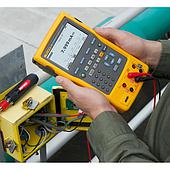
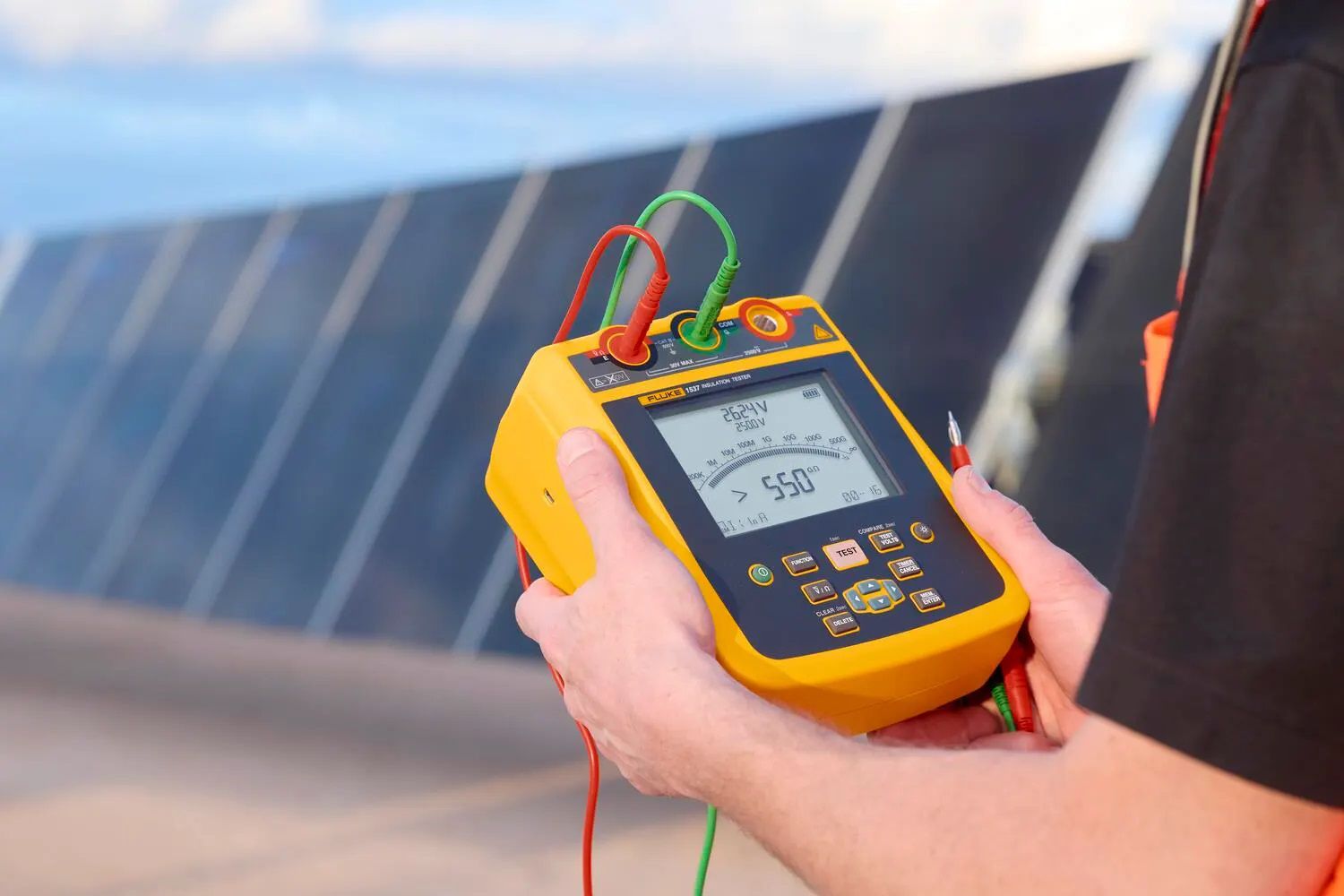
To meet testing standards for high-capacity systems, the Fluke PVA-1500HE2 PV Analyzer supports advanced I-V curve tracing up to 1500V and 30A . The instrument features a built-in PV module database for rapid comparison of actual power generation characteristics, paired with the Fluke 283FC Digital Multimeter (rated CAT IV 1500V) to ensure maximum safety during high-voltage DC measurements.
Pinpointing Fault Locations via Thermal and Acoustic Imaging Technologies
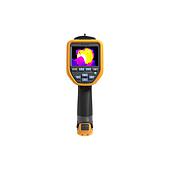
An anomaly on an I-V curve can sometimes result from a combination of causes, including shading and hardware faults. In such cases, diagnostic imaging devices play a key role in pinpointing the exact physical location of the fault. Using the Fluke TiS75PRO and Fluke Ti401U thermal cameras, technicians can visually observe temperature distribution across module surfaces to clearly distinguish between shaded areas, overheated cells, or abnormally hot connectors. For combiner box inspections or quick on-site field checks, the Fluke TC03A thermal camera module provides a convenient, rapid-view solution.
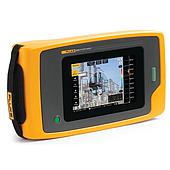
In addition to temperature and I-V parameters, solar power system faults are also linked to insulation issues and acoustic emissions. The Fluke ii915 Acoustic Imager detects partial discharge (PD) or electrical arc ticking sounds at DC joints from a safe distance—something that both the naked eye and thermal cameras can miss in the early stages.
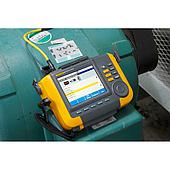
Furthermore, for silent insulation faults causing system-wide voltage drops, the Fluke GFL-1500 Ground Fault Locator enables accurate tracking of earth leakages on 1500"V" lines. To ensure output power quality after inverter conversion prior to grid connection, the Fluke 1777 Power Quality Analyzer monitors harmonics and voltage fluctuations, completing a comprehensive testing workflow.
⇒ Businesses and engineers interested in advanced measurement and maintenance solutions are cordially invited to register for:
Date: Friday, October 30, 2026
Location: Ninh Thuan Province, Vietnam