Fabric water permeability tester helps quality teams understand how a textile interacts with water under defined conditions. Depending on its intended use, a fabric may need to resist water penetration, shed water from its surface, or allow water to pass through. Rainwear, tents, and sails generally require water resistance, while filtration materials may be selected for water permeability.
These properties should not be treated as interchangeable. Surface wetting behavior is closely associated with the fabric surface, while resistance to water penetration can also depend on fibers, yarns, construction, and any waterproof treatment. Selecting the appropriate test method is therefore an essential part of meaningful quality control.
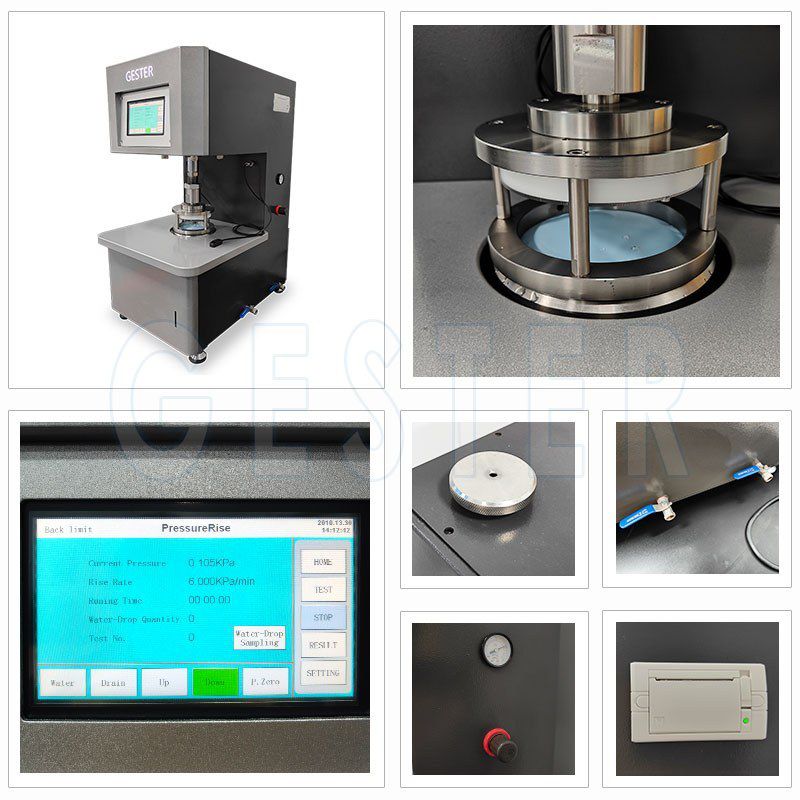
What's Fabric Waterproofness Tester ?
A fabric waterproofness tester is a specialized instrument used to measure and evaluate a textile material’s ability to resist water penetration or the extent to which water passes through its surface under controlled pressure, time, or flow-rate conditions.
Water permeability refers to the ability of water to pass through a fabric. The tendency of a fabric surface to become wet is mainly related to its surface properties and is therefore often evaluated in terms of surface water repellency.
The water resistance of a fabric sample can be affected by its fibers, yarns, fabric structure, and water-repellent treatment.
Different water exposure methods produce different testing conditions. Therefore, the results of a hydrostatic pressure test are not directly equivalent to those obtained from a spray test or rain simulation test.
Three common waterproof testing methods
Three commonly used approaches are the hydrostatic pressure method, the spray method, and the rain method. Each creates a different water exposure condition and produces a different type of result.
1. Hydrostatic pressure method
The hydrostatic pressure method evaluates a fabric’s resistance to water penetration while it is subjected to water pressure. It can be used with a broad range of fabrics, including materials that have received waterproof finishing.
In the source method identified as AATCC 127-2003, at least three specimens are taken diagonally from the material. The cited specimen size is 200 mm × 200 mm, with a 100 cm² test area. The fabric side in contact with water is identified because the two sides may have different resistance characteristics. The procedure uses distilled water at 21 ± 2 °C.
The test is considered complete when droplets appear at three different locations on the specimen. Leakage within 3 mm of the specimen holder is not counted under the described procedure. Results are averaged across the tested specimens. A higher value indicates that greater pressure was required before water passed through the material, indicating stronger resistance under this test condition.
2. Spray rating method
A spray rating test simulates the surface wetting that may occur during drizzle. It is applicable to water-resistant fabrics as well as untreated fabrics. Rather than measuring pressure-driven penetration, this method focuses on the degree of wetting visible on the specimen surface after a controlled spray.
The source describes AATCC 22-2005 with a specimen held flat and without wrinkles in a ring with a 152.4 mm diameter. A volume of 250 mL of distilled water is sprayed through a standard spray head at a 45° angle. The specimen is positioned 150 mm below the nozzle, and spraying lasts approximately 25 to 30 seconds.
After spraying, the holder is tapped according to the procedure to remove loose water. Water repellency is then evaluated on a five-level scale, where level 5 is the best result and level 1 is the lowest. Because fibers, yarns, fabric structure, and finishing can affect surface wetting, samples should be prepared and handled consistently for useful comparisons.
3. Rain test method
The rain test method is intended to simulate exposure to heavier rain. It can be used for single-layer and composite fabrics, with or without water-repellent finishing. This approach assesses water passing through a specimen under the impact of a directed water flow.
In the cited AATCC 35-2006 procedure, a standard absorbent paper measuring 15.2 cm × 15.2 cm is placed behind the specimen and weighed to 0.1 g before the test. The sample is mounted on a vertical rigid support and placed centrally in the spray pattern, 30.5 cm from the nozzle. Water at 27 ± 1 °C is sprayed horizontally for five minutes.
After exposure, the absorbent paper is removed carefully and weighed again. Its weight gain during the spray period is calculated and the test data are averaged. This measurement provides an indication of the water transmitted through the fabric during the specified rain simulation.
Choosing the right test for quality control
The best method depends on the exposure that the final product is expected to encounter. Fabric Waterproofness Tester is relevant when resistance under water pressure is the key concern. Spray rating is useful for evaluating surface water repellency during light rain exposure. Rain testing provides a controlled simulation of heavier rainfall and impact-driven water transmission.
For reliable fabric waterproof testing, laboratories should use the applicable method, keep specimen preparation consistent, identify the test side where relevant, and report results with the corresponding test condition. Comparing results only within the same method helps prevent incorrect conclusions about fabric performance.
Hydrostatic head, spray rating, and rain tests each evaluate a distinct aspect of water behavior in textiles. Together, they give quality control teams a clearer basis for assessing whether a fabric’s water-related performance aligns with its intended use.