Guide to Testing and Evaluating Total Harmonic Distortion THDi, THDv According to IEEE 519 Standards in Vietnam
The boom in non-linear loads such as variable frequency drives (VFDs), rectifiers, induction furnaces, and LED lighting systems is turning harmonic pollution into a major headache for industrial plants. To protect electrical systems and prevent fire hazards, measuring and evaluating total harmonic distortion according to IEEE 519 standards is a mandatory procedure for electrical and mechanical engineers.
What Are Total Harmonic Distortion THDi and THDv?
In an ideal AC power system, voltage and current waveforms are pure sine waves. However, non-linear loads generate current components at frequencies that are integer multiples of the fundamental frequency (50Hz), known as harmonics.
THDv (Total Harmonic Distortion for Voltage) represents the total harmonic distortion of voltage, reflecting the quality of the supplied power source. Meanwhile, THDi (Total Harmonic Distortion for Current) represents the total harmonic distortion of current, reflecting the level of harmonic pollution produced by internal plant equipment and injected back into the grid.
Threshold Limits According to IEEE 519 Standards in Vietnam
In Vietnam, Circular 39/2015/TT-BCT strictly regulates the operation of power transmission and distribution systems, strictly enforcing IEEE 519 limit standards.
The THDv voltage limit at the Point of Common Coupling (PCC) must not exceed 5% for standard distribution grids below 69 kV, with individual harmonic orders limited to 3%. For THDi current, limits depend on the ratio of short-circuit current (Isc) to maximum demand load current (Il) at the coupling point, ranging strictly between 5% and 20%. Exceeding these limits exposes plants to administrative fines or service disconnection by power utilities.
Technical 4-Step Harmonic Measurement Procedure
To obtain accurate results for compliance reports or acceptance testing, engineers must follow a standardized testing workflow. First, identify the Point of Common Coupling (PCC) at the Main Switchboard (MSB) directly downstream of the transformer, marking the boundary between utility and plant assets. Next, connect testing equipment safely using flexible current clamps matched to plant current ranges and attach voltage leads correctly to phases A-B-C-N.
The next step involves setting up data logging for at least 24 continuous hours, or ideally 7 days, to cover complete plant operational cycles. Finally, export data and perform evaluations by extracting harmonic analysis charts up to the 50th order to compare against IEEE 519 limit tables.
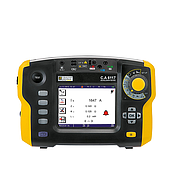
To observe and log rapidly fluctuating high-order harmonics accurately, standard digital multimeters or clamp meters are insufficient. Engineers must utilize specialized Power Quality Analyzers (PQA).

EMIN provides comprehensive portable power quality analyzer solutions from leading global brands, capable of deep measurement and analysis of voltage and current harmonics up to the 50th order, automatically calculating THDi and THDv indices while displaying visual bar charts directly on-site. These instruments feature large memory capacities supporting continuous multi-day data logging paired with software that automatically exports standardized compliance reports in accordance with international IEEE 519 and EN 50160 standards.
Related Articles:
Reactive Power Capacitors Swelling and Exploding Earlier Than Designed Lifespan
Overheating Neutral Wire, Neutral Current Higher Than Phase Current: What Are the Causes?
Comprehensive Power Quality Measurement Consulting from EMIN
For tailored advice on harmonic measurement equipment suited to your plant's electrical infrastructure, please contact our hotline or browse the product catalog on the EMIN website for prompt technical support.
Selecting professional power quality testing solutions from EMIN empowers enterprises to proactively control harmonics, safeguard equipment, and optimize electrical system operational costs.