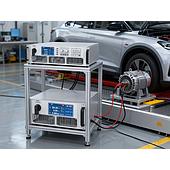
Battery cycle life testing evaluates how a battery changes after repeated charge and discharge events. A bi-directional DC supply supports this work by sourcing current during charging and sinking current during discharge in one instrument.
A reliable test depends on a defined cycling profile, controlled voltage and temperature conditions, periodic health checks, and consistent data logging. The resulting data can show capacity fade and changes in power capability over the course of the test.
Summary: A bi-directional DC supply combines charge and discharge functions. A cycle profile defines current, voltage limits, rest periods, and temperature. Periodic RPTs measure remaining capacity and DC internal resistance. Logged data supports degradation analysis.
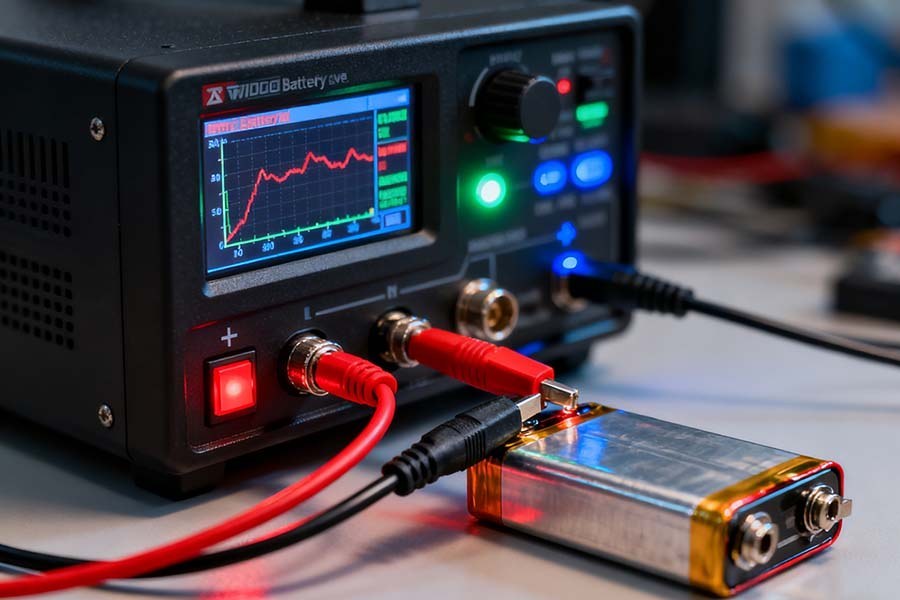
What is battery cycle life testing?
Battery cycle life testing is a repeated charge-discharge process used to observe changes in battery performance over time. It can be used for performance validation, comparison of cell chemistries or formats, quality control, and degradation-focused research.
A typical test runs a battery through many controlled cycles rather than relying on a single measurement. The primary conditions must be repeatable so that changes in measured capacity or resistance can be meaningfully compared.
Why use a bi-directional DC supply for battery cycle life testing?
A bi-directional DC supply can charge a battery by sourcing current and absorb current from the battery during discharge. This consolidates functions that might otherwise require a separate DC power supply and electronic load.
Using one instrument can simplify switching between charge and discharge steps and reduce the number of devices to coordinate. Some advanced bi-directional supplies may return discharge energy to the grid, but this capability depends on the specific instrument and should be confirmed before test planning.
What does a battery cycling profile need to define?
A battery cycling profile should define the charge and discharge rates, voltage limits, temperature, rest periods, and stopping conditions. These values determine both the relevance of the test and the validity of the results.
| Profile element | Purpose in the test |
|---|---|
| CC charge | Charges at a specified constant current until the maximum voltage is reached. |
| CV charge | Holds the maximum voltage while current tapers to the specified cutoff. |
| Rest period | Allows electrochemical stabilization between major steps. |
| CC discharge | Discharges at a specified constant current to the minimum voltage. |
| Temperature control | Maintains a defined test condition because temperature strongly affects degradation. |
The C-rate expresses charge or discharge current relative to battery capacity. For example, 1C corresponds to a theoretical full charge or discharge in one hour, while higher rates may accelerate aging but may not represent the intended application.
Note: Voltage limits are safety-critical test settings. They should be defined for the battery under test and strictly observed throughout the programmed sequence.
What is a Reference Performance Test (RPT) in battery cycling?
A Reference Performance Test, or RPT, is a periodic diagnostic sequence inserted between blocks of regular cycling. It provides comparable measurements of battery health instead of relying only on the main cycling data.
An RPT may include a low-rate discharge, such as C/3 from 100% to 0% state of charge, to measure remaining capacity. It can also include short high-current pulses to calculate DC internal resistance from the instantaneous voltage change and current change, expressed as ΔV/ΔI.
Performing an RPT every 100 or 200 cycles is an example interval described in the source material; the appropriate interval depends on the test objective and the battery being evaluated.
How should a bi-directional battery cycling test be set up?
The battery should be connected with correct polarity, suitable cables and secure connections. The source material also recommends using a controlled thermal environment with adequate ventilation and appropriate safety provisions.
Where the instrument supports it, four-wire or Kelvin sensing connects separate sense leads close to the battery terminals. This reduces the influence of voltage drop in the power leads, helping the instrument measure battery terminal voltage rather than lead-end voltage.
The programmed sequence can begin with an RPT, run a defined number of main cycles, and then repeat the RPT. A representative main cycle is CC charge to the maximum voltage, CV charge until the current cutoff, a rest period, CC discharge to the minimum voltage, and another rest period.
Which data should be logged during battery cycle life testing?
Voltage, current, power, charge capacity, discharge capacity, time, and cycle number are key values for analyzing a cycling test. The source material gives a logging interval of every 1 to 10 seconds as an example.
Monitoring can also use alarm thresholds for overvoltage, undervoltage, overtemperature, and overcurrent. Time synchronization between the DC power supply, temperature chamber, and data-acquisition system helps correlate a temperature event with a specific step in the cycle.
How are battery cycle life test results interpreted?
Capacity fade is commonly evaluated by plotting discharge capacity from each RPT against cycle number. A declining trend shows how the battery's measured capacity changes as cycling progresses.
DC internal resistance can be plotted against cycle number to indicate changes in power capability. Coulombic efficiency is calculated as discharge capacity divided by charge capacity for each cycle; a change in this value can indicate side reactions during cycling.
For battery chemistries with a relatively flat voltage curve, such as LFP, tracking state of charge by integrating current, known as Coulomb counting, may be more reliable than using voltage alone. Calibration of voltage and current measurement is also important because these measurements directly affect capacity and resistance calculations.