
For full functionality of this site it is necessary to enable JavaScript.
EMIN.VN
0

How does Leeb hardness testing differ from Rockwell hardness testing? What are the correct applications?

2026年03月11日 17時00分00秒

Have you ever wondered why there are so many different methods for material hardness testing? Leeb hardness testing and Rockwell hardness testing are two of the most popular, yet they differ significantly in their principles and applications. EMIN will provide a detailed analysis to help you better understand and select the right tool for your work.

What are Leeb and Rockwell Hardness Tests?

The Leeb hardness testing principle: Simple and Fast

Leeb hardness testing is based on the rebound method. The ratio of the rebound velocity to the impact velocity determines the hardness value. You obtain an HL (Leeb) value, which can be easily converted to HRC, HB, or HV. This is a non-destructive method, ideal for rapid testing using devices like the Equotip Live Leeb D, which features wireless app connectivity, a measuring range of 150-950 HL, and an accuracy of just ±4 HL. You can measure hundreds of points in minutes, with data syncing to the cloud instantly.

The Rockwell hardness testing principle: Static and Highly Accurate

In contrast, Rockwell hardness testing is a static method. A diamond cone or steel ball indenter is pressed into the material with a minor (pre-load) and then a major load. After holding the load and releasing it, the depth of the indentation is measured to calculate the HRC or HRB hardness. This method requires stationary equipment and is suitable for specialized laboratory environments. In practice, Rockwell provides stable results for large cast steel components, but you must prepare a flat, thoroughly cleaned surface.

Why are Leeb and Rockwell Hardness Tests Different?

Differences in testing type and equipment

Leeb testing is dynamic and uses ultra-compact handheld devices. You can easily carry them and measure on-site without dismantling components. Rockwell testing is static and requires heavy benchtop machines. While Rockwell is more accurate for large samples, it is less flexible.

Conversion between scales: HL 800 ≈ HRC 64, but this is not always 100% accurate due to material differences. The ASTM E140 conversion table is recommended for reference.

Pros and cons affecting measurement

Leeb testing is fast (1 second/point) and minimally destructive to the surface, but it is sensitive to rough surfaces or thin components. You need at least 5mm of thickness to avoid vibration. Rockwell testing offers high accuracy (±1 HRC) but leaves a deeper indentation (0.15mm), causing localized damage. Rockwell is ideal for uniform, non-portable materials. Research shows Leeb is suitable for concrete and rock with an error of less than 10%, while Rockwell is reserved for precision metals.
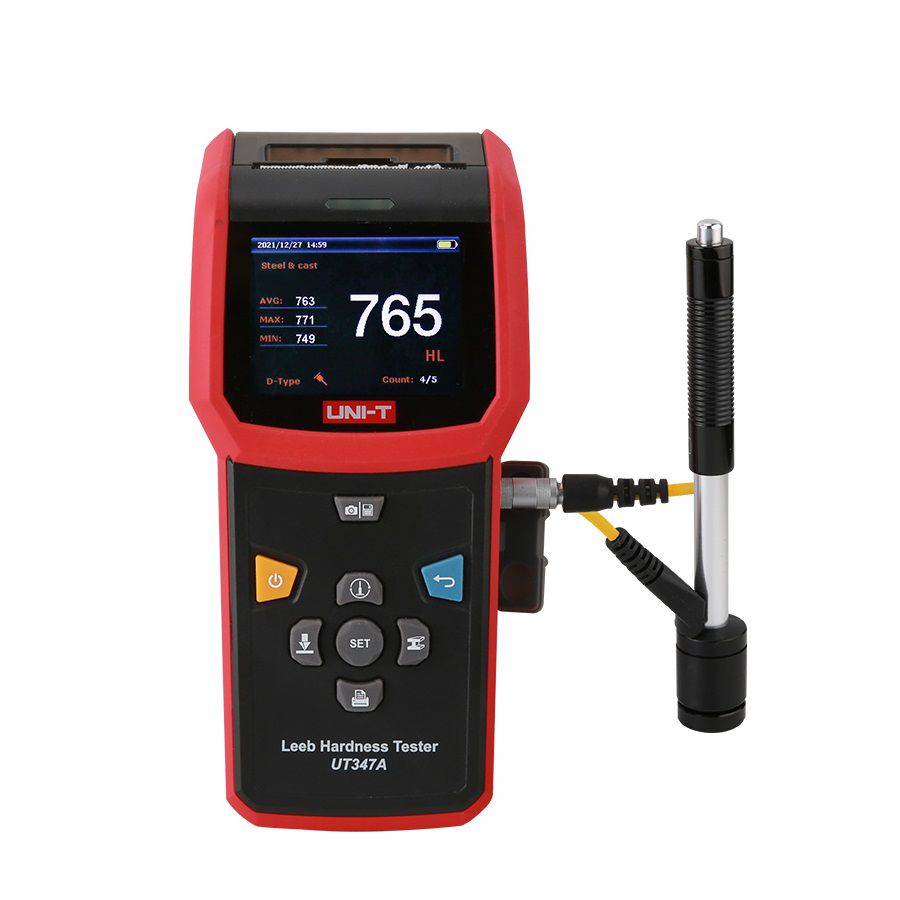
Leeb Hardness Meter

Learn more:

What is the difference between stainless steel hardness and steel hardness? What is the HRC of stainless steel 304, 201, 316?

Which handheld metal hardness tester is good?

Surface Hardness Testing With Technology From Novotest

How are these hardness measurement methods applied?

Flexible Leeb hardness testing in the field:

Leeb hardness testing is highly effective in mobile environments. You can inspect oil and gas pipelines or wind turbines without stopping machinery using devices like the NOVOTEST T-D2, which measures steel and aluminum with a bright screen, stores 1,000 results, and connects to an Android app. It offers a wide HL range, multi-material calibration, and 20 hours of continuous battery life. In welding, Leeb quickly checks the Heat Affected Zone (HAZ) without the need for dismantling. The PROCEQ Equotip Live Leeb D syncs data in real-time and emails reports instantly, saving significant time compared to lab testing.
Hardness Meter for Home Application

Rigorous Rockwell hardness testing in the lab:

Rockwell is used for strict QA in applications such as the production of cutting tools and automotive shafts. Precise hardness measurement helps ensure product longevity. You can measure tool steel at HRC 60-65 to ensure uniformity across large batches. This method complies with ASTM E18 and is highly reliable for certification. However, Rockwell is less effective in the field as it requires a stable power source and lengthy surface preparation.

Leeb is suitable for oil & gas and aerospace (on-site turbine blade inspection).

Rockwell is excellent for automotive and cutting tool industries (batch production inspection).

関連ニュース

Guide to Selecting Case and Sensor Materials for Pressure Gauges in Corrosive Chemical Environments
2026年10月13日 11時14分57秒

In chemical processing plants, wastewater treatment facilities, oil & gas operations, and food production, selecting the wrong material for a pressure gauge often leads to severe consequences: Bourdon tube failure, toxic chemical leaks, equipment breakdown, and serious occupational safety hazards. This article provides practical technical criteria for selecting the correct case and sensor materials when measuring pressure in corrosive environments.

Measuring COD and TOC in Electroplating Wastewater Using a Benchtop Analyzer? What Sources of Error Should Be Avoided?
2026年10月13日 10時55分11秒

The current situation regarding electroplating wastewater analysis presents challenges: the wastewater contains acids, alkalis, and heavy metals (such as Cr, Ni, and Cu), alongside persistent cyclic organic compounds derived from brightening agents, anti-misting additives, and degreasing solvents. This complex composition causes significant fluctuations in COD levels depending on the specific process stage and production shift. Sending samples to external laboratories results in a delay of several days—by which time the biological treatment tanks or coagulation systems may have already been operating improperly for too long. Utilizing a benchtop COD analyzer on-site reduces this turnaround time to just a few hours, provided the user fully understands the specific sources of error associated with electroplating wastewater

How to Rapidly Reduce COD in Domestic Wastewater?
2026年10月13日 10時25分11秒

Wastewater treatment plants serving apartment complexes, buildings, and residential areas sometimes experience effluent COD levels approaching regulatory limits, particularly following sudden load surges or shortly before scheduled compliance sampling. QCVN 14:2025/BTNMT, applicable to domestic wastewater from September 1, 2025, sets COD limits based on discharge volume and the receiving water body, while allowing dischargers to choose between TOC and COD parameters

Challenges of Pressure Gauges in Hydrogen Environments
2026年10月12日 16時47分15秒

The global energy transition trend is driving industrial plants, chemical facilities, and renewable energy sites to integrate hydrogen as a strategic fuel source to achieve decarbonization goals. However, practical experience shows that traditional mechanical pressure gauges rapidly degrade in service life and experience dangerous failures when in direct contact with hydrogen environments.

The Trend of Eliminating Mechanical Pressure Gauges in Semiconductor Fabrication Plants
2026年10月12日 14時44分38秒

In semiconductor cleanrooms, a single microscopic dust particle or a tiny toxic gas leak is enough to ruin an entire wafer batch worth millions of dollars. This vital requirement is accelerating a complete transition from traditional mechanical pressure gauges to digital pressure sensors and electronic pressure gauges.

お得な情報を受け取る

数量割引、まとめ買い価格の更新、新製品情報をメールでお届けします。

登録することで、当社の利用規約およびプライバシーポリシーに同意したものとみなされます。

クイックサポート

認定専門家へ直接アクセス



