Instructions for operation and use of universal angle gauge
2025年05月10日 09時02分48秒
When working with materials that require angular machining, checking and adjusting the deviation parameters is the first thing to pay attention to. The angle gauge is used in many technical processes such as milling, turning, or post-machining inspection to accurately determine the angular value of the part. Below are specific operating instructions to help you use this device accurately and effectively.
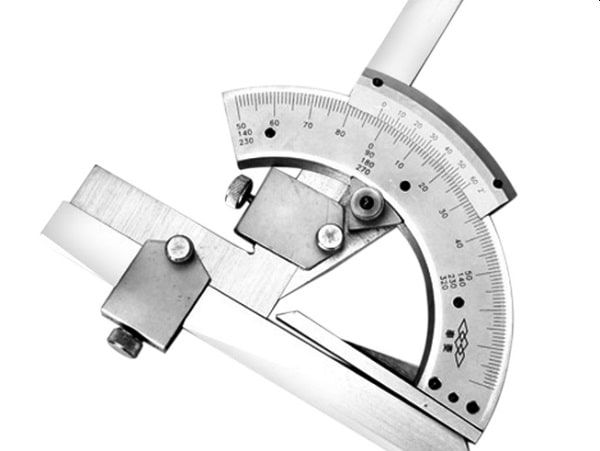
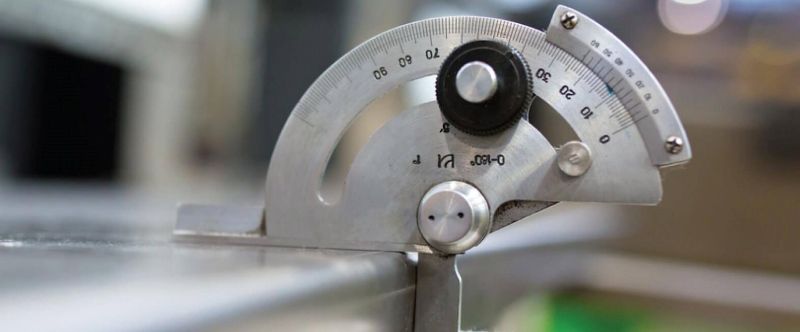
Application and Usage of the Universal Bevel Protractor
Protractor is designed to handle complex angular measurements, including acute, obtuse, and right angle, ensuring that measurement deviations remain within acceptable limits. In practice, this device is commonly used in inspection rooms and on assembly lines where angle verification of inclined or machined surfaces is required. The angular data obtained enables engineers to adjust machining programs or assess geometric errors on work
Specific usage process
To perform an angle measurement, follow these three fundamental steps in sequence
Step 1: Align the inner edge of the protractor’s body with the first side of the workpiece, while centering the protractor precisely at the vertex of the angle to be measured.
Step 2: Slide the movable arm to align its edge with the second side of the angle on the workpiece.
Step 3: Record the measured value at the intersection point where the sliding arm aligns with the graduated arc on the main scale.
During the measuring process, ensure that the contact surfaces between the protractor and the workpiece are free of dirt or burrs, as these can affect the accuracy of the reading.
Measuring Mechanism and Working Principle
The protractor is equipped with a vernier scale featuring 5-minute graduations, allowing precise readings down to small angular units. An integrated magnifying lens provides enhanced visibility of the intersection point between the main and vernier scales. Additionally, a fine-adjustment knob and locking clamp secure the angle after alignment, preventing any shift during reading. The protractor allows measurements in both clockwise and counterclockwise directions, with a measuring range up to 270 degrees (3 x 90°), suitable for a wide variety of measurement scenarios in manufacturing environments.
Component Structure
A standard universal bevel protractor set consists of the following components:
1. Thumb screw for quick fixation
2. Clamping screw to secure the measured part
3. Graduated metal blade made of stainless steel
4. Circular graduated dial attached to the main body
5. Fine-adjustment knob for precise positioning
6. Main scale disc for angle reading
7. Magnifying lens for clearer scale visibility
8. Vernier scale with fine graduations
9. Base support bar for stable positioning
10. Flat measuring surface for direct contact with the workpiece
11. Acute angle attachment for measuring hard-to-reach internal angles
12. Extension bar for compatibility with height gauges
13. Accessory clamp for mounting the protractor onto a base
Each component plays a specific role in the measurement process. Understanding the structure ensures more accurate operation and helps prolong the device’s service life.
Using the angle ruler is not overly complex if the operating principle and proper procedures are well understood. It is an essential tool in work environments that demand high geometric accuracy.
Why Can the Same Angle Produce Different Results When Measured Multiple Times ?
Even when measuring the same part, measurement results may vary if the position of the protractor changes between measurements. Differences can occur when the pivot point of the protractor does not align with the vertex of the angle, the measuring edge is not properly in contact with the surface, or inconsistent hand pressure is applied.
The surface of the part should also be inspected before measurement. Burrs, metal particles, or oil on the contact edges can create very small gaps, causing the measuring arm to shift away from the intended geometric position.
With mechanical protractors, the viewing angle when reading the scale can also affect the result due to parallax error. For consistent measurements, use the same positioning method, clean the contact surfaces, and check the contact points whenever there are discrepancies between repeated measurements.
Mechanical or Digital Protractor: Which Should You Choose ?
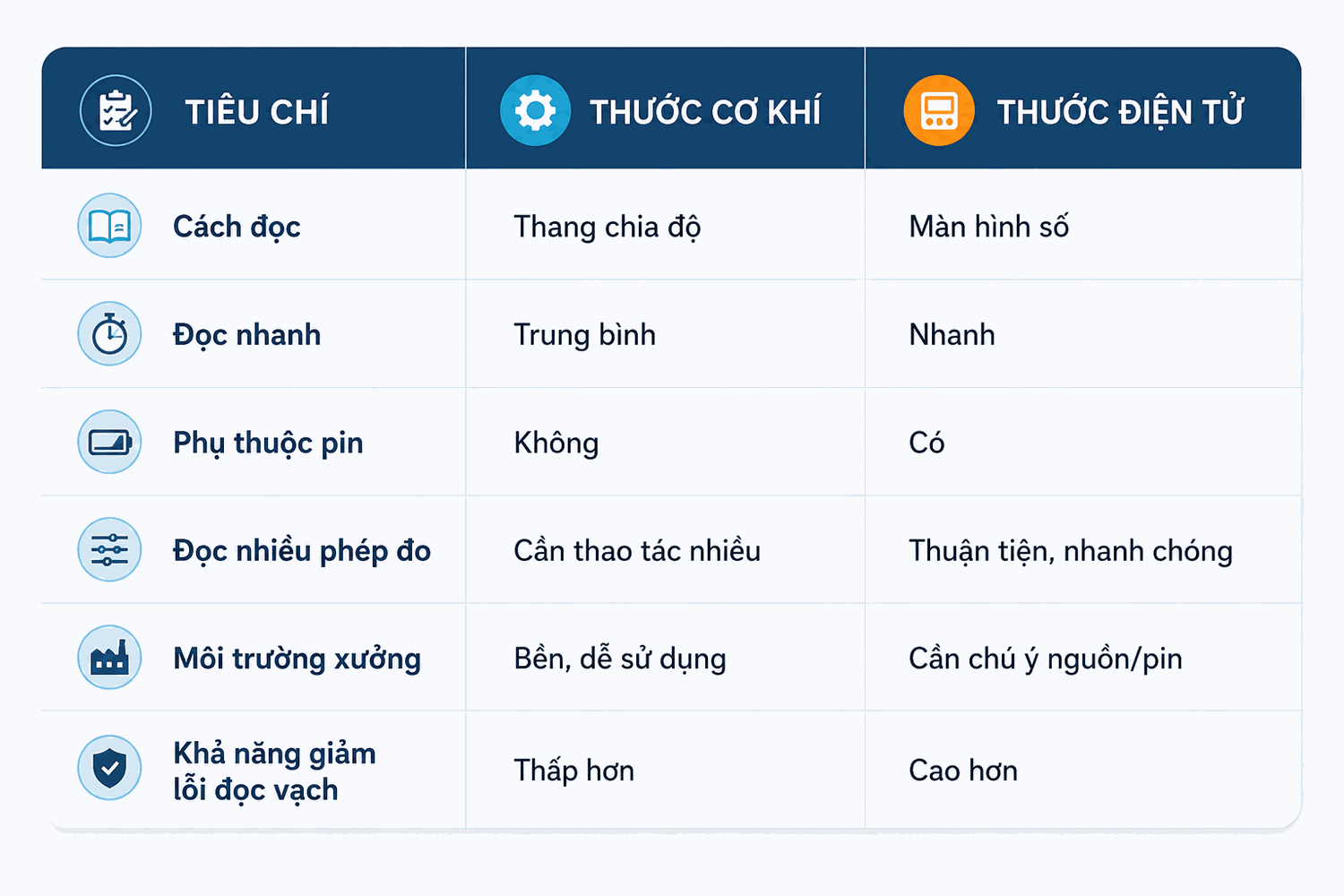
Mechanical protractors are suitable for direct inspection work in workshops. They do not require batteries and have a simple mechanical design. However, users need to read the graduated scale and Vernier scale, so measurement may take longer when performing multiple measurements in succession.
Digital protractor measure results on a digital screen, helping reduce reading errors and making them convenient for quick measurements or inspecting multiple parts. Some models also offer functions such as data hold, unit conversion, and zero setting at any position.
Comparison Table: Digital vs. Mechanical Protractors
Frequently Asked Questions (FAQ)
1. Is the resolution of a protractor the same as its accuracy ?
No. Resolution is the smallest increment that the instrument can display or read, while accuracy indicates how close the measurement result is to the reference or true value. A protractor with higher resolution does not necessarily have higher accuracy.
2. Can burrs affect angle measurement results ?
Yes. A burr on the contact edge can create a gap between the protractor and the workpiece. This may prevent the measuring arm from aligning correctly with the actual geometric edge, resulting in an inaccurate angle measurement.
3. Does a protractor need to be calibrated ?
Yes, especially when it is used for quality control or measurements that require metrological traceability. The calibration interval depends on factors such as frequency of use, working conditions, and the organization's measurement equipment management requirements.
4. Can a protractor measure acute angles ?
Yes. Depending on its design, a universal bevel protractor can measure acute angles, obtuse angles, and other types of angles within its specified measurement range.
5. Why can a 30° angle sometimes be read as 150° ?
This usually happens when the measured angle is confused with its supplementary angle. Before reading the result, make sure you identify whether you need the smaller angle between the two edges or the corresponding angle on the other side of the scale.
6. Does temperature affect angle measurement results ?
It can. Under normal measurement conditions, the effect is usually very small. However, when inspecting parts with tight tolerances, thermal expansion of both the protractor and the workpiece can affect the measurement result.
7. Should you check the protractor at 0° before measuring ?
Yes. Checking the reference position before measurement can help detect abnormal deviations in the instrument and prevent instrument error from being carried over into the measurement result.
8. What resolution should you choose for a protractor ?
It depends on the tolerance of the workpiece being inspected. A higher resolution should not be selected solely because it provides smaller increments. The actual accuracy of the universal protractorand the requirements of the measurement should also be considered.
Diagnosing the causes of plastic color variation, managing metamerism, distinguishing between SCI/SCE measurement modes, and applying Delta E standards for color deviation assessment in QA/QC
On the afternoon of October 19, 2026, the workshop “Solutions for Optimizing Performance and Ensuring Safe Operation of Solar PV Systems” was successfully held at Khanh Hoa College of Technology and Energy.
Decoding differential pressure parameters according to EU GMP Annex 1 and ISO 14644 standards, interpreting HEPA filter/AHU clogging levels, and applying error calculation formulas to select precise measurement ranges for project handover
Explaining hydraulic phenomena codes, identifying early signs of mechanical failure, and providing guidance on selecting pressure gauges and surge-protection accessories that meet technical standards for industrial systems
Proactively controlling CO concentrations with CO gas detectors requires a systems-based engineering approach, from optimizing combustion chambers to establishing continuous automated monitoring infrastructure.