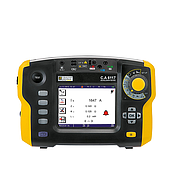
What is an electric tester?
With an electrical tester, you can easily check the power source in your home, especially when you need to determine whether the power source is leaking or whether the outlet is working.
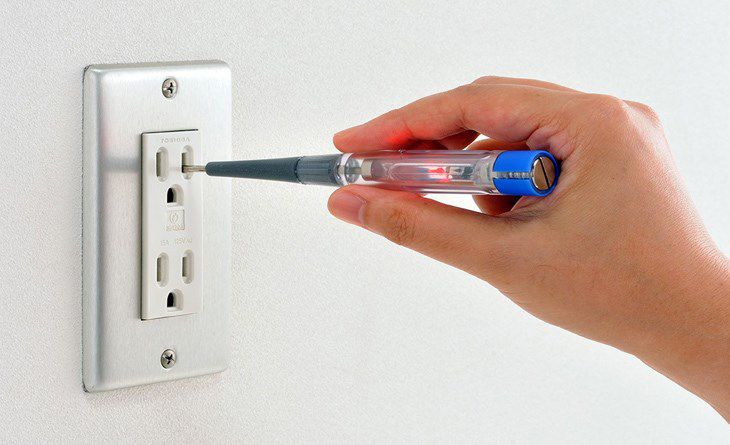
Although the design and usage of the electric tester is quite simple, its use is extremely important. Electricity brings many conveniences to life, but also poses great risks if not handled carefully.
Therefore, having an electrical tester in the home is necessary to ensure safety before performing any repair work related to electricity.
Advantages of using an electric tester
- Compact design, easy to use: The electric tester is designed to be compact and easy to use, making it easy for users to hold and operate. Thanks to its convenient size, you can carry the electric tester with you when working without feeling inconvenienced.
- Good price: In addition, with a price ranging from 45,000 - 710,000 VND, the electrical tester is a reasonable, budget-friendly choice compared to other specialized electrical measuring devices.
Disadvantages of using an electric tester
If there are advantages, there must also be disadvantages. Below are a few disadvantages of most current electrical testers:
- Limited function, only used to check whether current exists in the circuit or not, but cannot provide accurate information about voltage level like professional electrical measuring devices.
- Using an electrical tester also requires the user to know how to operate properly, otherwise it can lead to erroneous and dangerous results.
- In addition, an electrical tester is not a suitable choice for testing complex electrical circuits, because it cannot accurately measure parameters such as voltage or impedance.
Use an electrical tester safely and effectively
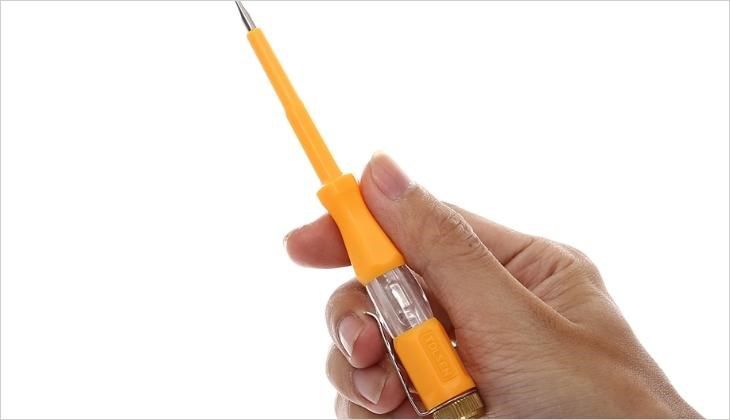
To use an electrical tester, place the tip of the pen on the circuit to be tested and touch the metal part at the tip of the pen with your thumb. If the circuit has power, the neon bulb in the pen will glow.
Electrical test with AC line:
When testing electricity with an AC line, place the pen in one of the two sockets to determine the hot and cold wires. If it is a hot wire (phase wire), the pen light will light up immediately; If the wire is cold (neutral wire or no power), the light will not light up.
However, if when testing the phase wire the pen light is weak or uneven, there may be a problem with the power source. In this case, it is necessary to check the power source immediately to avoid potential risks when using it. The neutral wire has no electricity, so the pen light cannot light up when it comes into contact with this wire.
Distinguishing direct current from alternating current:
Distinguishing between AC and DC electricity can be done by observing the neon light on the electric tester. When connected to a DC power source, only the terminal connected to the negative terminal of the source will make the light glow.
On the contrary, when tested with an AC power source, both poles of the neon light will alternate roles, causing both to glow at the same time.
In particular, when you connect the electric tester to the positive and negative poles of a DC circuit, only the pole connected to the negative pole of the power source will cause the light to light up.
Note when using an electric tester
- Do not use an electrical tester to check direct current (DC). Because this device relies on parasitic capacitance on the human body to conduct electricity, use of DC voltage can cause shock if the internal bulb or resistor fails.
- When using an electrical tester, always place the pen perpendicular to the measurement location to minimize the risk of direct contact with conductive parts, helping to ensure safety.
- On the market today there are many different types of electric test pens such as wall pens, touch pens, electronic pens... You should learn and choose the type of pen that best suits your purpose of use.
Conclude:
Above are important notes on how to use electrical testers as well as notes on how to use them safely and effectively. If you have any questions or concerns, don't hesitate to contact us to receive support!