Oscilloscope and Multimeter FAQ
In electronics manufacturing and test work, it helps to start with the right instrument and the right question. This FAQ brings together a few basic points about oscilloscopes and Bluetooth multimeters, using the product context from OWON.
What is an oscilloscope?
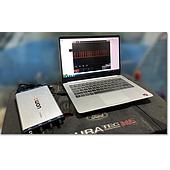
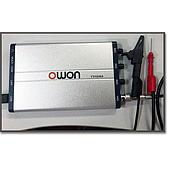
An oscilloscope is often described as the engineer’s eyes. It converts electrical signals that cannot be seen directly into a visible waveform. By observing that waveform, users can see how signal amplitude changes over time and use the results to judge whether a machine has a problem or whether a test instrument meets the expected standard.
It can also be used to measure different kinds of electrical properties such as voltage, current, frequency, phase, and amplitude. For many users, this makes the oscilloscope a core tool for troubleshooting and verification.
How do you choose a suitable oscilloscope?
Three practical factors are highlighted in the source material: bandwidth, sample rate, and number of channels.
Bandwidth
Bandwidth should match the frequency range of the signal you need to measure. The source gives a simple example: for car repair, a 100 MHz oscilloscope is enough.
Sample rate
A higher sample rate helps display a better waveform and more detail. The source notes a general rule of thumb that the sampling rate is five times higher than the bandwidth.
Number of channels
The right number of channels depends on how many signals you need to measure at the same time. Two channels may be enough for many tasks, but measuring three-phase electricity requires four channels.
What is the purpose of a Bluetooth multimeter?
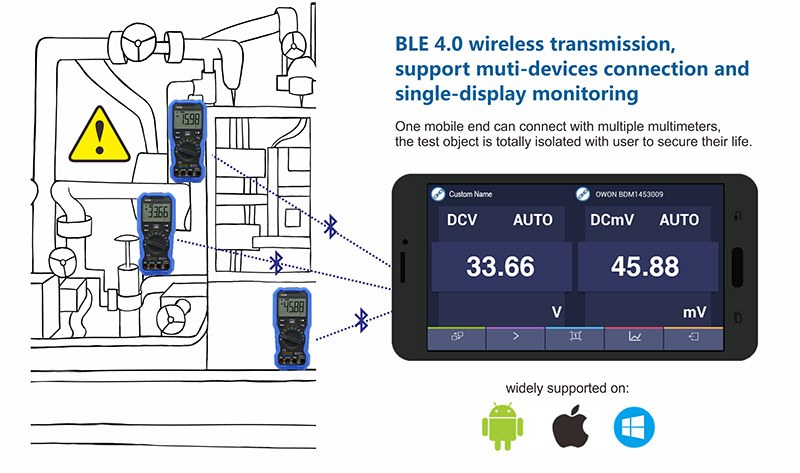
A Bluetooth multimeter supports wireless remote testing. This is useful for testing tasks in dangerous or difficult environments, because engineers can connect and control the meter without going directly to the test point.
It may also be helpful when physical movement could affect sensitive measurements. Another use case mentioned in the source is testing moving objects, such as vehicles in motion.
What is the difference between OW18B and B35T+ multimeters?
According to the source, both OW18B and B35T+ are 3 5/6 digit multimeters. The key difference mentioned is that B35T+ is better suited for industrial use. It can be used with industrial fixtures, consumes less power, and can record for longer at the same time.
Summary for practical selection
If you need a broader signal view, focus first on bandwidth. If waveform detail matters, pay close attention to sample rate. If your work involves several signals at once, choose the channel count accordingly. For remote or sensitive measurement tasks, a Bluetooth multimeter may improve convenience and safety. And when comparing OW18B and B35T+, the source points to B35T+ as the more industrial-oriented option.
These basics do not replace a full product selection guide, but they provide a useful starting point for electronics test and measurement decisions.
Related technical articles
- 2026 Spring Festival Holiday Notice
- OW18E - Low Power Consumption, High Performance Multimeter
- Oscilloscope and Multimeter FAQ
- XDS Series High Vertical Resolution Oscilloscope (Part 3)
- XDS Series High Vertical Resolution Oscilloscope (Part 2)
- XDS Series High Vertical Resolution Oscilloscope (Part 1)
- Popular Features of Current Oscilloscopes
- Why is the measured amplitude less than the real value?
- Introduction of comparator Part I
- What does oscilloscope consist of?